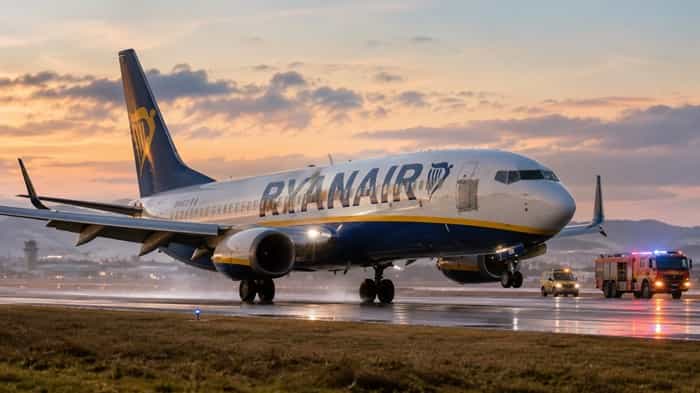
No airline wants the oxygen masks to arrive before the coffee trolley. Yet that was the grim order of service aboard Ryanair flight FR1879 on Friday, 10 July. A routine trip from Thessaloniki to Memmingen became a midair emergency in a matter of minutes.
The flight was operated by Ryanair for Malta Air. It left Thessaloniki at 6.12 am local time, 17 minutes late. The aircraft was a Boeing 737-800, registration 9H-QEU. It climbed to about 16,000 feet before a passenger window failed. The cabin lost pressure, and the oxygen masks dropped.
The cause is now under official investigation. That point is vital. Early reports said debris from a serious engine failure struck the window. Reuters said two airport sources gave the same account. Video posted on social media also appeared to show major damage to one engine. Even so, investigators have not yet published a final cause.
There is far less doubt about the fear inside the cabin.
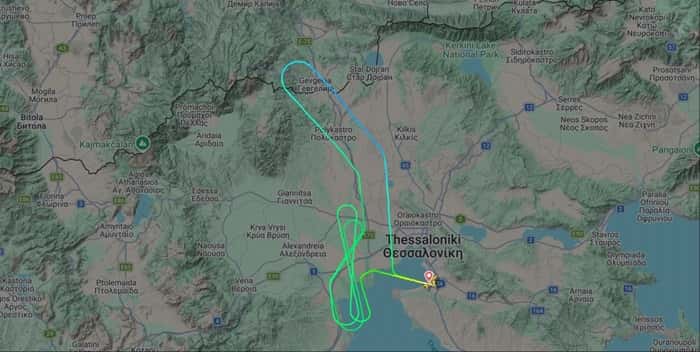
Ryanair flight FR1879 returned safely to Thessaloniki after a shattered window. Credit Flight Radar 24
Passenger Rescue and Safe Return
A Serbian man in his early 60s was reportedly pulled partly through the broken window. His head and shoulders were said to be outside the aircraft. Other passengers pulled him back into the cabin. Several reports said his wife held his legs until people nearby could help. Ryanair has not confirmed that detail.
The injured man was taken to AHEPA University General Hospital in Thessaloniki. Serbian officials said his injuries were not life-threatening. Reports described shock, cuts and friction burns. Greek reports said four people went to the hospital as a precaution. Most were later discharged.
Passengers heard a loud bang. The cabin then lost pressure, and the masks fell. One witness said the noise was “like a tyre bursting”. At cruising height, this was no small bump in the road. It was a grave emergency that called for fast action and cool heads.
The crew declared an emergency and turned back to Thessaloniki. Fire crews, ambulances and police waited at the airport. The pilots brought the aircraft down to a safer height, then prepared for landing. The Boeing landed safely after a little more than an hour in the air.
That safe landing deserves more than a passing line.
Aviation emergencies are often told through the most shocking picture. In this case, it was the broken window and the masks hanging from the roof. Yet the work that saves lives is often less dramatic. It lies in checklists, clear radio calls and crews doing what years of training have taught them to do.
Ryanair said the aircraft “landed normally and passengers returned to the terminal”. The airline also said one passenger received medical help. A replacement aircraft was then arranged for the trip to Memmingen. It left Thessaloniki at 9.53 am local time.
For an airline built around quick turnarounds, finding another aircraft within hours was a sound move. It did not make the first flight less serious. It did show why sound plans matter when a normal day goes badly wrong.
The passengers had already had quite enough excitement. A safe seat and an uneventful second flight were all anyone needed.
Investigators Face the Hard Questions
The hard work now moves to the investigators.
The aircraft was a Boeing 737 Next Generation model. It was fitted with CFM56 engines. Boeing said it was helping with the inquiry. The US Federal Aviation Administration also said it stood ready to assist. Authorities in Greece, Malta and North Macedonia are involved.
Their task is clear, though not simple. They must find out what failed. They must learn whether engine parts struck the window. They must also decide whether any earlier warning was linked to the event.
Flight records show that the same aircraft returned to Thessaloniki from a separate flight the night before. The reason for that earlier return has not been made public. It would be careless to link the two events before the experts have finished their work.
That last point deserves emphasis. In the first rush of an aviation story, rumour travels at roughly the speed of a startled passenger reaching for an oxygen mask. Proper investigation moves more slowly, but it usually arrives carrying evidence.
The event brings back memories of Southwest Airlines flight 1380 in 2018. In that case, an engine fan blade failed. Debris struck a cabin window, and a passenger died. The tragedy led to more checks and calls for changes to the Boeing 737 NG fan-cowl design. The FAA later required the relevant redesign to be completed by July 2028.
The comparison is fair, but only up to a point. Two events can look alike and still have different causes. The evidence must lead. Headlines must not.
Why the Travel Trade Should Pay Attention
For the travel trade, the message is not that flying has become unsafe overnight. Serious window failures remain rare. The real message is that trust rests on facts, open reporting and a proper inquiry.
Ryanair’s first response was short and practical. The aircraft returned. The injured passenger received care. Another aircraft took the other travellers to Germany.
The next response will need more detail. Passengers, regulators and the aviation industry will want to know what broke, why it broke and what will stop it from happening again.
There is also a commercial lesson. An airline can recover from a delay. It can reshuffle aircraft, find another crew and issue the inevitable apology. What it cannot easily repair is a loss of public trust. That is why a full, plain-English account of the investigation will matter well beyond one damaged Boeing sitting on the ground in Thessaloniki.
For now, the strongest fact is also the best one. The crew brought the aircraft and its passengers safely back to Thessaloniki.
On a morning of fear, noise and a window where no open window should ever be, sound training held firm.