

Vietnam has taken Asia’s branded residence crown, and it has done so at speed.
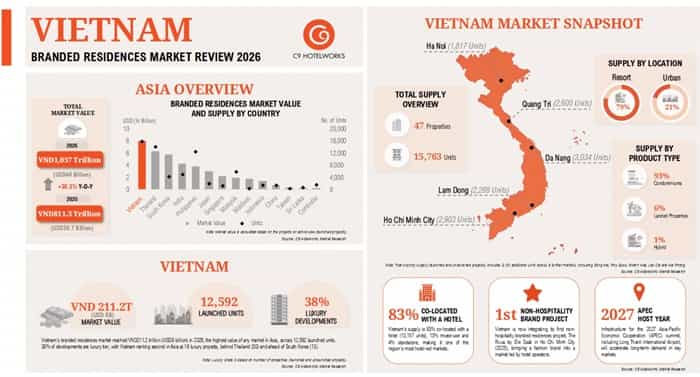
C9 Hotelworks’ Asia Branded Residences Market Review 2026 puts the nation first in Asia by total sales value. Vietnam’s market is worth about VND211.2 trillion, or US$8 billion. That is 20 per cent of Asia’s US$40 billion sector. Thailand follows at US$6.4 billion, with South Korea at US$5.8 billion.
This is more than a neat line for a property brochure. It is a clear shift in Asia’s luxury map. Vietnam has moved from a promising market to the region’s value leader. Hotel groups, fashion houses and developers are now racing to plant their flags in key cities and along the coast.
Vietnam-branded residences take the lead
Across Asia, the stock offered for sale covers 50,025 units. Total launched and future supply stands at 64,581 units in 268 projects. C9 says 18,545 units are due from 2026 to 2028. The region’s market value has jumped 30.3 per cent in one year.
Vietnam is the star of that growth. The report lists 15,763 units across 47 projects. The related media release lists 15,762, a one-unit gap that does not alter the result. Thailand still has more stock in launch, with 13,124 units against Vietnam’s 12,592. Once the future stock is added, Vietnam moves into the lead.
Luxury is doing much of the work. Some 38 per cent of Vietnam’s projects sit in the luxury tier. That helps lift the market’s value above nations with similar supply. In plain terms, Vietnam is not winning by building the most letterboxes. It is winning because many of those letterboxes come with a famous name, a concierge and a price to match.
One Central Saigon is a case in point. Launched in the second quarter of 2026, the mixed-use scheme includes The Ritz-Carlton Residences. It places a major global hotel brand in a prime development in Ho Chi Minh City and shows how strong demand for branded city homes has become.
“Vietnam’s rise as a regional hub for travel, hospitality and branded real estate has been remarkable,” said Bill Barnett, Managing Director, C9 Hotelworks. “The accelerated expansion and modernisation of the country’s infrastructure has been the catalyst for widespread investment and development, which has resulted in a huge supply of new residences in urban and resort destinations.”
Hotels hold the keys for now
Hotels still lead the charge. The release says 83 per cent of Vietnam’s branded residences are located next to a hotel. A further 13 per cent form part of mixed-use schemes. Only four per cent stand alone.
For buyers, the appeal is easy to see. They gain hotel service, shared facilities and a known brand. For developers, the model can bring in sales revenue while the hotel side takes shape. It is also one of the few homes where the doorman may learn your name before the neighbour does.
Yet hotels no longer own the whole stage. The Rivus by Elie Saab opened in Ho Chi Minh City in 2025. It became Vietnam’s first residence linked to an international fashion house. The lesson is simple. In luxury property, a strong design name can now carry almost as much weight as a hotel badge.
Luxury growth spreads nationwide
This boom is also spread across the country. Da Nang leads with 3,034 units. Ho Chi Minh City has 2,903, while Quang Tri has 2,600. Lam Dong has 2,288, and Ha Noi has 1,817. More stock is planned or underway in Dong Nai, Phu Quoc, Khanh Hoa, Lao Cai, Hai Phong and other markets.
That broad reach is important. Branded homes are following new roads, airports and visitor flows. They are not staying in old city cores. C9’s wider Asia report says resorts make up 55 per cent of supply, while condominiums account for 94 per cent.
The destination totals released in July are higher than figures in C9’s earlier Vietnam-specific market update. That earlier study listed 2,659 units in Da Nang and 1,818 in Ho Chi Minh City, suggesting the later numbers reflect added or reclassified pipeline stock.
Building is easier than selling
Building the homes is one task. Selling them is another.
Barnett has called sales and marketing an “unresolved question” for many developers. David Johnson, CEO of Delivering Asia, says these homes cannot be sold like standard flats.
“It’s a key issue and a process is often misunderstood. Marketing and sales strategies for branded residences is fundamentally different from traditional real estate,” Johnson said.
“Developers need to focus on building a narrative architecture, market positioning, and an integrated communications programme to drive desirability, buyer engagement, and sales performance if projects are to be successful.”
That warning matters. A well-known badge can open the door, but it will not close the sale. Buyers still want sound management, fair fees, clear ownership rules and reliable service. They also want proof that any rental plan can work over time.
C9’s Vietnam update adds a key point. Foreign buyers face ownership quotas and lease terms of up to 50 years, subject to possible extensions. Domestic buyers, therefore, remain the main source of demand. That may steady sales, but it also means each project must speak to local buyers rather than rely on overseas wealth alone.
Infrastructure extends Vietnam’s runway
Infrastructure gives the sector more room to grow. Vietnam will host the APEC Economic Leaders’ Week in Phu Quoc in 2027. The government sees the event as a spur for tourism, trade and infrastructure investment, with preparations extending well beyond the summit’s immediate needs.
Long Thanh International Airport is now targeted to begin commercial flights in the final quarter of 2026. The revised timetable calls for construction to be largely completed by September before commercial operations commence later in the year.
The approved 1,541-kilometre high-speed rail link between Ha Noi and Ho Chi Minh City is expected to cut the journey to about five hours. Construction is planned to begin in 2027, with passenger operations targeted for 2035.
For travel and hotel firms, the message is plain. Vietnam-branded residences are no longer a side note to the hotel story. They now link tourism, homes, luxury brands and major public works in one fast-growing field.
Vietnam has won Asia’s branded residence crown. Keeping it will take more than marble floors and glossy names. Good service, clear rules and sharp sales work will decide whether today’s boom becomes a lasting market.
Read the complete report: C9 Hotelworks’ Asia Branded Residences Market Review 2026.
By: Christine Nguyen – © 2026.
Read Time: 5 minutes.
Author Bio:
 Christine’s story is one of quiet courage, told without fuss and lived with remarkable grace. She arrived in Australia as a young refugee from Vietnam, carrying little more than hope, family, and a curiosity that refused to be extinguished. Sydney became home, built patiently, brick by careful brick.
She studied Tourism at TAFE and soon found her place in inbound travel, working with one of the city’s leading destination companies. Christine loved showing visitors the Australia that lives beyond postcards, warmer, truer, and far more interesting.
When the sea began to whisper, and life asked for a gentler rhythm, she listened. Designing brochures, writing blogs, she discovered storytelling waiting quietly inside her.
Today, at Global Travel Media, Christine writes with warmth and wisdom, reminding us, softly and persuasively, why travel still matters.











