

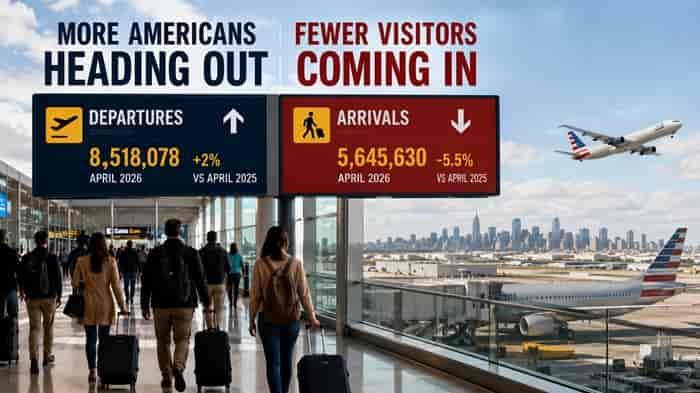
America’s international travel ledger delivered a telling April: fewer overseas visitors came through the front door, while more Americans packed their passports and headed the other way.
New data from the United States National Travel and Tourism Office (NTTO) show that 5,645,630 non-US residents visited the country in April 2026, a 5.5 per cent fall from April 2025.
At the same time, 8,518,078 US citizens departed for international destinations, up 2 per cent year on year.
That leaves a monthly movement gap of more than 2.87 million travellers.
It is not a balance-of-payments figure, nor does it measure visitor spending. However, it is a useful warning light for an industry that depends on full aircraft, occupied hotel rooms and international visitors arriving with time, curiosity and functioning credit cards.
The calendar deserves some blame before anybody reaches for the panic button.
Easter fell on 5 April in 2026, compared with 20 April in 2025, making a clean year-on-year comparison more slippery than an airport escalator in the rain.
Even so, the headline decline will give US destination marketers, airlines, accommodation operators and tourism authorities plenty to discuss.
Mexico And Canada Keep Arrivals Moving
Mexico remained the United States’ largest international source market in April, contributing 1,665,114 visitors.
Canada followed with 1,363,690, ahead of the United Kingdom with 356,712, France with 161,811 and India with 156,279.
Together, those five markets represented 66 per cent of all international arrivals.
That concentration underlines the importance of dependable air access, efficient borders and sustained marketing in the countries that continue to do much of the heavy lifting.
Among overseas holidaymakers, the United Kingdom led with 304,371 arrivals. France followed with 144,974, Brazil with 137,041, India with 113,191 and Japan with 106,134.
Business travel told a similar story, although with a different pecking order.
The United Kingdom again ranked first, producing 50,892 business arrivals. India supplied 38,107, Germany 25,805, Japan 24,022 and China 17,394.
China remained the leading overseas student market, with 8,230 arrivals. India contributed 4,981, South Korea 1,862, the United Kingdom 1,449 and Brazil 1,390.
These figures matter beyond simple league tables.
They reveal where airline capacity, trade relationships, education links and destination promotion are translating into actual journeys rather than cheerful PowerPoint forecasts.
Americans Keep Voting With Their Passports
Outbound travel was the brighter half of April’s ledger.
US citizens made 8,518,078 international departures, with North America accounting for 50.2 per cent and overseas destinations taking the remaining 49.8 per cent.
Mexico alone recorded 3,204,057 US departures, equal to 37.6 per cent of the monthly total. Canada posted a 6.5 per cent year-on-year increase.
Europe was the second-largest outbound region, attracting 1,834,932 US travellers.
That represented 21.5 per cent of all April departures and a 5.2 per cent increase from April 2025.
Year to date, Mexico attracted 13,702,545 US departures and the Caribbean 3,947,662.
Combined, the two regions accounted for 53.4 per cent of American international departures.
Sunshine, proximity and relatively straightforward access remain a persuasive sales team.
For travel businesses, the divergence is commercially significant.
Strong outbound demand supports airlines, cruise lines, tour operators and overseas destinations selling into the US market.
Softer inbound volume, however, places pressure on American hotels, attractions, retailers and city tourism bodies that rely heavily on foreign visitors.
Land Borders Tell Their Own Story
Separate NTTO findings covering overnight land visitors during 2025 add valuable context to the monthly figures.
The United States welcomed 14.4 million Mexican visitors and 7.4 million Canadian visitors by land during the calendar year.
California was the leading state for Mexican land visitors, receiving 6.3 million.
Texas followed with 5.6 million, Arizona with 1.5 million, Florida with 613,000 and Nevada with 590,000.
Mexican land visitors stayed an average of 5.7 nights, visited 1.6 states and spent an average US$2,634 per travel party.
Holidays were the principal purpose of travel for 73.6 per cent of visitors, while sightseeing was the most popular leisure activity at 59.3 per cent.
Shopping attracted 37.6 per cent, national parks and monuments 24.2 per cent, and amusement or theme parks 22.3 per cent.
For Canadian visitors to land, New York ranked first with 2.1 million arrivals.
Washington welcomed 887,000, Florida 883,000, Michigan 515,000 and California 433,000.
Canadians stayed longer, averaging 6.9 nights and 1.9 states per trip, while average expenditure reached US$2,497 per travel party.
Holidays represented 73.9 per cent of Canadian visits. Sightseeing again topped the activity list at 47.4 per cent, followed by shopping at 32.8 per cent and fine dining at 25.1 per cent.
Those land-border numbers may not be glamorous, but they are economically muscular.
They show how family visits, shopping trips, holidays and road travel bind neighbouring markets together in ways that no long-haul advertising campaign can easily replicate.
NTTO’s visitor-arrival programs combine United States border and travel data with information supplied by Canadian and Mexican statistical authorities. The agency’s I-94 arrivals program provides the principal official framework for measuring non-resident visitation to the United States.
America’s Inbound Challenge Becomes A Sales Challenge
April’s result does not prove a long-term collapse, particularly given the Easter timing distortion.
It does, however, reinforce a familiar truth of tourism: travellers have choices, and destinations must earn the booking.
The United States still benefits from extraordinary global attractions, deep aviation connections and powerful source markets.
Yet brand strength is not a self-driving vehicle.
Competitive pricing, welcoming borders, efficient visa processing and consistent destination marketing all matter. So does confidence that the arrival experience will match the promise made in the brochure.
Americans, meanwhile, appear in no mood to leave their passports in the drawer.
The outbound market is moving, Europe is gaining, Mexico remains dominant, and the Caribbean continues to catch the eye.
For the US inbound sector, the message is plain enough.
The world still wants to travel, but it may require a sharper invitation to travel to America.
By: Alison Jenkins – © 2026.
Read Time: 4 minutes.
Author Bio:
 Alison Jenkins has lived most of her working life in the slipstream of aviation, where timetables matter, and people matter more. In airline sales, she built a reputation the old-fashioned way: by knowing her clients, her routes, and never missing the human detail.
Quick with a smile, quicker with a solution, she made deals with warmth and kept her edge intact.
Trade shows, FAMILS, airport lounges and hotel lobbies became her second address. And somewhere along the way, notebook in hand, she began writing the journeys rather than selling them. Her reports grew lively, observant, full of the small truths only travellers notice.
That was the moment it dawned on her: she wasn’t simply travelling. She belonged in its stories.











