

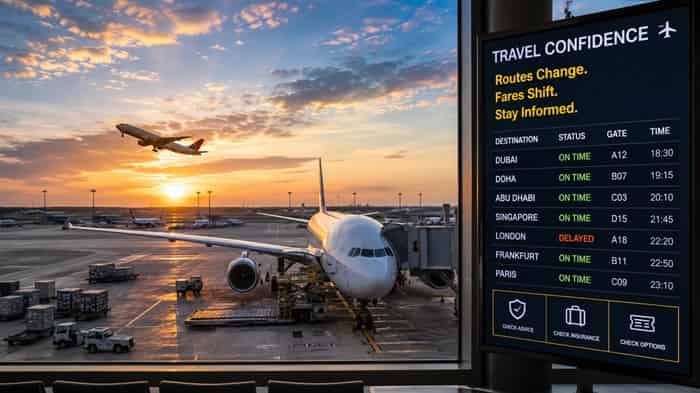
Aviation has delivered one of those numbers that looks grim at first glance, but becomes far more interesting once the tray table is down and the figures are read properly. Global air passenger demand fell in May. That is the headline. The story, however, is not a simple loss of appetite for flying. It is a story about disrupted routes, nervous passengers, stubborn fares and the slow return of confidence in the Gulf.
IATA’s May 2026 passenger data show that total demand, measured in revenue passenger kilometres, fell by 2.2 per cent compared with May 2025. Capacity slipped 2.3 per cent. Yet the load factor reached 83.5 per cent, a record for May. In other words, aircraft were still flying at full capacity. The world did not suddenly decide to stay home and alphabetise the linen cupboard. It kept travelling, but not always by the same route, at the same price, or with the same confidence.
The Middle East explains much of the statistical downdraft. IATA says the May decline was driven by the impact of war in the Middle East, with demand for carriers in the region down 28.4 per cent year-on-year. That sounds brutal, and it is. But it was also a marked improvement from the 46.6 per cent fall recorded in April. Resilience, like a good long-haul aircraft, is not always elegant, but it is built to keep going.
Strip the Middle East out of the global number, and the picture changes. IATA says demand grew 0.7 per cent excluding the region. International demand fell 1.6 per cent overall, but rose 3.1 per cent when the Middle East was excluded. That matters because it tells airlines, wholesalers and agents that the passenger has not vanished. The passenger has simply become more calculating.
The old Australia-to-Europe playbook has been particularly unsettled. For years, the Gulf carriers made the kangaroo path feel almost automatic: Australia to Dubai, Doha or Abu Dhabi, then onward to Europe with a decent lounge, a punctual connection and, for many travellers, the comfortable illusion that 24 hours in the air was somehow civilised. The conflict changed that arithmetic. Hub closures, airspace disruption and Australian travel warnings pushed some travellers toward Asian airlines, especially on Asia-Europe routings.
Reuters reported that Emirates, Qatar Airways and Etihad carried nearly one-third of passengers from Asia to Europe, and more than half of those travelling from Australia and New Zealand to Europe, before the conflict. When Gulf hub airports were affected after the start of the Iran war on 28 February, Asian carriers picked up valuable traffic. But that windfall is now fading as Gulf operations recover. By mid-June, flights by the major Gulf carriers had returned to around 90 per cent of normal levels, according to Flightradar24 data cited by Reuters.
For Australian travel sellers, the confidence switch is the key commercial point. On 17 June, the Australian Government lowered its travel advice for Bahrain, Israel, Kuwait, Qatar and the United Arab Emirates from “Do Not Travel” to “Reconsider your need to travel”. It also warned that conditions could deteriorate rapidly and that “reconsider your need to travel” includes reconsidering your need to travel by transit. This was not a green light wrapped in bunting. It was a cautious amber light. But in aviation, amber can still move bookings.
Reuters reported that Flight Centre Travel Group saw bookings on Emirates, Qatar, and Etihad rise 36 per cent in the week after Australia lifted the “Do Not Travel” warning that had affected traveller insurance at Gulf hubs. That is the sort of number that gets airline sales teams smiling again and Asian competitors sharpening their pencils.
The Asia-Europe contest is therefore entering a more subtle phase. During the disruption, some Asian airlines benefited from travellers who wanted to avoid Gulf transit. But as Gulf carriers rebuild schedules and confidence improves, Asian airlines may not keep all the market share they gained. Reuters reported non-stop traffic from Asia to Europe was up nearly 30 per cent year-on-year in March, but by May that gain had narrowed to 15 per cent. Singapore Airlines, Cathay Pacific, Korean Air and ANA are not suddenly in trouble. They are simply facing the return of formidable rivals whose hubs were built for exactly this game.
Fares are the other part of the story, and nobody should expect them to behave politely. IATA director general Willie Walsh said May demand appeared largely resilient despite high fuel prices and air fares. He also warned that lower oil prices may take time to flow into normalised jet fuel pricing, while airlines operating on a 2.0 per cent margin have little choice but to keep testing whether passengers will absorb higher fares.
That phrase “testing demand resilience” deserves a place on every travel agent’s desk. It is airline language for finding out how much travellers will pay before they yelp. For agents, this creates a practical selling challenge. Some clients will still pay for the perceived safety, convenience and schedule strength of a preferred carrier. Others will hunt for value on Asian routings. Many will ask about insurance, transit risk and refundability before they ask about champagne, seat pitch or whether the in-flight chicken has been improved since federation.
For tourism boards, the lesson is equally plain. Air access is not only about seats. It is about traveller confidence, distribution certainty and whether consumers believe the route is sensible. A destination with strong demand can still underperform if its air pathways feel exposed, expensive or confusing. That applies to Europe, Thailand, Australia, New Zealand and every stop in between.
For GTM, the editorial angle is not “air demand collapses”. That is too blunt and, frankly, too lazy. The sharper story is that demand remains present but has become more selective. Travellers are still flying. Airlines are still filling seats. But route choice, travel advice, insurance cover, fare volatility and geopolitical risk now sit in the same shopping basket.
The winners will be the airlines and travel sellers that give passengers clarity without condescension. The losers will be those who pretend nothing has changed. The old aviation map has not been torn up. It has been folded, refolded and stuffed into the seat pocket. Anyone selling travel now needs to pull it out, smooth it down and read the small print before promising a smooth journey.
By: Prae Lee – © 2026.
Read Time: 5 minutes.
Author Bio:
 You can tell a great deal about a person by how they meet a Bangkok morning. Prae Lee doesn’t charge into it; she glides, unhurried, as if time itself has agreed to behave. There is a calm assurance about her, the sort earned by knowing both your roots and your destination.
A graduate of Chulalongkorn University, she earned her business degree with quiet pride, then further honed it in Singapore and Australia. Travel didn’t change her. It refined what was already there: curiosity, discipline, grace.
Back in Bangkok, she slipped modern life into the family business, mastering social media with an instinct for listening and selling with Thai gentleness.
Prae never seeks attention, yet everything she touches grows brighter.
Now with Global Travel Media, she writes with authenticity, drawing on culture, travel and a rare, steady confidence.











