


Travel is changing fast. Not politely. Not slowly. It is turning up with a boarding pass, a phone full of video clips, and an AI tool that never sleeps.
That was the clear message from RateHawk Futurecast. The online event brought together leaders from RateHawk, TikTok, Lufthansa City Centre, Travelport and MakeMyTrip. They looked at three big shifts now facing the trade: agentic AI, new travellers, and the sharp rise of travel APIs.
RateHawk, part of Emerging Travel Group, is a B2B platform for hotels, flights, transfers, car rentals and other travel services. The company promotes access to more than 2.9 million hotels worldwide, backed by API links for business users.
The event also formed part of RateHawk’s 10th anniversary campaign. At Futurecast, RateHawk presented its new Phocuswright white paper, “Supercharging Travel: Ten Trends That Will Shape the Industry Over the Next Decade”, a report focused on traveller behaviour, market shifts and tech adoption.
“If the last 10 years taught us anything, it is that the pace of change is only accelerating. For travel businesses, this creates both opportunity and uncertainty,” said Astrid Kastberg, Managing Director of RateHawk, in her opening remarks.
She is right. Change is no longer a passing shower. It is the weather.
Gen Z is one reason. Young travellers are not waiting for a glossy brochure to land on the desk. They are finding trips through social media, short videos, friends, creators and real stories. They want proof, not polish. They want a voice they trust, not a slogan-wearing a hat.
Siiri Palisaar, Senior Director Sales Steering at Lufthansa City Centre, said agents must show up where customers now spend their time. “Travel agents should advertise and create content on social media and digital platforms themselves because it’s where their audience is.”
That may sound simple. It is not. The web gives travellers more choice than ever. It also gives them more doubt. A holiday search can now feel like standing in front of 300 departure gates with one sandwich and no sleep.
Palisaar said the trade still has a vital role. “The world is becoming ‘noisy’, and the decision-making process is not getting any easier. Travel businesses are better equipped with information than ever before, which allows them to create particularly relevant offers. Demand for their support is increasing as it helps travelers navigate the uncertainty and the overwhelming amount of choice.”
In plain English, people still need people. Good agents save time. Great agents give calm.
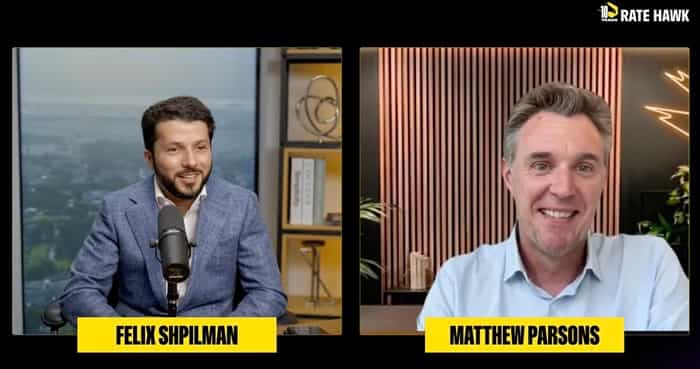
Fireside – Shpilman and Parson
Futurecast also put APIs in the spotlight. These quiet tech links matter because they help systems talk to each other. They help bring rates, rooms, stock and content into one cleaner flow. The traveller sees a smooth screen. Behind it, the trade needs pipes that do not leak.
Sinead Reilly, Senior Director Global Enterprise Sales at Travelport, said: “We’re only at the beginning of what APIs will enable in terms of personalisation and connectivity, combined with AI and cloud-based technologies. The ultimate goal is to deliver less fragmented and more standardised content to the frontline travel professionals.”
Ilya Kravtsov, Chief Commercial Officer at Emerging Travel Group, said demand will grow as more firms move online and seek better partners. “Travel businesses want to focus on customer acquisition and service rather than managing dozens of supplier integrations, so we’ll see many strong technology partnerships in the upcoming decade,” says Kravtsov.
He also pointed to RateHawk’s Demand Shift tool. The tool is now in beta testing. It is designed to give travel sellers clearer insight into new demand trends.
Then came AI. No modern travel event can avoid it. To do so would be like launching a cruise ship and forgetting the sea.
Felix Shpilman, President and CEO of Emerging Travel Group, urged firms to start now and start small. “You cannot afford to wait. Start by automating simple tasks, one at a time, learn from the process, and scale what works,” said Shpilman.
Kravtsov also made the human case. “While agentic AI will excel at finding answers and doing routine tasks, people will remain irreplaceable in understanding the context and delivering service with empathy.”
That is a useful lesson. AI can find. APIs can connect. Social media can spark. But people still sell trust.
“We believe that long-term success will belong to businesses that stay close to change and act with confidence,” wrapped up Kastberg.
For travel professionals, the call is clear. Use the tools. Learn the channels. Read the data. But keep the service human. The future may be digital, but the best travel advice still comes with judgement, care and a steady hand.
By: Soo James – © 2026.
Read Time: 3 minutes.
Author Bio:
 There’s nothing rehearsed about Soo James, and that’s precisely the point. Malaysian by heritage, Sydney-schooled, she arrived at UNSW to study Arts, then took a left turn into IT, not out of ambition but out of curiosity. Somewhere among systems and schedules, she worked out what really held her attention: people, language, and the quiet spaces between them.
Writing followed naturally. Travel and lifestyle gave her room to observe, to listen, to notice the details others rush past. Soo writes the way good travellers move, watching the room before admiring the view, catching the gesture before chasing the headline.
At Global Travel Media, her stories don’t shout or sell. They linger. They slow you down, open a door, and gently suggest there’s more to see if you’re willing to look.











