

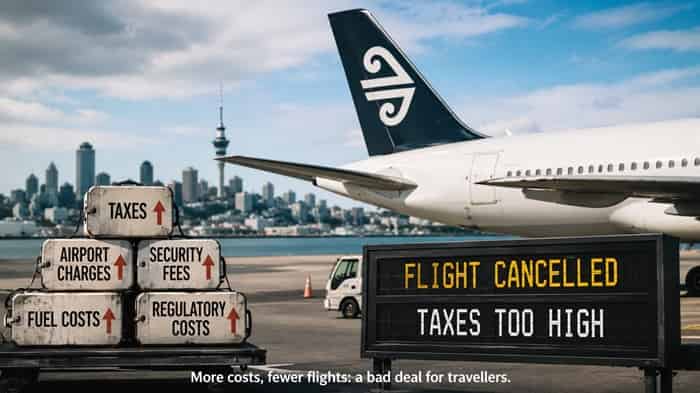
Australia and New Zealand’s aviation sector has fired a fresh warning shot across the bows of governments on both sides of the Tasman, cautioning that relentless increases in taxes, charges and regulatory costs are now translating into an uncomfortable reality for travellers: fewer flights and higher fares.
And the first casualties have already emerged.
An airline has confirmed the suspension of services between Auckland and the Sunshine Coast, as well as flights linking Christchurch and Cairns, citing a combination of increased government-imposed costs and weaker passenger demand.
According to Airlines for Australia and New Zealand (A4ANZ), the move is unlikely to be an isolated case.
Professor Graeme Samuel AC, Chair of Airlines for Australia and New Zealand, said the industry had repeatedly warned governments that continually adding costs to aviation would eventually force airlines into difficult commercial decisions.
“Airlines for Australia and New Zealand has been warning governments for some time that escalating taxes, fees, charges and regulatory costs imposed on airlines would inevitably result in higher airfares, reduced services, or both,” Samuel said.
For regional communities, the implications could be profound.
Thin regional routes have long operated on wafer-thin margins, particularly those served by low-cost and value carriers. When operating expenses climb, these services are often first in the firing line. Airlines can either absorb the cost, pass it on to passengers, or withdraw services altogether. Increasingly, the maths simply no longer stacks up.
The pressure on airline balance sheets is mounting from several directions at once.
Conflict in the Middle East has pushed fuel prices higher, while governments continue introducing additional taxes and compliance obligations. In Australia, the Federal Government recently lifted the Passenger Movement Charge from $70 to $80 per traveller.
At the same time, AusCheck credentialling fees for aviation workers have surged from $92 to $262 per employee, while Airservices Australia is proposing significant increases to air traffic control charges.
Adding further strain, airport passenger charges continue to rise at around twice the rate of inflation, while airlines face new expenditure associated with accessibility reforms and future sustainability measures.
Individually, many of these increases may appear modest. Collectively, however, they are creating what industry leaders describe as a mounting cost avalanche.
Samuel warned that governments risk undermining one of the region’s most important economic enablers.
“Governments rightly recognise the importance of aviation in supporting tourism, trade, investment and regional development. However, every additional tax, fee and charge makes it more expensive to fly and more difficult for airlines to sustain services,” he said.
The consequences extend well beyond airport terminals. Tourism operators, regional businesses, accommodation providers and local economies all depend heavily on reliable and affordable air access.
Aviation has traditionally been one of the great democratisers of travel, shrinking distances and opening opportunities for communities that would otherwise remain isolated. If policymakers continue to treat airlines primarily as a revenue source, travellers may soon discover that affordable air travel is becoming an increasingly rare commodity.
As Samuel bluntly observed, “Affordable air travel should not become a luxury.”
For an industry still rebuilding capacity and navigating global economic uncertainty, the message to governments is clear: tread carefully, or risk grounding growth itself.
For further information on aviation policy, visit the official websites of the International Air Transport Association (IATA) at https://www.iata.org and Airlines for Australia and New Zealand at https://a4anz.com.au.
By: Karuna Johnson – © 2026.
Read Time: 2 minutes.
Author Bio:
 Karuna Johnson’s career only makes sense if you know she truly loves travel. Thai by birth, with dual citizenship, she moves easily between worlds, equally at home sharing street food in Bangkok or sitting quietly through a Sydney boardroom meeting.
Educated in both Thailand and Australia, she speaks several languages and has applied them across destination management companies and hotels, spanning sales and administration. She’s the sort who keeps things running smoothly while others are still waking up.
Her journeys have taken her across Asia, Europe, and the United States, but it’s the smaller details that stay with her: people, customs, and the stories beneath every trip.
Worldly without being showy, Karuna brings a steady, thoughtful voice to Global Travel Media, exactly what the travel industry needs.











