

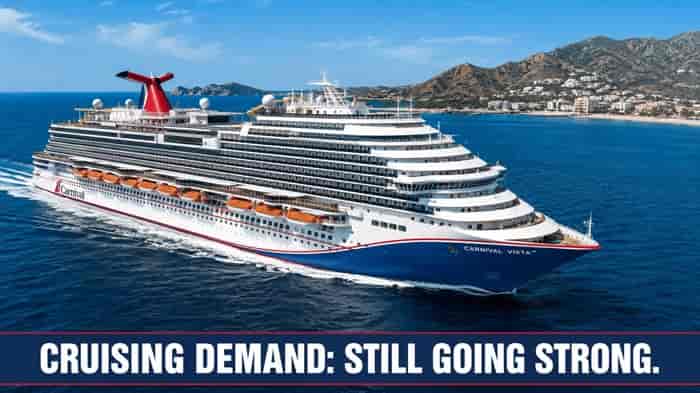
Carnival proves once again that bad news on land rarely sinks holiday dreams at sea.
If there was ever any doubt that the world’s love affair with cruising remains alive and well, Carnival Corporation has just torpedoed it.
The world’s largest cruise company has delivered another blockbuster quarter, posting record revenues, record profits, record customer deposits and its twelfth consecutive quarter of record net yields, all while navigating geopolitical turmoil, soaring fuel prices and enough global uncertainty to make even seasoned travel executives reach for the aspirin.
In short, cruising’s remarkable post-pandemic comeback isn’t slowing. In fact, it appears to be gathering speed.
Carnival reported second-quarter revenues of US$6.7 billion, the highest in the company’s history, while adjusted net income climbed to a record US$569 million, more than 20 per cent higher than the same period last year. Customer deposits also reached an all-time high of US$9 billion.
Not bad for an industry that, only a few years ago, many armchair commentators had confidently written off.
Carnival President and CEO Josh Weinstein wasn’t shy about celebrating the result.
“We achieved another quarter of record results, marking our twelfth consecutive quarter of record net yields and delivering over 20 per cent more to the bottom line, overcoming extreme geopolitical headwinds and nearly 30 per cent higher fuel costs,” Weinstein said.
For cruise veterans, the significance is hard to overstate.
Fuel prices have surged almost 30 per cent year-on-year, conflict in the Middle East has rattled traveller confidence, and parts of Europe, traditionally among cruising’s hottest destinations, have endured months of uncertainty.
Yet passengers continue to flock to ships.
Apparently, when the world becomes chaotic, many travellers decide the best place to watch events unfold is from a balcony cabin with a cocktail in hand.
Bookings keep rolling in
Carnival says it is now 93 per cent booked for the remainder of 2026, with less inventory available than this time last year and prices sitting at historically high levels.
That’s a dream scenario for any cruise executive.
Even more encouraging is what lies ahead.
Demand for 2027 and beyond is currently running ahead of previous years, with both booking volumes and prices outperforming prior-year levels. European sailings, in particular, have enjoyed a significant rebound despite recent regional tensions.
Weinstein said Carnival’s booking curve is now the furthest out on record.
Translation? Consumers are booking earlier, spending more and showing little appetite for postponing their holidays.
For travel advisors, that’s music sweeter than a ship’s sail-away horn.
Strong demand offsets geopolitical headaches
The Middle East conflict did create some turbulence, particularly for Mediterranean deployments situated closest to regional flashpoints.
Rather than slash prices to fill cabins, however, Carnival chose to hold its nerve.
The company deliberately prioritised pricing integrity, relying on strong occupancy levels rather than discounting heavily. It’s a strategy that appears to have paid dividends.
After all, discounting may fill ships, but premium pricing fills balance sheets.
The company said recent booking trends suggest that some of those geopolitical headwinds are already easing.
Shareholders are finally getting rewarded
Investors, meanwhile, are finally seeing tangible rewards.
Carnival has already repurchased more than US$450 million in shares under its buyback program and paid US$414 million in dividends during the first half of 2026.
Chief Financial Officer David Bernstein noted that the company has continued to strengthen its balance sheet while investing in future growth.
Carnival’s net debt-to-adjusted EBITDA ratio has improved to 3.1 times, more than half a point better than a year ago. Moody’s recently rewarded that progress with a credit-rating upgrade and maintained a positive outlook.
For a company that carried enormous debt through the pandemic years, that’s a noteworthy milestone.
Bigger ships and bigger ambitions
Carnival certainly isn’t putting away the cheque book.
Princess Cruises has ordered three new LNG-powered vessels for delivery between 2035 and 2039. The new Voyager-class ships will become the largest ever operated by the brand.
Across the wider portfolio, fleet enhancement programs continue at pace.
Holland America Line’s Evolution Program and AIDA Cruises’ modernisation initiatives are designed to refresh onboard experiences, expand guest offerings, and ensure that repeat passengers continue to find something new each time they sail.
Meanwhile, Carnival’s growing portfolio of private destinations continues to expand.
Celebration Key has already welcomed more than two million guests since opening last year, while upgrades at RelaxAway, Half Moon Cay and newly rebranded Isla Tropicale are increasing capacity and broadening guest experiences.
Full steam ahead
Carnival expects full-year adjusted EBITDA to reach approximately US$7.11 billion and adjusted net income to hit around US$3.07 billion. Net yields are forecast to rise another 3.2 per cent over already record 2025 levels.
Of course, the company acknowledges that plenty of risks remain, including geopolitical uncertainty, fuel price volatility, adverse weather events and broader economic pressures.
But if Carnival’s latest results tell us anything, it is this: consumers may cut back on many things, but the annual holiday increasingly isn’t one of them.
And for cruise lines, that means the tide remains very much in their favour.
By: Michelle Warner – © 2026.
Read Time: 6 minutes.
Author Bio:
 Michelle Warner has always carried stories the way others carry passports lightly, faithfully, and with purpose. She learned her craft in newsrooms, shaping sentences with care, before swapping deadlines for departures as a flight attendant with some of the world’s great airlines. Years aloft sharpened her eye for character and deepened her fondness for the small, dignified rituals of travel, the quiet kindness of strangers, the poetry of arrival, the patience learned between time zones.
Now grounded by choice, Michelle has come home to writing with the same calm authority she once brought to turbulent cabins. Her prose blends an editor’s discipline with a traveller’s wonder, tinged with humour and reverence for the golden age of travel. Each piece feels like a handwritten boarding pass, gracious, observant, and unmistakably alive.











