

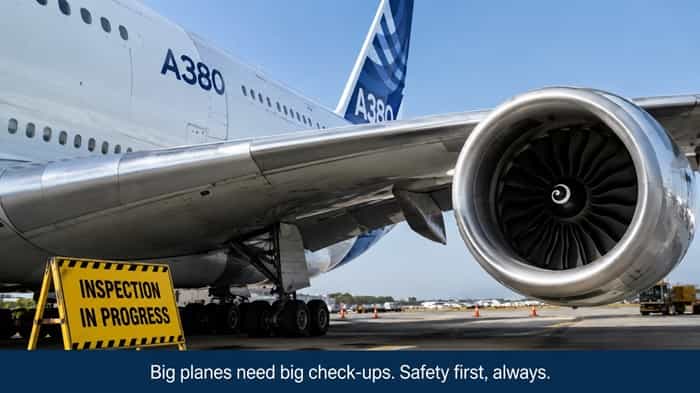
Just when the Airbus A380 looked comfortably settled into middle age, the world’s biggest passenger aircraft was called back to the engineering surgery for another check-up.
And no, this isn’t simply an airline equivalent of “turn your head and cough”.
Airbus and European safety regulators have ordered inspections on a small group of A380 superjumbos after cracks were discovered in a structural section of the aircraft’s wing assembly during maintenance checks.
The issue affects 16 aircraft worldwide, 15 operated by Emirates and one belonging to Qantas.
For an aircraft that has already survived production battles, market scepticism, a pandemic-induced grounding and several earlier engineering headaches, it’s another reminder that even aviation royalty occasionally needs a visit from the doctor.
Before nervous flyers start cancelling seats in 68A, aviation experts stress there is no immediate safety concern.
In fact, quite the opposite.
The cracks were discovered during routine inspections, precisely the sort of painstaking maintenance work designed to identify problems long before they become operational issues.
In aviation, finding something early is considered good news. Not finding it would be the problem.
The European Union Aviation Safety Agency (EASA) has issued an airworthiness directive requiring affected aircraft to undergo inspections of a wing-spar component that carries and distributes enormous aerodynamic loads generated during flight.
Airbus has acknowledged that if left unchecked, cracking in the component could eventually compromise the wing’s structural integrity.
Five Emirates aircraft have been singled out for immediate inspections, while the remaining affected aircraft must be checked before reaching specified operational thresholds.
For Qantas, the timing could hardly have been better.
The airline’s only affected aircraft is currently in Dresden, Germany, undergoing heavy maintenance, so passengers are unlikely to notice any impact.
The Flying Kangaroo says the directive is not expected to disrupt services.
Still, the announcement has inevitably reopened old wounds.
Long-time aviation watchers may remember the rather uncomfortable period in 2012 when wing cracks first emerged on parts of the A380 fleet.
At the time, regulators around the globe ordered widespread inspections, airlines shuffled schedules, and Airbus embarked on an expensive repair and redesign programme.
For a while, the phrase “hairline crack” became about as welcome in Toulouse as a Ryanair press conference.
To Airbus’ credit, the manufacturer addressed those earlier issues, redesigned components and strengthened inspection regimes.
The latest findings appear confined to a relatively small number of aircraft built during a particular production period, rather than representing a broader fleet-wide problem.
Even so, regulators aren’t taking any chances.
Commercial aviation remains one of the safest forms of transport on earth precisely because the industry obsesses over detail.
Engineers inspect, re-inspect, and then inspect again, usually while the rest of us are still trying to work out how to recline our seats without annoying the passenger behind us.
The timing is particularly significant because the A380 has enjoyed something of a renaissance.
Written off by many during the pandemic, the superjumbo has staged an impressive comeback as international travel demand surged.
Passengers still adore the aircraft.
Cabins are quieter. There’s more space. Boarding somehow feels less like entering a sardine tin at 38,000 feet.
Airlines, however, continue to wrestle with the economics.
Operating four engines in an era increasingly dominated by highly efficient twin-engine aircraft such as the Airbus A350 and Boeing 787 isn’t cheap.
Neither is maintaining an aircraft carrying more than 500 passengers.
Airbus ceased production of the A380 in 2021, effectively drawing the curtain on one of aviation’s boldest and most ambitious programs.
Yet the aircraft remains critically important to carriers such as Emirates and Qantas, particularly on heavily trafficked international routes where airport slots are scarce, and demand remains strong.
Replacing an A380 isn’t simply a matter of swapping keys at the dealership.
There are very few aircraft capable of moving similar numbers of passengers on ultra-long-haul routes.
For Qantas, newer Airbus A350 aircraft entering the fleet under Project Sunrise are expected to gradually shoulder more long-haul flying in the coming years. But for now, the A380 still has plenty of life left in it.
And despite the latest headlines, passengers booked on upcoming superjumbo flights should expect business as usual.
If anything, the latest inspections demonstrate why commercial aviation continues to maintain such an enviable safety record.
The system worked.
The aircraft were inspected.
A potential issue was identified.
Engineers are fixing it.
Which, in aviation circles, is generally regarded as a very good day at the office.
By: Jason Smith – © 2026.
Read Time: 4 minutes
Author Bio:
 Jason Smith didn’t learn travel from textbooks. He learned it in airports, taxis and hotel lobbies, watching the business unfold long before he played his own part. Half American, half Asian, he grew up around the quiet workings of tourism, where people come and go, and stories rarely stand still.
Bangkok came first, then formal study, then a career that carried him through Singapore, Malaysia and Vietnam. Each place left something behind. In the end, Thailand felt like home, and I took on a senior role in hotel sales.
Then everything stopped. Borders shut, planes grounded, and Jason found himself back in America with time to reflect.
Now at Global Travel Media, he writes travel as it really is, not polished, not perfect, but human, and all the better for it.











