

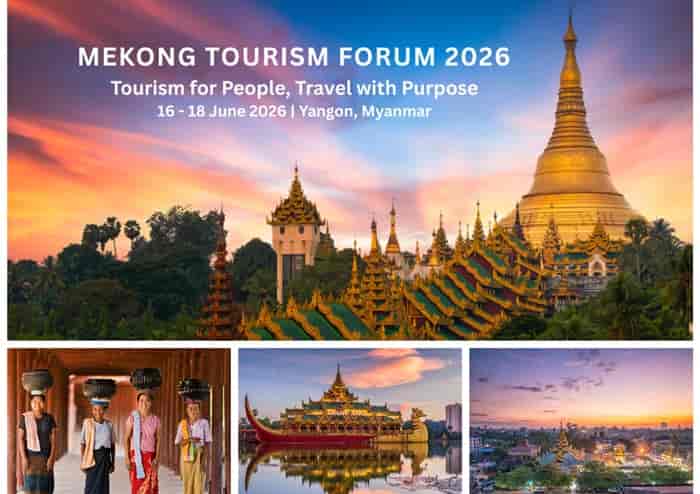
There was a moment during the Mekong Tourism Forum in Yangon that neatly summed up everything the tourism industry has spent years trying to rediscover.
No PowerPoint slide. No economic forecast. No consultant with 47 graphs and a laser pointer.
Just three simple words.
“Welcome, brother.”
Veteran travel writers often say that long after the airline seat, hotel room and conference speeches have faded from memory, it is the people one remembers. AirAsia MOVE’s Chattan Kunjara Na Ayudhya reminded delegates of precisely that when he recalled a ticket seller at Myanmar’s magnificent Shwedagon Pagoda greeting him simply with: “Welcome, brother.” In a forum overflowing with worthy presentations and polished PowerPoints, those two words probably said more about tourism than all of them put together.
In a world of tourism increasingly dominated by apps, algorithms, AI, and enough acronyms to fill a small dictionary, the reminder was both disarmingly simple and deeply moving.
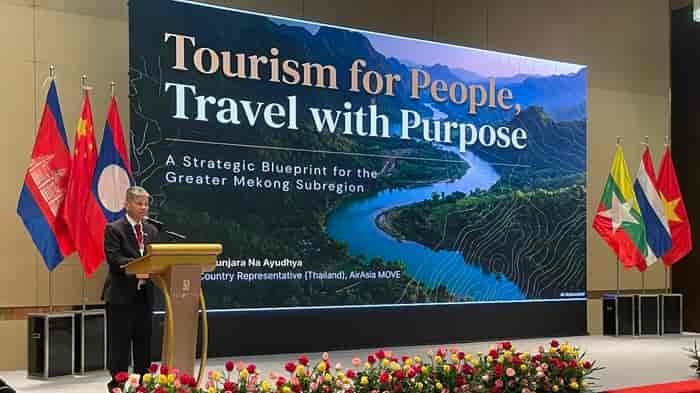
“Tourism for People, Travel with Purpose”
People remember people.
Always have.
Always will.
And that, in many ways, became the beating heart of this year’s Mekong Tourism Forum, held in Yangon under the wonderfully refreshing theme, “Tourism for People, Travel with Purpose.”
Refreshing because, if we’re honest, tourism sometimes loses its way.
We’ve all attended conferences where speakers proudly announce another million visitors, another record-breaking year, another airport expansion. Wonderful news, of course, unless you’re the local resident stuck in traffic behind the airport bus, wondering when any of this prosperity might eventually trickle down your street.
Yangon offered a different conversation.
Hosted by Myanmar’s Ministry of Hotels and Tourism together with the Mekong Tourism Coordinating Office (MTCO), this year’s gathering brought together ministers, tourism bosses, academics, community leaders, artists and entrepreneurs from across the Greater Mekong Subregion.
But unlike many industry gatherings, the atmosphere felt remarkably personal.

Panel Discussion “Living Culture & Creative Expression”
There were hugs.
There were old friendships rekindled.
There were plenty of serious discussions too, naturally, but there was also lots of laughter.
After several turbulent years for global tourism, perhaps simply being together again in Myanmar carried an emotional significance all its own.
Opening the forum, Myanmar’s Union Minister of Hotels and Tourism, H.E. Mr. Maung Myint, alongside Cambodia’s Minister of Tourism, H.E. Mr. Huot Hak, spoke passionately about cooperation across the Mekong region.
Cooperation is one of those words frequently tossed around at conferences.
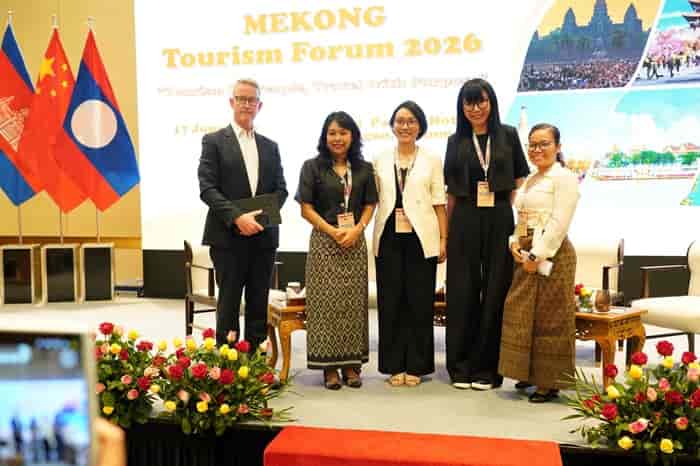
Panel Discussion “People at the Centre of Tourism”
In Yangon, it felt genuine.
That authenticity was helped enormously by MTCO Executive Director Ms Suvimol “Dee” Thanasarakij.
Dee has long been one of the region’s most respected tourism leaders, and throughout the week she quietly steered discussions with warmth, diplomacy and no small amount of patience, an essential quality whenever tourism people gather in large numbers, and everyone believes they have the answer.
Behind the scenes, MTCO Operations Manager Ms Sasithorn Chantarklum, universally known and affectionately called “Aey,” performed miracles.
Seasoned conference delegates know there is no such thing as a flawless event.
Only very talented people solve problems before anyone notices.
Aey belongs firmly in that category.
The keynote address by Global Ecotourism Network Chairperson Masaru Takayama challenged delegates to think differently.
His framework, Conservation, Community, Culture and Commerce, resonated strongly.
Importantly, commerce came last.
That wasn’t accidental.
For decades, tourism has often operated on the assumption that if visitor numbers rise, everybody wins.
Reality, of course, is rarely so tidy.
The forum’s most emotional session centred on people.
Real people.
Not “human resources”.
Not “stakeholders”.
People.
Women entrepreneurs.
Young workers.
People living with disabilities.
Communities are trying to preserve centuries-old traditions while simultaneously welcoming twenty-first-century visitors.
Thiri Aung, CEO and Founder of Women Transforming Myanmar, delivered perhaps the week’s most powerful line.
“Invest in women, when women thrive, communities thrive.”
Nobody reached for their phones.
Nobody checked their emails.
The room simply listened.
You could almost hear heads nodding.
Equally compelling was the contribution from Sokny Onn, CEO of Epic Arts, who reminded delegates that accessible tourism is not some fashionable add-on.
It’s basic human decency.
And frankly, it’s about time the industry started treating it that way.
Another memorable voice came from Vietnam’s Thai Hai Village.
Representing one of UN Tourism’s Best Tourism Villages, Thuy An Phan spoke not about strategy, market segmentation or yield management.

MTF2026 Farewell dinner
She spoke about love.
Yes, love.
A word rarely heard at tourism conferences and perhaps not nearly often enough.
“With love, we can do anything. Love creates our village. Love with nature can create meaningful tourism,” she said.
For a brief moment, the room fell silent.
Because deep down, everyone knew she was right.
Tourism, at its very best, has never really been about hotels, aircraft or visitor statistics.
It’s about human connection.
The meals were shared.
The stories exchanged.
The friendships formed.
The stranger who becomes a friend.
Or perhaps simply the local who smiles and says:
“Welcome, brother.”
As delegates departed Yangon and Thailand prepared to host the Mekong Tourism Forum 2027 in Chiang Rai, there was a genuine sense that something important had happened.
No, the forum did not solve every challenge facing tourism.
No conference ever does.
But for a few days in Yangon, the industry paused, looked itself in the mirror and remembered something rather important.
Tourism has a soul.
And thankfully, in the Mekong region at least, it’s still beating strongly.
By: Supaporn Pholrach – © 2026.
Read Time: 6 Minutes.
Author Bio:
 Supaporn Pholrach came up in advertising when deals were sealed with a handshake, and deadlines lived on scraps of paper, not dashboards. She learned early that people mattered more than process, and it stuck. Armed with solid training and a stubborn work ethic, she built a reputation for getting results without turning hard or hollow.
Fifteen years at Bangkok Shuho would test anyone’s stamina. Supaporn stayed the distance. These days, as Sales Manager at Global Travel Media, she helps tourism brands cut through the noise with common sense, good humour and genuine warmth.
She doesn’t chase quick wins. She earns trust, builds loyalty and keeps her word. In an industry that rarely slows down, Supaporn is someone you’re quietly glad to have on your side.











