

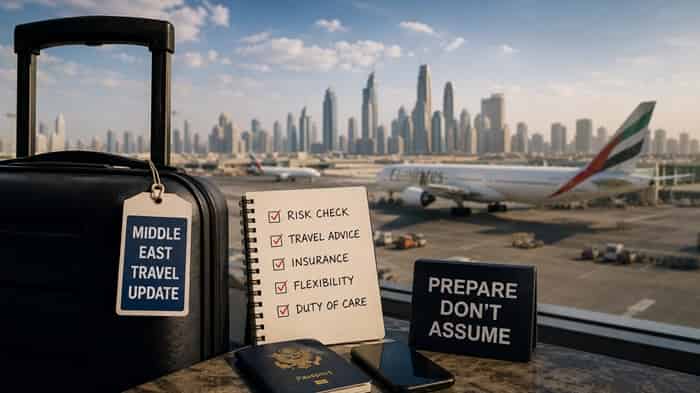
There is an old saying in aviation: just because the turbulence has eased doesn’t mean you should take your seatbelt off.
Australian businesses would do well to remember that.
After months of conflict, uncertainty and enough flight diversions to keep airline operations teams awake at night, the Australian Government has finally eased travel advice for several Middle Eastern destinations. It is the first meaningful softening of official warnings since tensions escalated across the region.
For travel managers, however, this is no green light to simply dust off the corporate travel policy and carry on as if nothing happened.
Far from it.
The latest advice from the Australian Government has lowered warnings for Bahrain, Israel, Kuwait, Qatar and the United Arab Emirates from “Do Not Travel” to “Reconsider Your Need to Travel”. While conditions have clearly improved, Canberra is still warning travellers that circumstances could deteriorate quickly and without warning.
In travel industry language, that translates to: proceed carefully and keep your phone switched on.
The Middle East remains critically important to Australian business travel. More than 31 per cent of passengers travelling between Europe and Australasia typically pass through Gulf hubs, making Australian companies among the most exposed in the world when disruption strikes the region.
When airports in the Gulf sneeze, Australian business travel catches a cold.
For many organisations, the past few months have been an uncomfortable reminder of just how dependent Australia has become on the Middle East’s aviation super-connectors.
The encouraging news is that those connectors are steadily returning to full strength.
Qatar Airways has announced a summer schedule covering more than 160 destinations globally as part of its phased recovery, while Emirates has restored 96 per cent of its worldwide network. For Australian road warriors accustomed to crossing half the planet to shake a client’s hand, that is welcome news indeed.
Yet seasoned corporate travellers know all too well that aircraft schedules are only one part of the equation.
Geopolitical instability, rapidly changing airspace restrictions, visa complications, insurance exclusions and employee safety concerns have all become regular features of the corporate travel landscape.
In short, business travel has become considerably more complicated than simply booking seat 3A and collecting the frequent flyer points.
That reality is reflected in recent research from International SOS, which found that 57 per cent of business leaders believe new risks are emerging faster than their organisations can manage. Nearly three-quarters say the time available to make critical decisions is shrinking, while only 35 per cent are confident they can mobilise teams quickly during a crisis.
Those numbers should be giving CFOs and CEOs pause.
Melissa Elf, Global Chief Operating Officer of FCM Travel and Corporate Traveller, believes the approaching end of the financial year offers companies the perfect opportunity to reassess their travel strategies.
“The end of financial year is the right moment for businesses to pressure-test their travel programmes,” said Elf.
“The businesses that will move fastest in FY27 are those that treat travel risk management as a strategic function, not something that only gets attention when things go wrong.”
It’s a message many businesses appear to be embracing.
Despite the Middle East crisis reaching its most acute phase earlier this year, Corporate Traveller recorded a 3.2 per cent increase in international bookings between March and May 2026.
That growth says something important.
Deals still need to be signed. Relationships still need nurturing. And despite endless predictions that video conferencing would replace travel altogether, face-to-face meetings remain stubbornly and reassuringly alive.
“Business travel remains a key driver of growth, even through disruption. The question businesses should be asking is not how much they are spending on travel, but whether their programme is built for the world they are operating in,” Elf added.
As companies finalise FY27 budgets, travel experts are encouraging executives to ask some tough questions.
Do travellers understand exactly where their flights are routing?
Are tickets flexible enough to cope with sudden changes?
If employees possess transit visas, should rerouting become necessary?
Will insurance policies actually respond if a conflict disrupts travel?
And perhaps most importantly, does the organisation know precisely where its travellers are at any given moment?
In today’s volatile environment, duty of care is no longer merely an HR obligation. It has become a board-level responsibility.
Because when things go wrong overseas, they tend to go wrong very quickly.
As Elf rightly observed: “Business travel is one of the most powerful tools Australian companies have for building relationships, closing deals, and staying competitive.”
“FY27 is an opportunity to make sure that tool is working as hard as it should with the right people, the right flexibility, and the right protections built in from the start.”
The Middle East may be reopening.
But for Australian businesses, now is not the time to relax. It is time to prepare.
By: Michelle Warner – © 2026.
Read Time: 5 minutes.
Author Bio:
 Michelle Warner has always carried stories the way others carry passports lightly, faithfully, and with purpose. She learned her craft in newsrooms, shaping sentences with care, before swapping deadlines for departures as a flight attendant with some of the world’s great airlines. Years aloft sharpened her eye for character and deepened her fondness for the small, dignified rituals of travel, the quiet kindness of strangers, the poetry of arrival, the patience learned between time zones.
Now grounded by choice, Michelle has come home to writing with the same calm authority she once brought to turbulent cabins. Her prose blends an editor’s discipline with a traveller’s wonder, tinged with humour and reverence for the golden age of travel. Each piece feels like a handwritten boarding pass, gracious, observant, and unmistakably alive.











