

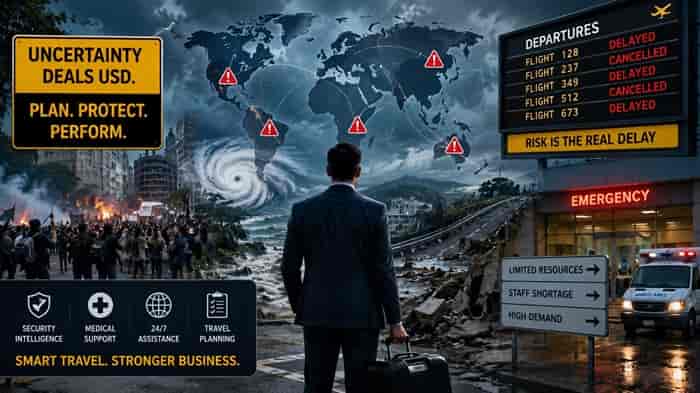
Business travel has changed, quietly, but decisively. The international workforce is moving again, yet the environment they’re moving through is more volatile, less predictable and often less forgiving than it was a decade ago. Companies are deploying employees and contractors into regions where civil unrest can ignite overnight, natural disasters strike without warning, and healthcare infrastructure is uneven at best. Those threats don’t just endanger individuals. They disrupt operations, delay projects, fracture teams and erode productivity in ways leaders frequently underestimate.
In Global Rescue’s Winter 2026 Traveller Sentiment and Safety Survey, travellers themselves signal the shift: 38% describe international travel danger in 2026 as unpredictable, and 36% say it is more dangerous than pre-2020 travel. Only 1% believe it will be less dangerous. When asked about personal security risks like kidnapping, extortion and violent crime, 82% express at least some level of concern. That is the voice of a workforce that knows the ground truth: uncertainty is now a constant variable in global mobility.
The problem is that corporate systems often lag behind field reality. Many organisations still approach travel risk as an HR checkbox or a policy document, something you acknowledge and file away. But for an international workforce, risk is operational. It shows up in missed meetings, rerouted flights, sudden shelter-in-place orders, roadblocks between an airport and a job site and employees making split-second decisions in unfamiliar environments without reliable local intelligence.
And when something goes wrong, an injury, an illness, a robbery, a political flashpoint, productivity doesn’t simply “pause.” It collapses into a cascade: medical diversion, emergency replacement staffing, project delays, contract penalties, reputational fallout and real human consequences that ripple through teams long after the incident is over.
The new business travel reality: three threats that break productivity
Civil unrest and security volatility: Executives tend to picture civil unrest as something visible, such as smoke, crowds, and headlines. On the ground, it’s usually subtler and faster: a protest that shuts down a main artery, a labour strike that freezes transport, an election-related flare-up that triggers curfews, or a localised security incident that spreads through rumour before official confirmation.
Business travellers are especially vulnerable because their routines are predictable. They go from the airport to the hotel to the office or site, often at the same time, using the same routes. Predictability is convenient for scheduling, and convenient for criminals. Add unfamiliar terrain, language barriers and the tendency to look distracted or device-focused, and you’ve created a soft target.
When security volatility spikes, productivity doesn’t just take a hit; it becomes impossible to plan. Meetings convert to last-minute virtual calls. Site visits get cancelled. Teams burn hours trying to interpret fragmented information. The most damaging effect is indecision: leaders back home lack sufficient reliable data to make timely decisions, while employees in-country feel forced to improvise.
Natural disasters and secondary emergencies: Natural disasters are rarely single events. Earthquakes, hurricanes, floods, wildfires and severe storms often trigger cascading failures: power outages, fuel shortages, damaged roads and bridges, disrupted communications, contaminated water, overwhelmed hospitals, broken supply chains and strained local security forces. An earthquake doesn’t end when the shaking stops; aftershocks, structural instability, and transportation shutdowns can lock down a city as effectively as any curfew. A storm doesn’t just flood a city; it can strand personnel, shut airports and create a safety vacuum where opportunistic crime increases.
For companies, the productivity impact is immediate and measurable: missed deadlines, interrupted operations, broken logistics, and costly rescheduling. But the human impact is decisive. Employees who feel abandoned or unsupported won’t perform at full capacity, and they’re far less likely to accept future deployments, especially to high-risk regions where a natural disaster can instantly become a personal safety crisis.
Poor healthcare infrastructure and medical downtime: Most productivity losses in international travel aren’t caused by dramatic security events. They’re caused by medical issues, illness, injury, infection, dehydration, gastrointestinal distress, respiratory complications and untreated chronic conditions flaring under stress and time zones.
In strong healthcare environments, those are inconveniences. In weaker environments, they become trip-ending events. The question isn’t simply, “Can we find a clinic?” It’s, “Can we trust the care once we get there, starting with the diagnosis?” Is the facility capable of handling complications? Are medications legitimate? Is there reliable imaging? What happens if the situation escalates?
Medical uncertainty is a productivity killer. Employees lose days navigating systems, waiting for care or recovering without adequate support. Managers lose time coordinating help from afar. Teams lose momentum. Projects lose continuity.
What high-performing organisations do differently
Companies with resilient international operations treat traveller safety as an operational capability, not a policy. They build systems that reduce risk and protect productivity.
They research destinations with business-relevant granularity. Not “Is the country risky?” but “What’s the security picture in the specific districts our people will be in?” They monitor civil unrest triggers, crime patterns, transportation reliability and local medical capacity near worksites.
They plan movement like logistics, not improvisation. Airport transfers, vetted transport, route discipline and contingency planning are not “extras.” They are what keep an employee on schedule and out of trouble.
They define decision thresholds before travel begins. What conditions trigger a delay? A relocation? A shelter-in-place? An extraction? Pre-set thresholds prevent paralysis when situations evolve quickly.
They support health as a business continuity issue. Pre-travel medical preparation, access to telemedicine or medical advisory and a clear plan for escalation protect both the individual and the project timeline.
They train travellers to reduce exposure without reducing effectiveness. Simple behaviours, situational awareness, secure device habits, reducing predictability, and knowing what to do at checkpoints or during demonstrations prevent incidents that derail work.
The bottom line
Global mobility is back, but the environment has changed. Civil unrest, unpredictable natural disasters and weak healthcare infrastructure don’t just threaten the safety of your international workforce; they threaten your ability to execute. The organisations that succeed in 2026 and beyond will be the ones that acknowledge a hard truth: you can’t separate traveller safety from operational performance.
The workforce can’t “power through” risk. But with the right intelligence, planning and support, they can travel smarter, stay safer, and keep work moving when the world doesn’t cooperate.
By: BFernando Lopez Medina – © 2026.
Read Time: 8 minutes.
Author Bio:
Fernando Lopez Medina is a former U.S. Army Special Forces Green Beret and security operations supervisor at Global Rescue, the world’s leading provider of medical, security, evacuation and travel risk management services.











