

For more than 25 years, the travel industry has been fighting the same battle.
Airlines have spent millions encouraging travellers to book direct.
Hotels have invested heavily in loyalty programs designed to lure guests away from online travel agencies.
Destination marketing organisations have poured resources into websites, search engines and digital campaigns, all with one objective in mind: get travellers onto their platforms and keep them there.
Now, according to some of the travel sector’s most influential technology leaders, that entire model could be heading for its biggest shake-up since the arrival of online booking.
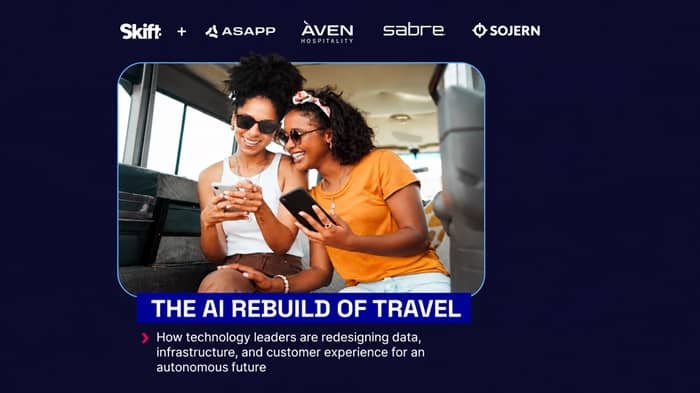
The warning comes from a new Skift report, The AI Rebuild of Travel, which reveals an industry quietly preparing for a future where artificial intelligence may become the primary gateway between travellers and travel brands.
In simple terms, tomorrow’s holidaymaker may never visit your website.
Their AI assistant might do it instead.
And that possibility is sending executives from airlines, hotels, destinations and travel technology companies back to the drawing board.
The implications are enormous.
For decades, success in travel marketing was measured by website traffic, search rankings and conversion funnels.
In the AI era, visibility inside intelligent systems may become just as important as visibility on Google.
That reality is already influencing strategic decisions at some of the world’s largest tourism organisations.
Royce Chwin, CEO of Destination Vancouver, believes destinations can no longer assume travellers will discover them through traditional channels.
“Destinations need to be visible and understood inside AI systems,” Chwin said.
It’s a subtle statement carrying enormous consequences.
If AI assistants increasingly influence where people travel, destinations are no longer competing solely for consumer attention. They’re competing for algorithmic recognition.
The tourism brochure of tomorrow may not be a glossy publication or even a website.
It may be a structured database designed for machines.
That shift is already affecting destination marketing organisations worldwide, as organic website traffic faces increasing pressure from evolving search behaviour and AI-powered discovery tools.
Yet despite the excitement surrounding artificial intelligence, industry leaders repeatedly return to one word.
Trust.
The report reveals that trust, rather than technology, may become the defining competitive advantage of the next decade.
Nirmal Mukhi, Chief Architect at ASAPP, argues that many organisations are misunderstanding the challenge entirely.
“The framing of this question assumes modernisation is mainly a technical problem, but it’s actually a confidence problem,” Mukhi said.
His observation strikes at the heart of the industry’s AI dilemma.
Travellers may be willing to let artificial intelligence suggest restaurants, build itineraries and compare hotel rates.
Allowing an AI agent to manage a family holiday worth thousands of dollars is an entirely different proposition.
The industry understands that confidence will be earned gradually, not demanded overnight.
That is why many companies are adopting hybrid models in which AI handles routine interactions while humans retain authority over sensitive decisions involving relationships, reputation, and customer goodwill.
Meanwhile, the airlines are confronting another reality.
Most aviation technology was never designed for an AI-driven world.
American Airlines Vice President of Digital Customer Experience Sam Liyanage says the industry’s future depends less on collecting more information and more on making existing data usable, connected and available in real time.
That sounds straightforward.
It isn’t.
Airlines operate some of the most complex technology environments on the planet, where safety, reliability and operational continuity remain non-negotiable.
The solution, according to Liyanage, is modernisation through layers rather than wholesale replacement.
It’s the digital equivalent of renovating a flying aircraft.
Hotels face similar challenges.
Mark Hollyhead, Chief Transformation Officer at Aven Hospitality, delivered perhaps the report’s most brutally honest assessment.
“AI doesn’t fix bad data structures. It exposes them.”
For many hospitality businesses, that observation hits close to home.
Years of disconnected systems, inconsistent data definitions and fragmented technology environments have created complexity that artificial intelligence cannot magically solve.
In fact, AI often highlights weaknesses that previously remained hidden.
The lesson is simple.
Before companies can embrace intelligent automation, they need to ensure the fundamentals are sound.
That means clean data, clear governance and systems capable of communicating with one another.
Sabre President of Product and Engineering Garry Wiseman believes the future belongs to organisations embracing openness rather than control.
“We’re building for a world of external assistants and partner systems, not creating walled gardens,” Wiseman said.
It represents a dramatic shift in industry thinking.
For years, many travel companies focused on keeping customers inside their own digital ecosystems.
Now, the emphasis is moving towards interoperability, open APIs and connected platforms capable of serving travellers wherever they choose to engage.
The biggest surprise from the report may be what artificial intelligence won’t change.
Travel remains fundamentally human.
People still dream about distant destinations.
Families still save for once-in-a-lifetime holidays.
Business travellers still need confidence when schedules unravel.
No algorithm can replace those emotions.
What AI can do is remove friction.
It can simplify planning, improve personalisation and help companies respond faster when things go wrong.
The winners won’t necessarily be those with the most advanced technology.
According to the report, they will be the organisations combining trusted data, operational discipline and meaningful customer relationships.
In other words, the same qualities that have always defined successful travel brands.
The tools are changing.
The principles are not.
And as artificial intelligence takes its place at the centre of the travel ecosystem, the industry faces a challenge unlike any it has encountered before.
Not because machines are taking over travel.
But because they are rapidly becoming the new gatekeepers, deciding which travel experiences travellers see first.
That may have turned out to be the most significant disruption to tourism since the internet itself.
By: May Marclay – © 2026.
Read Time: 8 Minutes.
About the Author.
 May Marclay’s career hasn’t followed a straight line, and she’s better for it. She began in real estate, then moved into hospitality, finding her rhythm with Centara in the Maldives. There, she worked the Asian markets the old-fashioned way: building trust, closing deals, and turning conversations into lasting business.
The UAE sharpened its focus. At IHG, supporting an Area General Manager, she saw the machinery of a major travel hub from the inside, no gloss, just how things actually get done.
Now, with her sights set on healthcare, May brings a broader lens than most. She speaks three languages, reads widely, travels with intent, and writes with the calm assurance of someone who understands both the detail and the bigger picture without needing to say so too loudly.











