


Every so often, an airline announcement arrives that tells a much bigger story than the routes being launched.
This is one of those moments.
On the surface, Vietjet’s latest announcement is straightforward enough. A handful of new international routes. A maintenance investment in Thailand. A mountain of promotional fares designed to grab attention.
But look a little deeper and something far more interesting emerges.
Vietnam is rapidly transforming itself from a popular holiday destination into one of Asia’s most important aviation hubs, and Vietjet appears determined to sit firmly in the pilot’s seat.
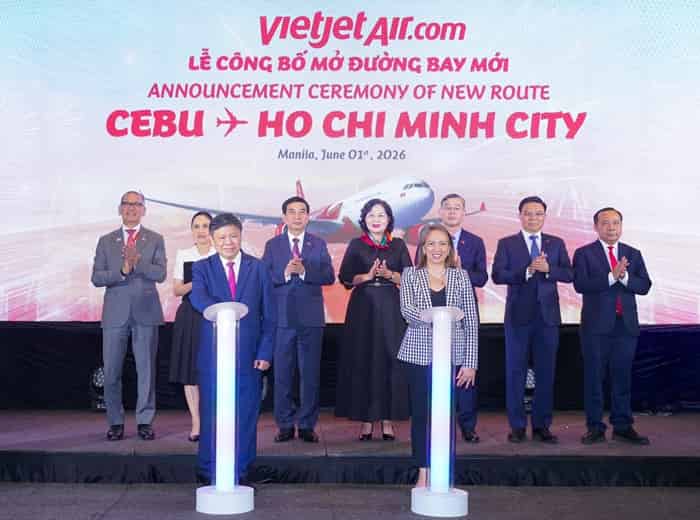
Vietjet announces its new Ho Chi Minh City–Cebu route at the Vietnam–Philippines Business Forum in Manila
For Australian travel advisors, that’s a trend worth watching.
For Australian travellers, it may be even more important.
Because while much of the aviation world’s attention remains focused on traditional heavyweights such as Singapore, Bangkok, Hong Kong and Dubai, Vietnam is quietly building something that only a decade ago would have seemed remarkably ambitious.
Connectivity.
And lots of it.
Vietjet’s latest expansion demonstrates exactly how quickly that transformation is unfolding.
The airline has announced a new direct service linking Ho Chi Minh City to Cebu, Philippines, starting 11 December 2026.
At first glance, some readers might ask why Cebu matters.
Travel advisors already know the answer.
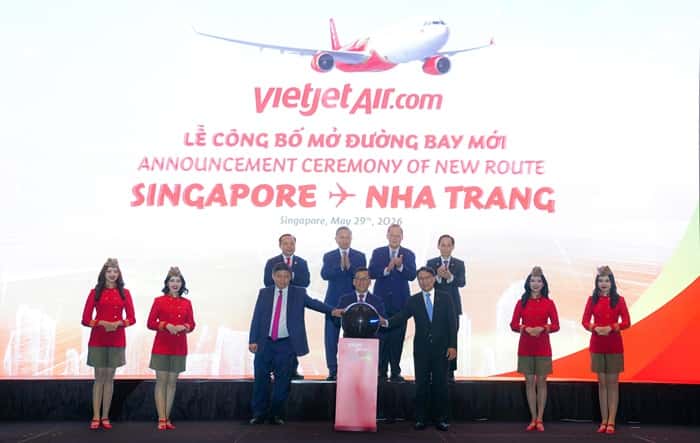
Vietjet announces its new Nha Trang–Singapore route in the presence of Vietnam’s General Secretary and President To Lam
Cebu is one of the Philippines’ most important tourism and commercial centres, serving as a gateway to some of the country’s most sought-after island destinations. For Australians looking beyond the usual holiday trail, the new route creates another convenient pathway through Vietnam and deeper into Southeast Asia.
That’s becoming a recurring theme for Vietjet.
The airline is no longer simply flying passengers into Vietnam.
Increasingly, it is positioning Vietnam as the place where passengers connect onwards.
The same thinking applies to the carrier’s newly announced Nha Trang-Singapore service.
Nha Trang has spent years quietly building a reputation as one of Asia’s great-value beach destinations. While other resort markets have steadily marched up the pricing ladder, Nha Trang has continued attracting travellers seeking sunshine, beachfront accommodation and a healthy dose of value.
The addition of direct Singapore connectivity only strengthens that appeal.
For travellers looking to discover more about Vietnam’s rapidly expanding tourism offerings, destination information is available on the official tourism website, Vietnam Travel.
Yet, it is the airline’s European ambitions that perhaps reveal the boldest part of the strategy.
Vietjet has announced a new Hanoi-Prague service operating via Almaty, Kazakhstan.
Now there’s a route that would have raised a few eyebrows around airline boardrooms not all that long ago.
But aviation is changing.
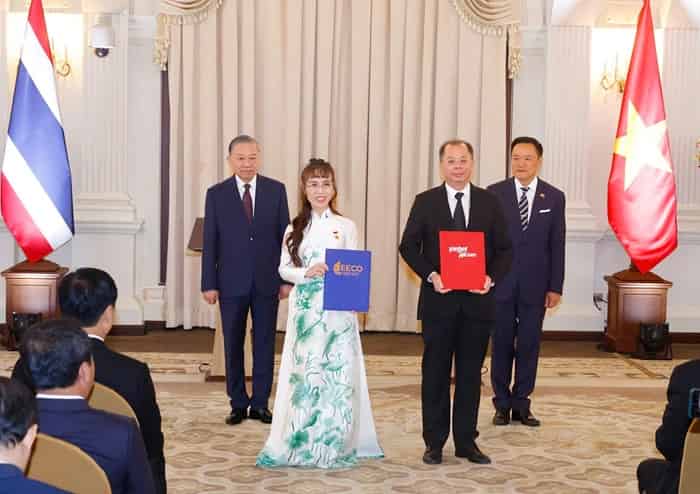
Vietjet and Thailand’s Eastern Economic Corridor Office (EECO) sign an agreement to cooperate on developing an MRO center at U-Tapao International Airport
The days when growth could only be found by connecting major global hubs are fading. Airlines increasingly see opportunity in linking emerging markets, secondary cities and fast-growing tourism economies.
Prague fits neatly into that story.
One of Europe’s most beautiful capitals, the Czech city continues attracting strong tourism demand while offering Australians an alternative gateway into Central Europe.
Travellers interested in exploring the destination can find further information through Visit Czechia.
The Prague route is significant for another reason.
It demonstrates confidence.
Airlines do not launch new long-haul services in the hope that passengers might appear.
They launch them because the data tells them demand already exists.
That confidence extends beyond routes.
Away from the spotlight generated by new destinations and promotional fares sits what may have turned out to be the most strategically important announcement of all.
Vietjet has signed an agreement with Thailand’s Eastern Economic Corridor Office to develop a new Maintenance, Repair and Overhaul facility at U-Tapao International Airport.
Now, maintenance centres rarely feature in glossy tourism brochures.
Nobody books a holiday because an airline built a hangar.
But aviation professionals understand their importance.
Airlines can announce all the shiny new routes they like, but eventually somebody has to maintain the aircraft.
Infrastructure is what separates ambition from execution.
Without it, growth becomes difficult.
With it, growth becomes sustainable.
That’s why this investment deserves attention.
It signals that Vietjet is planning for the next decade rather than the next quarter.
The airline is effectively laying foundations beneath the network expansion now appearing on travellers’ booking screens.
And speaking of booking screens, there is another reason this announcement is likely to generate considerable interest across the Australian market.
Price.
At a time when travellers remain conscious of value, Vietjet has launched one of its largest fare promotions to date.
The airline is offering 12 million promotional seats across its network, including Eco-class fares between Australia and Vietnam from AUD$199, including taxes and fees.
The sale runs until 2 am AEST on 8 June 2026 using promotional code SALE66.
Travellers booking Hanoi-Almaty and Hanoi-Prague services can also access a 15 per cent discount on Deluxe fares using promotional code HELLOVIETNAM.
Additional offers are available across Deluxe, SkyBoss and Business fare categories.
Current fares, route schedules, and booking conditions can be viewed on Vietjet Air’s Official Website and in the airline’s mobile application.
For travel advisors, the timing could hardly be better.
Demand for Asia remains strong. Vietnam continues punching well above its weight as a tourism success story. Travellers are actively searching for value. And increasingly, they are willing to explore destinations beyond the traditional favourites.
All of which creates opportunity.
The real story here is not simply a new route to Cebu.
Or another service to Singapore.
Or even a connection to Prague.
The bigger story is that Vietnam is steadily becoming one of the most important aviation gateways in Asia.
Five years ago, some of these announcements might have seemed ambitious.
Today, they feel inevitable.
And that may be the clearest sign yet of just how far Vietnam’s aviation sector has come.
For travellers seeking new adventures and advisors seeking new opportunities, that’s a journey worth paying attention to.
By: My Thanh Pham – © 2026.
Read Time: 5 Minutes.
About the Author.
 My Thanh Pham has led a life of travel more than most people ever do. After studying tourism, she went straight into the work of building journeys across South-East Asia, temples, beaches, night trains, and all, quietly fixing the messy bits, so others could enjoy the ride.
She was never meant to stay behind a desk. Airline life followed, dividing her days between reservations and the airport floor, right where travel shows its true colours. Missed flights, tight hugs, frayed tempers, sudden joy, she saw it all, close up.
Now at Global Travel Media, My Thanh has traded ticket stubs for a keyboard. She writes the way she once worked: steady, clear-eyed and respectful of the road’s unpredictable rhythm, guiding readers through a world she knows from the inside.











