

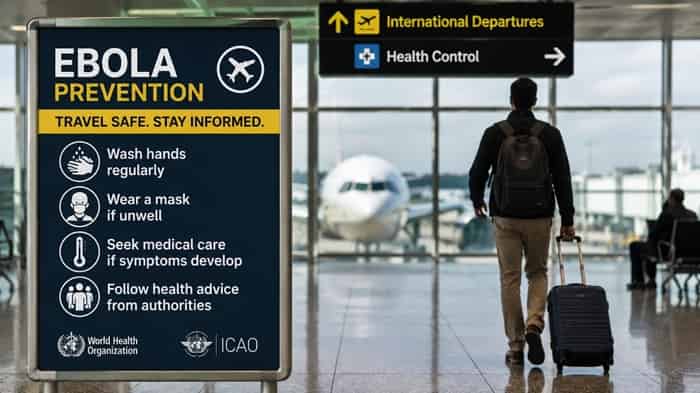
There’s a certain sense of déjà vu in aviation circles this week, though thankfully without the full-blown panic that once emptied terminals and grounded fleets.
A fresh Ebola outbreak in Central Africa has prompted renewed warnings from the World Health Organisation and the International Civil Aviation Organisation, but the tone is markedly different from those early, uncertain days of COVID. This time, the message is less about shutting the world down and more about quietly doing the job properly.
In the Democratic Republic of the Congo, the Bundibugyo strain is causing real concern. More than 900 suspected cases and around 220 deaths have been reported, figures that would rattle any health authority. Across the border in Uganda, a handful of confirmed cases has been enough to put the region, and by extension the aviation sector, on alert.
But here’s the difference: the system is no longer guessing.
No Appetite for Panic
The WHO has classified the outbreak as a public health emergency of international concern, noting that it is spreading faster than containment efforts can keep pace with. That’s the clinical view.
The aviation response, however, is far more pragmatic.
There is no call for border closures. No rush to cancel flights. No dramatic announcements about sealing off continents. Instead, ICAO is urging governments and airlines to stick quite firmly to the protocols developed during COVID.
It’s a subtle shift, but an important one. The industry has learned, sometimes painfully, that overreaction can be as damaging as inaction.
The COVID Playbook Lives On
What’s quietly working in aviation’s favour is the legacy of the pandemic. Systems that once felt intrusive, digital health declarations, contactless processing, and coordinated data sharing are now simply part of the furniture.
They’re not perfect, but they’re proven.
ICAO has been clear: international air services remain safe, provided these measures are followed. That means targeted interventions rather than sweeping restrictions. Exit screening in affected regions makes sense. Monitoring symptomatic passengers is sensible. Preventing confirmed cases from boarding commercial flights is non-negotiable.
Beyond that, the industry is being encouraged to keep moving.
Confidence Is the Real Cargo
If aviation runs on anything, it’s confidence. Lose that, and even the most sophisticated safety systems won’t fill a cabin.
That’s why the messaging matters. By reinforcing that travel remains safe and by resisting the urge to impose blanket restrictions, ICAO and WHO are effectively protecting more than just public health. They’re safeguarding the fragile recovery that airlines have spent the past few years rebuilding.
And let’s not pretend that recovery is complete. Many carriers are still balancing debt, rebuilding routes, and coaxing passengers back into long-haul travel with a mixture of competitive pricing and cautious optimism.
Another round of widespread disruption would be more than inconvenient; it would be costly.
A More Mature Industry Response
What’s perhaps most striking is how measured the response has been.
A decade ago, an Ebola outbreak might have triggered a far more fragmented reaction, with airlines making unilateral decisions, governments scrambling for policy, and passengers left to interpret the chaos.
Now, there’s coordination. ICAO, WHO, governments and airlines are speaking broadly the same language, following a framework that, while born of crisis, has matured into something far more useful: a standing playbook.
That doesn’t mean the risk is trivial. Ebola is a serious disease, and outbreaks demand vigilance. But the response is no longer driven by fear alone.
Steady Hands on the Controls
For travellers, the practical reality is straightforward. Flights will continue. Airports will operate. Safety measures largely invisible to the average passenger will be quietly reinforced behind the scenes.
And for the industry, the test is one of discipline rather than innovation. The tools already exist. The systems are in place. The question now is whether they are applied consistently.
If they are, this outbreak will likely remain what it is today: a serious regional health issue, rather than a global aviation crisis.
That, in itself, is progress.
by Maya Punchanit – (c) 2026.
Read Time: 3 minutes.
About the Author.
 Maysa Punchanit has never waited for life to become easy. She’s far too practical for that. Instead, she’s built her path the way many strong women do, step by step, job by job, learning something useful everywhere she’s been.
Her working life has taken her through hospitality, sales, beauty therapy and the fast-moving world of social media, where she partnered with some of Thailand’s best-known companies. Along the way, she discovered a steady voice for blogging, warm, direct and grounded in real experience rather than marketing spin.
Being a single mother sharpened her resolve rather than slowing her stride. If anything, it gave her purpose.
Now with Destination Thailand News and Global Travel Media, Maysa arrives not as a newcomer, but as someone quietly battle-tested, resilient, capable and ready for the next chapter.











