

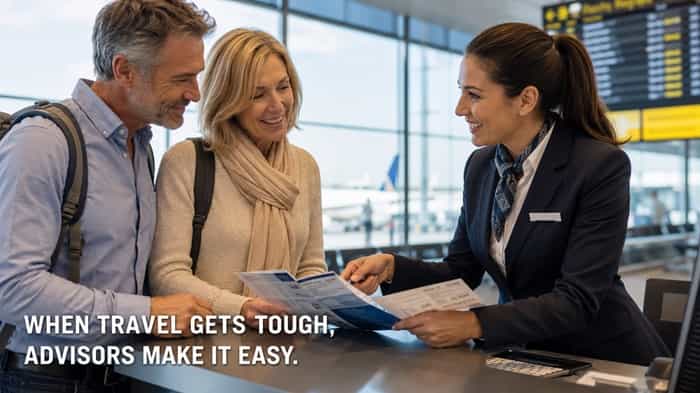
There was a time when booking travel meant sitting across a desk from someone who knew more about airline schedules than most pilots and could recite visa rules with the precision of a High Court barrister. Then along came the internet, comparison sites, flashy booking apps and enough “exclusive online deals” to make consumers believe travel advisors had gone the way of paper tickets and airport smoking lounges.
Funny thing, though. The more complicated the world becomes, the faster Australians return to the professionals.
And right now, with geopolitical instability rattling air corridors, travel scams multiplying like airport baggage fees, and flight disruptions turning once-simple itineraries into logistical Sudoku puzzles, the humble travel advisor is enjoying something of a renaissance, albeit one earned through long hours, calm heads and the occasional midnight rescue mission.
On Global Travel Advisors Day, the Australian Travel Industry Association (ATIA) is doing more than simply celebrating the sector. It is reminding Australians that accredited travel advisors are no longer viewed as an optional extra for nervous travellers or luxury holidaymakers. Increasingly, they are becoming the industry’s emergency services unit.
And frankly, judging by recent events, it is not hard to see why.
One recent example perfectly captures the point. A couple travelling through Queenstown found themselves stranded after their flight was delayed and eventually cancelled. The airline’s proposed alternative was about as useful as an umbrella in a cyclone. Eight exhausting hours into the ordeal, their accredited travel advisor intervened directly with airport staff, secured accommodation, arranged transport, and had the travellers safely checked into town before the terminal queues had even begun to untangle themselves.
No drama. No fuss. Just professional competence quietly doing what algorithms cannot.
That kind of behind-the-scenes rescue work rarely makes headlines, largely because when a good travel advisor is involved, disasters often get solved before clients even realise how bad things could have become.
ATIA says this invisible labour has become increasingly important as global instability continues disrupting travel patterns worldwide.
The recent turmoil across the Middle East has once again demonstrated how quickly international travel can unravel. Airspace closures, rerouted flights, cancelled sectors, and shifting government advisories have left many independent travellers trapped in endless airline phone queues or desperately refreshing apps that offer little more than automated apologies.
For travellers working with accredited advisors, however, the experience is markedly different.
Sarah Szubanski, Managing Director of Platinum Travel Group, says the real value of a travel advisor only becomes apparent when situations deteriorate rapidly.
“I’ve worked in corporate travel long enough to know that the real value of a travel advisor shows up in the hard moments,” she says.
“With everything that’s unfolded across the Middle East recently, we’ve seen exactly what that looks like: businesses scrambling to locate travellers, reroute itineraries, and navigate airspace that changed by the hour. We’re not just travel bookers. We’re problem-solvers, risk managers, and the first call when things go wrong.”
It is a sharp observation and one increasingly shared across the industry.
Nathaniel Musters, Australian Director and Commercial Lead at Traveltrust, believes travellers are rediscovering something many in the sector never forgot.
“Travel advisors matter because travel rarely goes perfectly to plan, and when it doesn’t, people need more than a booking engine. They need someone who knows what to do, who can cut through the noise, and who genuinely cares about getting them where they need to be.”
That “cut through the noise” line may well resonate with anyone who has recently tried dealing directly with an airline chatbot while stranded in transit somewhere between Doha and despair.
Yet operational disruptions are only one side of the equation.
The explosion in sophisticated online travel scams has added another layer of anxiety for Australian consumers. Fraudulent booking sites, fake confirmation emails, cloned accommodation listings and social media travel “specials” that vanish moments after payment are no longer fringe risks. They are becoming alarmingly mainstream.
And unlike a regulated accredited advisor, fake websites tend to disappear faster than complimentary peanuts in economy class.
That is where ATIA accreditation becomes particularly important. Consumers booking through accredited professionals are dealing with accountable businesses operating under recognised industry standards, not anonymous websites hiding behind glossy graphics and suspiciously cheap airfares.
For many travellers, especially older Australians and corporate clients, that reassurance now carries significant value.
But perhaps the greatest misconception about travel advisors is the belief that their role only matters when things go wrong.
In reality, seasoned advisors spend most of their time ensuring problems never happen in the first place.
The impossible transit connection gets avoided. The misleading “luxury” hotel with more construction scaffolding than ocean views gets ruled out. The insurance policy loophole gets identified before departure rather than after a medical emergency.
That preventative expertise remains the industry’s real secret weapon.
Mario Paez of Planetdwellers says clients increasingly value the emotional reassurance that accompanies professional guidance.
“We make your travel dreams look easy. We’re in your corner from your first boarding pass until you’re safely home. Having an ATIA-accredited travel expert means you have a partner who truly cares, turning what if into what’s next for a seamless journey.”
There is also the accumulated wisdom that only years in the trenches can provide.
Peta Godfrey, Director of Travel Focus Group, believes too many travellers underestimate how much professional expertise shapes a successful trip.
“Travel advisors matter for the same reason you use any professional: you get a better result. Knowing how it all fits together, where small changes can save money and making sure the trip matches the client. That kind of knowledge isn’t built online. It’s built over time.”
And increasingly, that expertise extends well beyond traditional holiday bookings.
Sandy Chen, Managing Director of Suncatcher Holidays, says even travellers visiting friends and relatives are now seeking elevated experiences rather than merely functional trips.
“Visiting friends and relatives doesn’t have to mean compromising on quality,” she says.
“More of our clients are choosing premium cabins, private transfers, luxury serviced apartments and exclusive dining experiences, because reuniting with loved ones is a special occasion worth celebrating in style. That’s the sweet spot where emotion meets elegance, and where a travel advisor makes all the difference.”
There is perhaps something reassuringly old-fashioned about the entire concept.
In an era increasingly dominated by automation, faceless platforms and artificial intelligence, Australians appear to be rediscovering the value of trusted human expertise, particularly when thousands of dollars, complex itineraries and precious family holidays are involved.
Brian Conway, General Manager of Bonaventure Travel, believes trust remains the industry’s most valuable currency.
“Our clients aren’t buying a trip,” he says. “They’re placing their trust. After nearly twenty years in the industry, that’s still the part I take most seriously. Global Travel Advisor Day is a reminder that the trust is well placed.”
The numbers certainly support the argument.
More than 70 per cent of international air sales in Australia are still made through accredited agents, while over 90 per cent of corporate travel bookings continue flowing through professional advisors. In a supposedly “DIY digital age”, those figures speak volumes.
ATIA also notes that 92 per cent of its members are small businesses, while women make up 72 per cent of the industry workforce, making the sector one of Australia’s most locally embedded and economically diverse professional communities.
Today’s Global Travel Advisors Day recognises the work of roughly 28,000 accredited travel professionals supporting almost 17 million Australian travellers every year.
Not bad for an industry some once predicted would disappear entirely.
Australians seeking an accredited travel professional can visit Travel Tick.
by Jason Smith – (c) 2026.
Read Time: 5 minutes.
About the Author.
 Jason Smith didn’t learn travel from textbooks. He learned it in airports, taxis and hotel lobbies, watching the business unfold long before he played his own part. Half American, half Asian, he grew up around the quiet workings of tourism, where people come and go, and stories rarely stand still.
Bangkok came first, then formal study, then a career that carried him through Singapore, Malaysia and Vietnam. Each place left something behind. In the end, Thailand felt like home, and I landed a senior role in hotel sales.
Then everything stopped. Borders shut, planes grounded, and Jason found himself back in America with time to reflect.
Now at Global Travel Media, he writes travel as it really is, not polished, not perfect, but human, and all the better for it.











