

The modern traveller will happily fork out for a rooftop cocktail in Barcelona, a luxury ryokan in Kyoto or an extra luggage fee that appears to have been dreamt up during a boardroom lunch. But paperwork? Ah, yes, that’s where the turbulence begins.
A new survey from Global Rescue reveals that most international travellers remain remarkably relaxed about the growing list of travel fees set to take effect in 2026. However, a looming European entry requirement known as ETIAS is quietly catching many travellers off guard, particularly men and American travellers.
And therein lies the problem. A €20 fee is one thing. Being denied boarding at the airport because you forgot to complete an online authorisation? That’s the sort of travel memory nobody frames on the mantelpiece.
The latest Global Rescue Winter 2026 Traveller Sentiment and Safety Survey found that nearly one-third of travellers (29 per cent) have no awareness of the European Union’s upcoming ETIAS requirement. Another 17 per cent admit they are only slightly aware.
That leaves a rather uncomfortable number of people wandering toward Europe blissfully unaware that a new digital gatekeeper is waiting at the terminal.
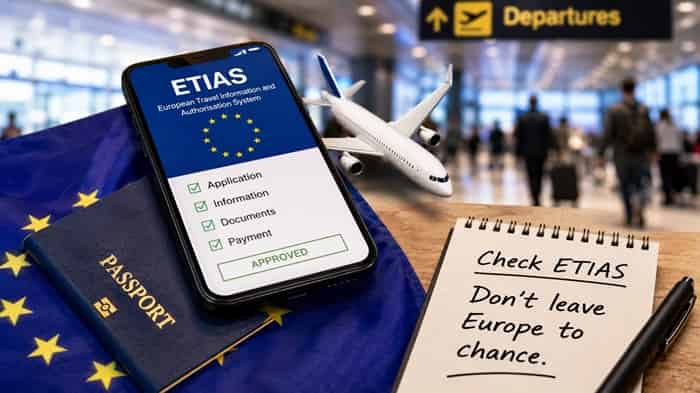
The European Travel Information and Authorisation System, better known as ETIAS, will require travellers from visa-exempt nations, including Australia, the United States, the United Kingdom and Canada, to complete an online application before entering the Schengen Area for short stays. The system is expected to roll out in late 2026.
In practical terms, it is hardly the bureaucratic apocalypse. The application is online, relatively inexpensive and designed to improve border security and traveller screening. Yet travel history repeatedly teaches one simple truth: even small administrative hurdles can create airport chaos when people fail to prepare.
Dan Richards, CEO of Global Rescue Companies and a member of the US Travel and Tourism Advisory Board at the US Department of Commerce, did not mince words.
“ETIAS is a meaningful change for visa-exempt travelers, and the lack of awareness, particularly among US travelers and men, is concerning,” Richards said.
“Failure to complete the process in advance could result in denied boarding or entry delays, which can disrupt trips before they even begin.”
That warning carries weight in an industry already drowning in digital forms, airline app notifications, biometric screening and enough password resets to make even seasoned travellers mutter under their breath at 3am.
Interestingly, women appear significantly more informed than men regarding the upcoming European requirement. According to the survey, 42 per cent of women said they were “very aware” of ETIAS compared with just 26 per cent of men.
Meanwhile, one-third of male respondents admitted they were not aware of ETIAS at all.
One suspects many partners across Australia are already preparing to become unofficial travel compliance officers before the family holiday to Rome.
Geography also influenced awareness levels. Travellers outside the United States displayed stronger familiarity with the requirement than their American counterparts, suggesting international markets may already be paying closer attention to changing European border policies.
Yet while ETIAS may be generating concern, the new tourism fees themselves appear to be causing barely a ripple.
Thailand’s proposed 300-baht entry fee, roughly AUD$13 depending on currency fluctuations and airport coffee inflation, appears unlikely to deter visitors in any meaningful way.
A commanding 92 per cent of travellers surveyed said the fee would not discourage them from visiting the Kingdom.
Frankly, after paying for airport sandwiches in 2026, most travellers probably view a $10 entry fee as little more than a rounding error.
The findings reinforce what the travel industry has known for decades: travellers may complain loudly about fees, taxes and surcharges, but they rarely cancel holidays because of them. Wanderlust, it seems, still beats wallet fatigue.
The same trend emerged regarding proposed overnight visitor fees in major tourism hotspots, including Barcelona, London and Kyoto, where charges could climb as high as US$65 per day.
Overall, 45 per cent of respondents said the fees would not prevent them from travelling or staying in those destinations, while another 36 per cent indicated the impact would depend on the exact amount charged.
Only 15 per cent said the fees would discourage travel.
That resilience says much about the psychology of modern travel. Consumers may tighten spending elsewhere, but international experiences in particular continue to hold extraordinary emotional value after years of pandemic disruption, inflationary pressures, and geopolitical uncertainty.
Richards believes the distinction between fees and preparation is crucial.
“Travelers are showing resilience and flexibility when it comes to reasonable fees, but administrative requirements like ETIAS are a different matter,” Richards said.
“Fees may be an inconvenience, but lack of preparation can stop a trip entirely. That’s where education and planning become critical.”
And there it is, the real lesson for the travel sector.
Travellers will tolerate taxes. They will endure queues. They will somehow survive paying $14 for bottled water at airports. But what they cannot afford is arriving at check-in unaware that Europe has quietly changed the rules of entry.
Because nothing ruins the romance of a European getaway faster than discovering your holiday ends before the aircraft door even closes.
For more information, visit Global Rescue.
by Michelle Warner – (c) 2026.
Read Time: 4 minutes.
About the Author.
 Michelle Warner has always carried stories the way others carry passports lightly, faithfully, and with purpose. She learned her craft in newsrooms, shaping sentences with care, before swapping deadlines for departures as a flight attendant with some of the world’s great airlines. Years aloft sharpened her eye for character and deepened her fondness for the small, dignified rituals of travel, the quiet kindness of strangers, the poetry of arrival, the patience learned between time zones.
Now grounded by choice, Michelle has come home to writing with the same calm authority she once brought to turbulent cabins. Her prose blends an editor’s discipline with a traveller’s wonder, tinged with humour and reverence for the golden age of travel. Each piece feels like a handwritten boarding pass gracious, observant, and unmistakably alive.
==================================











