

For years, corporate travel approval sat in the same dusty administrative drawer as photocopier maintenance agreements and forgotten procurement manuals, necessary, unloved, and rarely discussed outside finance departments with flickering fluorescent lights and dangerously stale biscuits.
Not anymore.
In 2026, as Australian business travel roars back with the enthusiasm of a delayed Qantas departure finally finding a runway slot, artificial intelligence is quietly reshaping one of enterprise finance’s most overlooked battlegrounds: pre-travel approval.
And unlike some of AI’s louder cousins, the chatbot poets, the slide-deck generators, and the meeting-summary magicians, this version is delivering something Australian CFOs adore almost as much as lower tax bills: measurable business outcomes.
According to SAP subsidiary SAP Concur, intelligent pre-travel authorisation is emerging as one of the most practical and commercially valuable AI applications currently gaining traction across Australian enterprises.
That may not sound glamorous. But in boardrooms increasingly obsessed with governance, cost visibility and compliance discipline, practicality has suddenly become very fashionable indeed.
Jonathan Beeby, managing director of SAP Concur Australia and New Zealand, says the numbers tell a compelling story.
“SAP Concur data shows that flight bookings in Australia increased almost 10% in 2025 compared to 2024. March 2025 achieved the highest velocity, with corporate bookings surging more than 44% compared to March 2024, reflecting a sharp rebound in corporate travel demand,” he said.
That rebound matters.
While corporate Australia is once again packing carry-on bags, booking airport lounges and rediscovering the subtle misery of 6am domestic departures, finance leaders are simultaneously tightening scrutiny of discretionary spending.
The post-pandemic era has produced a fascinating contradiction: businesses want people back on the road, rebuilding relationships, but they also want tighter financial control than ever before.
That tension is precisely where AI-powered travel approval is finding its moment.
Traditionally, travel and expense management operated like an archaeological dig. Employees travelled first, spent money second, and finance teams excavated the receipts later in search of policy breaches, questionable upgrades or mysteriously expensive “client dinners” involving seafood towers and premium Shiraz.
Reactive governance worked eventually but it rarely prevented overspending before it happened.
Now the emphasis is shifting upstream.
Beeby explained the transformation succinctly.
“Travel and expense management is no longer about post audits but preventative control,” he said.
“In traditional travel and expense programs, compliance was largely reactive: employees book trips, later file expenses, and finance teams audit them against policy afterwards. That approach can identify where policy was breached, but it offers little in the way of early prevention, and cost visibility and management.”
And therein lies the commercial appeal.
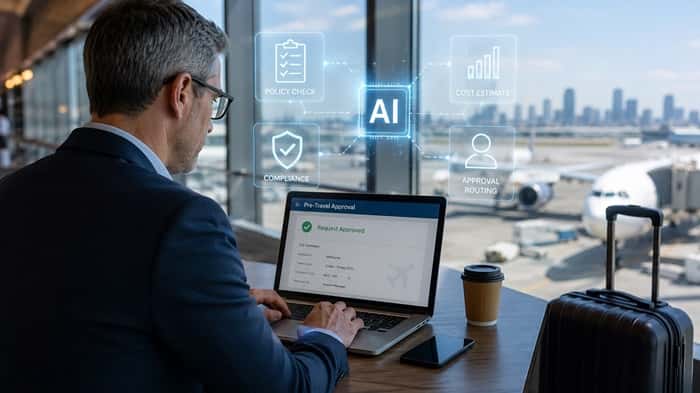
Modern AI-enabled pre-travel approval systems require employees to submit structured requests before bookings are confirmed. Those requests include business rationale, estimated costs, policy exceptions and approval pathways.
On paper, that sounds procedural.
In practice, it is becoming remarkably intelligent.
Today’s enterprise AI platforms can automatically estimate likely travel costs using historical patterns, identify out-of-policy selections in real time, and escalate approvals based on employee seniority, trip risk or expenditure thresholds.
In other words, the software is beginning to think like an experienced finance manager, only faster, less emotional, and without the need for a second coffee before 9am.
Beeby said the value lies in intelligent contextual decision-making rather than rigid bureaucracy.
“Intelligent automation interprets context and provides richer guidance at the point of request rather than relying solely on rigid, static business rules,” he said.
“This helps organisations scale governance controls without multiplying manual checks, giving finance teams early insight, and travellers clearer guidance toward compliant choices.”
That “guidance” element matters more than many organisations realise.
For years, employees viewed travel approvals as obstacles deliberately designed to destroy morale somewhere between the booking tool and the airport gate.
But AI-driven systems are changing that dynamic by reducing repetitive administrative tasks and speeding up approvals for routine, low-risk travel.
Frequent domestic routes, recurring client visits and standard accommodation requests can move quickly through automated workflows, while unusual or high-cost itineraries trigger additional scrutiny.
The result is less friction, fewer rejected claims and a noticeably smoother employee experience.
And in Australia’s fiercely competitive talent market, experience matters.
Nobody joins a modern enterprise expecting to battle archaic approval chains that feel as though they were designed during the dial-up internet era.
The deeper value, however, sits inside the data.
One of the long-standing frustrations in corporate travel management has been the poor quality of post-trip reporting. Expense reports often rely on vague explanations, inconsistent coding and fragmented documentation that becomes difficult to audit months later.
AI-driven pre-travel approval changes that equation entirely.
Instead of reconstructing intent after the fact, organisations capture purpose, estimated spend, approvals and policy exceptions before travel begins.
That creates what finance leaders increasingly describe as a “machine-readable audit trail” structured, defensible and highly transparent.
Beeby believes this is becoming increasingly critical as governance expectations rise.
“One of the most compelling benefits of AI-driven travel requests is the quality of data created,” he said.
“Rather than free-text explanations submitted after travel, structured requests capture why the business travel is necessary, anticipated costs, and which manager approved the itinerary and under what conditions.”
“This produces a defensible, machine-readable audit trail that shows approvals, edits, and exceptions over time; a powerful asset as Australian organisations face greater oversight from boards and internal audit functions.”
That oversight is only intensifying.
Across Australian enterprises, boards are demanding earlier visibility into expenditure commitments, while audit and risk committees are seeking stronger evidence that governance controls exist before money leaves the business, not months afterwards, when reconciliation begins to resemble forensic accounting.
For CFOs, perhaps the greatest attraction is predictive visibility.
Historically, travel expenses appeared as lagging indicators buried inside monthly reports long after commitments had already been made.
AI-powered authorisation changes travel from a retrospective accounting exercise into a leading indicator of future spend.
That may sound subtle, but financially it is transformative.
When finance teams can see authorised travel commitments before bookings hit the general ledger, forecasting becomes materially more accurate.
That is particularly valuable in Australia, where geography remains both a blessing and a budgetary nightmare.
Aviation pricing fluctuates sharply between regions. Accommodation costs spike unpredictably around events. Interstate travel remains expensive. And anyone attempting last-minute flights into mining regions or major conference destinations quickly discovers the meaning of “dynamic pricing”.
AI-driven forecasting gives organisations earlier warning signs around cost pressures and travel patterns before budgets spiral into uncomfortable conversations.
Importantly, this is not speculative innovation searching desperately for a business case.
This is operational AI delivering tangible commercial outcomes now.
Reduced risk. Better compliance. Faster approvals. Improved forecasting. Stronger governance.
No futuristic jargon required.
And perhaps that is the real lesson emerging from enterprise AI adoption in Australia.
The most valuable AI applications are not necessarily the flashiest ones, making headlines or dazzling conference stages with theatrical demonstrations.
Sometimes the smartest technology simply removes friction, improves decision-making and helps organisations spend money more intelligently.
Not every revolution arrives with fireworks.
Sometimes it quietly approves your flight to Melbourne before you even finish your morning coffee.
For more information, visit SAP Concur or explore enterprise travel management insights via SAP.












