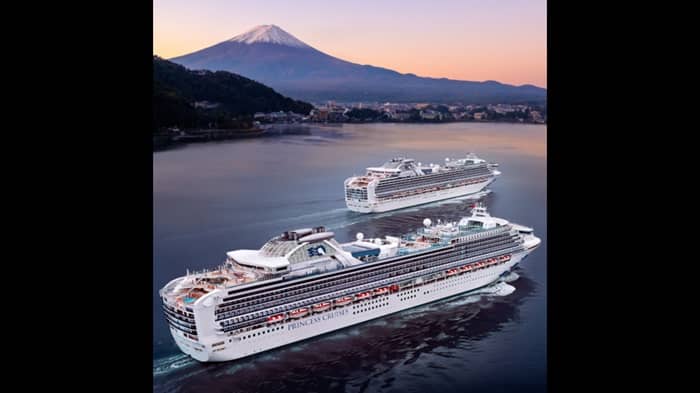
If ever there was a moment when a cruise line decided to stop dipping its toe in the water and instead dive in headfirst, this is it.
Princess Cruises has unveiled its most ambitious Asia program to date, and it reads less like a seasonal release and more like a declaration of intent. Japan is no longer just part of the portfolio. It is the centrepiece.
And not before time.
With demand from Australian travellers for culturally rich, “do it properly” experiences running hot, the line’s 2027–2028 deployments, spanning Southeast Asia and its largest-ever Japan season, leans into that appetite with admirable confidence.
The numbers, as ever, are impressive. Ninety-six departures. Sixty-one itineraries. Fifty-five destinations across nine countries. But numbers alone rarely tell the full story. It’s how they’re stitched together that matters.
Here, Princess has been rather clever.
Tokyo, Finally, Gets the Keys
For the first time, two ships, Diamond Princess and Sapphire Princess, will homeport in Tokyo for an entire season.
Now, that might sound like a logistical footnote, but in cruise terms it’s anything but. Tokyo isn’t merely a gateway; it’s an experience in its own right. Bringing embarkation closer to the city centre reduces friction, cuts transfer fatigue, and, crucially, gives travellers more time where it counts.
Jim Berra, the line’s Chief Commercial Officer, put it succinctly, noting the program reflects “how our guests want to experience the destination today.”
Translation? Less ticking boxes, more soaking it in.
Japan, After Dark, Where It Really Comes Alive
There’s a long-held truth in travel: if you leave before sunset, you’ve only seen half the place.
Princess seems to have taken that to heart. Late-night port stays, once treated like a bonus, are now baked into the itineraries. Aomori, Hakodate, Hiroshima, Kochi, Osaka and Tokushima all feature extended calls, giving guests front-row seats to Japan’s summer festival season.
And what a season it is.
The Aomori Nebuta Festival, all illuminated floats and pounding drums. Tokushima’s Awa Odori is a dance that feels as though the entire city has joined in. Even Osaka’s Bon Odori makes the cut, newly added and shared across both ships.
This isn’t passive sightseeing. It’s participation at least as much as one can manage without donning a yukata and joining the dance.
Following the Seasons, Not the Schedule
Too many itineraries chase efficiency. These chase beauty.
Princess’ Japan program tracks the country’s natural rhythms, cherry blossoms creeping northward in spring, autumn foliage cascading south in reverse. It’s a simple idea, but one that requires careful choreography.
The result is a series of voyages that feel almost narrative in structure. You’re not just moving between ports; you’re moving through seasons.
85 departures across 52 itineraries, from seven days to a rather indulgent 29, offer plenty of choice. The headline act is the Grand Circle Japan voyage, a nearly month-long exploration touching up to 24 ports.
That’s not a holiday. That’s a relationship.
Culture That Goes Beyond the Brochure
It’s easy to promise “immersion.” It’s harder to deliver it.
Here, Princess leans on its Local Connections program, an initiative built on longstanding ties with communities across Japan. The result is access to experiences that feel less staged and more, well, real.
Think tea ceremonies that aren’t performed for show, interactions with local artisans who don’t normally entertain tourists, and moments that resist tidy packaging.
Michael Mihajlov, Director of Destination Management, sums it up neatly: Japan’s appeal lies in its balance of ancient and modern, polished and raw, and that balance becomes clearer the further you move from the major cities.
In other words, the magic is often in the margins.
A Culinary Thread Running Through It All
One cannot, in good conscience, discuss Japan without mentioning the food.
From seafood markets in Shimizu to Aomori’s famously crisp apples, the shore experience is as much about taste as it is about sight. Sushi, ramen, tempura, wagyu, yes, they’re all here, but so too are the quieter pleasures: a tucked-away izakaya, a sake brewery visit, a meal that doesn’t try too hard.
Onboard, Chef Makoto Okuwa’s Edomae-style sushi at Makoto Ocean keeps the theme alive. It’s a neat touch bringing the destination onto the ship without turning it into a caricature.
Southeast Asia: The Supporting Act That Steals a Scene
While Japan carries the headline billing, Southeast Asia plays a supporting role of surprising depth.
Operating largely on Diamond Princess, these voyages are longer, slower, and dare one say it, more grown-up. Some stretch to 28 days, linking Japan, Korea and Southeast Asia in a single sweep.
It’s a format that rewards patience.
Highlights include overnight stays in Laem Chabang (for Bangkok) and late-night calls in Hong Kong and Osaka again, that welcome emphasis on time rather than haste.
The destinations read like a traveller’s wish list: the Giant Buddha on Lantau Island, Malaysia’s Batu Caves, Vietnam’s Cu Chi Tunnels. Yet it’s often the unscripted experiences, a tuk-tuk ride through Bangkok, a sampan drift along the Mekong that linger longest.
Why This Matters for Australian Travellers
For Australians, the appeal is obvious and growing.
Matthew Rutherford, Vice President Asia Pacific, points to strong and rising demand for immersive travel, particularly as interest in regional Japan gathers pace.
And here’s the thing: Japan offers the cultural depth of Europe, without quite the same logistical gymnastics. Add cruising into the mix, and suddenly the country’s more complex corners become accessible.
It removes barriers to language, transport, and planning, replacing them with something far simpler: curiosity.
Rutherford also makes a broader point. By opening up lesser-visited ports, cruising spreads economic benefits and encourages cultural exchange. In an era where overtourism dominates headlines, that’s no small achievement.
The Practicalities (And a Gentle Nudge to Book)
Naturally, the commercial side of the ledger hasn’t been forgotten.
The 2027–2028 program is on sale now, with early-booking incentives including up to AU$1,200 in savings per stateroom and complimentary location upgrades for bookings made before 31 May 2026. Captain’s Circle members receive an additional AU$300 saving.
More information can be found via the official Princess Cruises website: https://www.princess.com.
Or, as tradition would have it, by speaking to a trusted travel advisor, still, in many cases, the wisest route.
Final Boarding Call
There’s a sense, reading through this program, that Princess Cruises has stopped trying to be everything to everyone and instead focused on doing a few things exceptionally well.
Japan is one of them.
By anchoring two ships in Tokyo, aligning itineraries with festivals and seasons, and embracing the nuances of regional travel, the line has crafted something that feels considered rather than constructed.
And in a market increasingly wary of the generic, that’s a welcome shift.
If this is what the next chapter of Asian cruising looks like, it’s shaping up rather nicely indeed.