


The international award-winning exhibition, Bloodsuckers: Nature’s Vampires, has opened at the Australian Museum (AM) for a six-month run, exploring the remarkable creatures that have inspired centuries of mythology and impacted global populations, shaping modern medicine.
From leeches to lampreys, mosquitoes and mites, this science and pop culture exhibition was developed by the Royal Ontario Museum (ROM), Toronto, Canada, featuring interactive displays, larger-than-life installations, specimens, and historic medical artefacts that explain how tiny micro-predators have evolved to dominate the planet.
Director and CEO of the Australian Museum, Ms Kim McKay AO, said that for the first time, the exhibition also features a special section focusing on Australia’s homegrown bloodsuckers, incorporating the latest research from Australian Museum scientists.
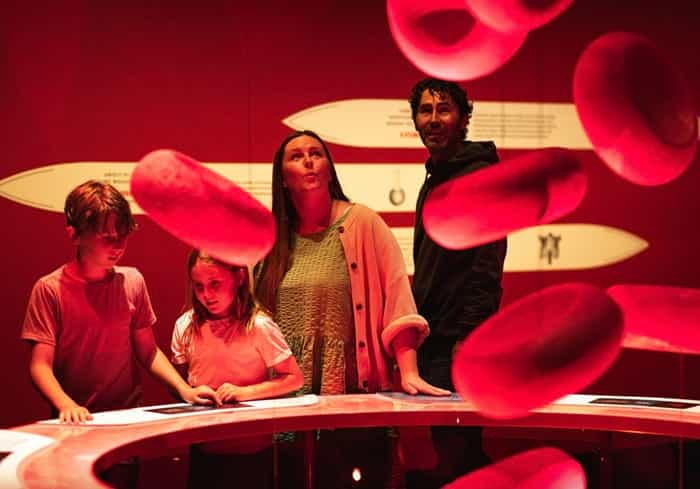
Bloodsuckers C. Photo credit Kattya Brook
“The Bloodsuckers exhibition gives visitors a rare opportunity to understand the remarkable biology behind what we too often dismiss as a nuisance. Whether a mite, tick or a leech, these ingenious creatures have developed highly specialised and sophisticated ways to live with hosts, access blood and survive. The essence of this extraordinary exhibition is the power of evolution in action.
“Australia is known across the globe for its beautiful environment, but also its biting insects. We have drawn upon the Australian Museum’s scientific research adding a new element to the exhibition that demonstrates how bloodsuckers have adapted to this unique habitat,” Kim McKay said.
Australian Museum Chief Scientist Professor Shane Ahyong said the Bloodsuckers exhibition explores both the biology of blood-feeding and the extraordinary adaptations that make it possible.
“Blood-feeding is one of nature’s most sophisticated evolutionary strategies. It has taken millions of years to acquire the skill, from developing specialised piercing mouthparts to saliva containing anticoagulants and anaesthetics. It gives you a whole new insight into that mosquito about to land on your arm,” Professor Ahyong said.
Senior Curator of Entomology at the Royal Ontario Museum, Doug Currie, said the exhibition reveals how diverse and wide-ranging blood-feeding is across time and geography.
“Bloodsuckers have elicited both fear and wonder in humans across history and cultures. By learning more about these creatures, visitors may come to appreciate that some things that seem unpleasant on the surface are also deeply important,” Mr Currie said.
Bloodsucker facts…
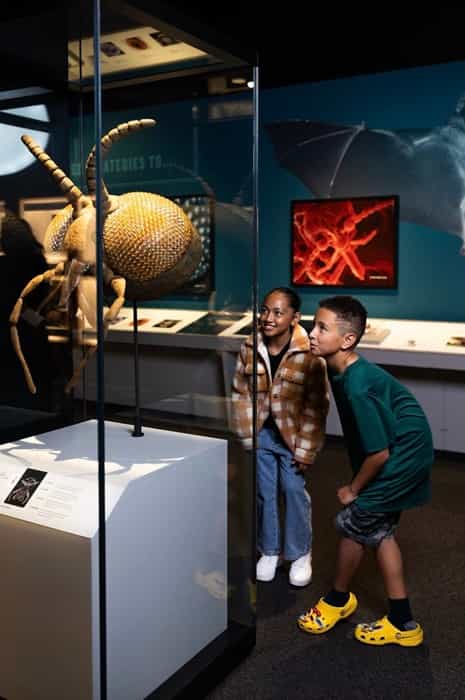
Bloodsuckers B. Photo credit Kattya Brook
- Vampire bats are the only mammals that survive entirely on blood
- Only female mosquitoes drink blood, using it to nourish their eggs inside their bodies
- Evidence shows that leeches were used as bloodletting instruments from around 400 BCE
A rich learning experience spanning not only the scientific but also the History and English curricula, the exhibition includes a section focusing on how bloodsuckers have impacted cultural history and pop culture, from mythology to modern storytelling, including the iconic Dracula. Free school holiday Bloodsucker-inspired activities will also take place throughout April.
Tickets are priced from $31 for adults and $20 for children aged 4-15; purchase via the Australian Museum website.
Bloodsuckers: Nature’s Vampires is proudly supported by hotel partner, Pullman Sydney Hyde Park. Pullman Sydney Hyde Park is offering family-of-four accommodation packages for Australian Museum visitors, including tickets to Bloodsuckers: Nature’s Vampires exhibition, buffet breakfast, overnight accommodation, and an activity pack for children. The hotel is only a three-minute walk from the Australian Museum. Bloodsuckers: Nature’s Vampires is also proudly supported by PetSure, connecting insurance, innovation and veterinary care to help improve access to pet healthcare in Australia.
Edited by Peter Needham – (c) 2026.
Read Time: 2 minutes.
About the Author.
 With more than 35 years in travel journalism, Peter Needham has filed stories from Fleet Street to Fiji, and just about everywhere in between. As Managing Editor (Australasia) for Global Travel Media, he shapes industry coverage with the steady hand of someone who’s seen fashions come and go and knows what lasts.
Since going freelance in 1993, his byline has appeared in the Sydney Morning Herald, Australian Financial Review, Reader’s Digest and Qantas’ inflight magazines. He edited Inside Tourism for seven years, wrote the long-running Travel Tales column for Vacations & Travel, and even crafted copy for Tourism Australia ahead of the Sydney 2000 Olympics.
A Reuters, Guardian and AAP veteran, Peter has travelled widely from South American backpacking trails to a Saudi military hospital, gathering stories the old-fashioned way: by being there.











