

There’s an old rule in aviation: just because the runway lights are on doesn’t mean it’s safe to land.
Iraq has reopened its airspace and all commercial airports after more than a month of enforced silence, and on cue, the headlines have declared the skies open again. Technically correct. Operationally, not so fast.
The Iraqi Civil Aviation Authority made the call with commendable clarity. Its head, Bangen Rekani, confirmed that “airspace and all Iraqi airports will be opened starting today.” After 40 days of closure, brought on by escalating tensions between the United States, Israel and Iran, it’s a significant step.
But in this business, reopening is the easy part. Trust is harder to come by.
The Shortcut the World Missed
For those outside the industry, Iraq doesn’t immediately scream “aviation powerhouse”. No flagship mega-hub, no parade of A380s taxiing past glass terminals.
Yet what Iraq offers is something far more valuable: geography.
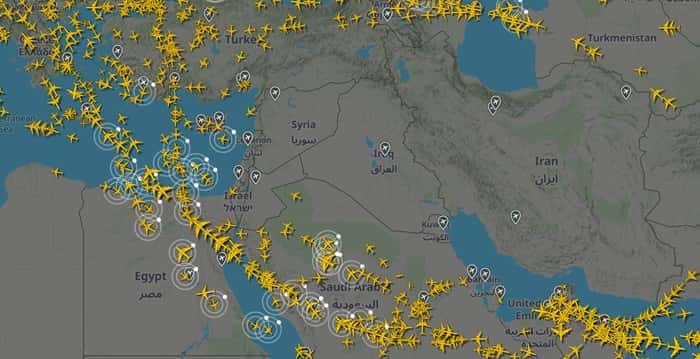
The Baghdad Flight Information Region sits like a well-placed hinge between Europe and Asia. Before February’s shutdown, thousands of flights slipped through this corridor each day, the quiet backbone of long-haul efficiency. Carriers like Qatar Airways, Emirates and Etihad Airways relied on it as routinely as a commuter relies on a morning train.
Take that away, and the system doesn’t collapse, but it limps.
Flights were pushed onto longer tracks, arcing around danger zones like drivers avoiding a washed-out bridge. More distance meant more fuel. More fuel meant more cost. And in an industry that counts pennies with forensic precision, those costs sting.
The Price of Going the Long Way Round
Airlines don’t complain loudly; it’s not the culture, but they feel it.
Rerouting added anything from half an hour to well over an hour to some sectors. Multiply that across fleets and schedules, and the impact becomes significant. Crews time out. Aircraft utilisation slips. Margins thin.
All of it is happening at a time when fuel prices are already behaving like they’ve had too much strong coffee.
Rekani is right to point out that reopening Iraqi airspace restores a valuable east–west corridor. It does. But corridors only matter if people are willing to use them.
And right now, willingness is in short supply.
Open in Theory, Tested in Practice
The official line says Baghdad, Erbil, Basra and Najaf are open for business. And they are on paper.
In reality, activity has been modest. A handful of flights, largely domestic or operated by Iraqi carriers, have begun to trickle through. The big international players are, for the moment, watching from the sidelines.
That caution isn’t paranoia. It’s memory.
Airlines have lived through enough sudden closures, last-minute advisories and worst-case scenarios to know that “open today” can become “closed tomorrow” with alarming speed.
The ceasefire underpinning this reopening is just a pause. Talks between Washington and Tehran are due to begin, but no one in aviation is betting the fleet on a diplomatic handshake.
A Region Still Holding Its Breath
Even with Iraq back in play, the broader picture remains patchy.
Airspace over Iran is still shut. Kuwait and Bahrain remain off the board. Elsewhere, openings have been selective rather than sweeping.
Layer in ongoing advisories from the European Union Aviation Safety Agency, and what you have is not a restored network, but a partially repaired one.
For flight planners, the unsung tacticians of aviation, this is a puzzle with missing pieces. Routes can be improved, certainly, but not yet optimised.
Passengers: A Little Patience Required
For travellers, the temptation is to assume this means shorter flights and cheaper fares are just around the corner.
Eventually, yes.
Immediately, no.
Airlines will ease back into Iraqi airspace carefully, adjusting schedules, reassessing risk, and ensuring insurers and regulators are comfortable with it. These things move at a measured pace, not at the speed of a press release.
If you’re booked to fly through the region, the advice is simple: check, then check again.
The View from Australia
From an Australian standpoint, the message remains refreshingly blunt.
The government’s Smartraveller continues to advise “Do not travel” to Iraq and a number of neighbouring countries, and crucially, that includes transit.
That last point catches people out.
Passing through an airport might feel harmless enough, but in volatile regions, airports are not immune to disruption. Nor are the air routes that feed them.
The official guidance makes it clear: airspace can close without notice, flights can be cancelled mid-journey, and travellers can find themselves somewhere they never intended to be and unable to leave.
It’s not alarmist. It’s practical.
Aviation’s Familiar Balancing Act
There’s a certain rhythm to aviation in times like these.
Routes close. Airlines adapt. Costs rise. Then, slowly, cautiously, things begin to reopen.
But reopening isn’t the end of the story; it’s the beginning of a new phase, where confidence rebuilds one decision at a time.
What Iraq has done is restore an option. It has not yet restored certainty.
The Final Approach
So yes, the skies over Iraq are open again.
Aircraft will return. Routes will shorten. The economy will improve.
But don’t expect a rush.
Airlines are in the business of getting people safely from A to B, not quickly from A to regret. They will come back, but only when the risk looks manageable, not merely tolerable.
For now, the corridor is open.
The confidence to use it? Still taxiing.
by Jill Walsh – (c) 2026.
Read Time: 6 minutes.
About the Author.
 Jill Walsh has always kept a pen close and a suitcase closer. She started out on media releases, then learned the trade properly by escorting press trips around the world, discovering which stories travel well and which need a sharper edit.
Before long, she wasn’t just promoting destinations, she was representing them, translating civic ambition and local pride into words people actually wanted to read. These days, semi-retired and happily so, Jill has traded departure boards for deadlines, joining old friend and colleague Stephen at Global Travel Media on a casual basis.
Her patch is the business end of wanderlust: balance sheets, route maps, tender wins and the numbers that quietly decide where travellers go. She writes with dry humour, clean prose and an old-school respect for facts, a steady voice when the market starts shouting.











