

There’s always a moment of quiet at first when a trend stops being a novelty and becomes a habit. In travel, that moment has arrived for artificial intelligence.
New research from Phocuswright suggests the industry is no longer flirting with AI; it’s living with it. More than half of U.S. leisure travellers, 56%, have now used AI to plan, book or manage a trip in the past 12 months. Not trialled. Not tested. Used.
That figure alone would raise eyebrows. The speed of the climb should raise a few more. Adoption sat at 43% late last year and was barely half that in 2024. For an industry that traditionally moves at the pace of infrastructure and regulation, this is less a shift and more a lurch forward.
“AI has crossed the threshold from curiosity to utility,” said Pete Comeau. It’s a neat line and, for once, not marketing fluff. Travellers aren’t dabbling anymore; they’re delegating.
The new first stop: not Google, but conversation
For decades, the starting point of any trip was a search bar. Now, increasingly, it’s a prompt.
Generative tools such as ChatGPT and Gemini are now used by 33% of travellers for trip research. That’s a fivefold jump in just two years and within touching distance of traditional search engines, which still hold at 35%.
But before we declare the death of search, a reality check. Travellers, it seems, haven’t abandoned their instincts. Only 8% are willing to take AI at its word. The rest 51% still click through to the source material.
As Mike Coletta put it, “this violates the common narrative of a zero-click world.” Quite right. Travel has always been a high-stakes purchase. You might trust AI to suggest a wine bar; you’re less inclined to trust it blindly with your holiday.
Not just using AI, preferring it
What’s more telling is where travellers are choosing to engage. Standalone AI platforms, not embedded tools, not search add-ons, are leading the charge.
Some 64% of AI users have turned to these platforms, and 81% say they’re the most useful environment for planning. That’s not convenience; that’s preference.
It marks a subtle but important shift in behaviour. Travellers aren’t just consuming information, they’re interacting with it. Asking follow-up questions. Refining ideas. Building itineraries in real time. In short, doing what a good travel agent used to do, only faster, and at 11 pm.
A generational divide? Not anymore
It would be easy to assume this is a young traveller’s game. For a time, it was.
Millennials still lead, with 74% adoption, closely followed by Gen Z at 72%. But the real story lies further up the age ladder. Gen X has reached 50%, and baby boomers, once the industry’s most cautious adopters, have more than doubled their usage in six months, from 13% to 27%.
That’s not experimentation. That’s acceptance.
From planning tool to travel companion
Perhaps the most interesting development occurs after the booking is made.
AI is no longer confined to the planning phase. It’s travelling with the traveller.
More than half 51% used AI for real-time, in-destination support. Finding a restaurant, navigating a new suburb, adjusting plans on the fly. And 95% rated it helpful.
That last figure is the quiet headline. Helpfulness is what turns a tool into a habit.
The industry’s balancing act
For airlines, hotels, and online travel agencies, this presents a delicate equation. AI reduces friction that’s undeniable. It simplifies decisions, accelerates research, and, in many cases, enhances the experience.
But it also shifts influence.
If a traveller begins their journey in a conversational interface rather than a branded website, the traditional pathways to purchase start to blur. Yet the continued reliance on source verification suggests that authority still matters. Perhaps more than ever.
It’s a reminder that while technology changes quickly, trust does not.
What comes next
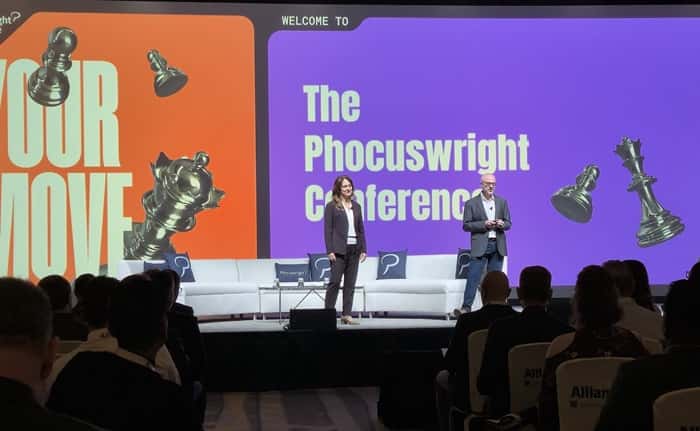
The timing of the report is no accident. With Phocuswright Europe approaching, the industry will gather, as it often does, to debate what it already suspects: that AI is no longer a side conversation.
“This is the fastest behavioural shift we have measured in well over a decade,” Comeau noted. And in travel, a decade is a long time between revolutions.
There’s a certain symmetry in all this. Travel, at its heart, has always been about discovery. The difference now is that the journey begins not with a map or a guidebook, but with a question and an answer that arrives in seconds.
Whether that answer is always right is another matter entirely. But travellers, as ever, seem happy to find out.
by Susan Ng – (c) 2026.
Read Time: 4 minutes.
About the Writer.
 With the polish of an international hotel professional and the instincts of a born storyteller, Susan Ng learned hospitality where it truly lives behind reception desks, in banquet halls, beside linen carts. She understands that excellence isn’t announced; it’s felt, in the small, quiet gestures that linger long after checkout.
Away from the bustle, her curiosity found a new front desk: the blank page. Her blog, candid and gently wry, drew readers who recognised truth when they saw it. She wrote about grace and imperfection with the steady eye of someone who had lived both.
Today, at Global Travel Media, Susan brings that same warmth and insight to her stories. Expect writing that is polished, generous, and reassuring, like the perfect welcome after a long journey.











