

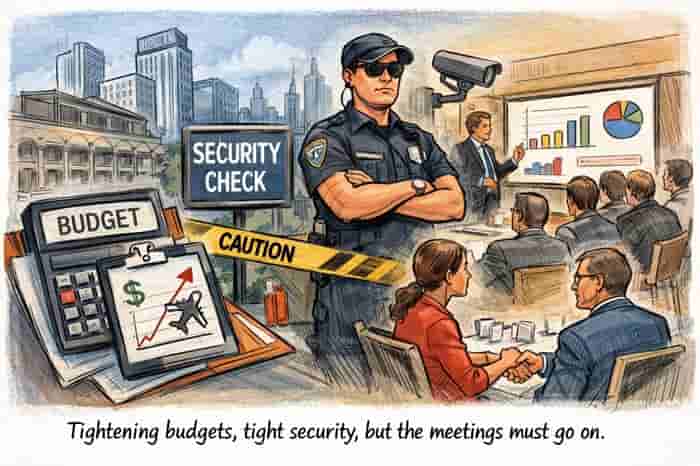
If the meetings industry has learned anything over the past few years, it’s that resilience isn’t just a buzzword; it’s practically the business model.
From pandemic shutdowns to economic jitters and shifting traveller expectations, the sector has been through its share of turbulence. Yet, somewhat stubbornly, perhaps even reassuringly, people still want to meet in person.
They just want to do it a little more carefully and a little more cheaply.
That, in essence, is the takeaway from the latest research released by MMGY Travel Intelligence, which has taken a fresh look at the evolving priorities of meeting planners and conference delegates across the United States.
Its newly published 2026 Portrait of Meeting Planners & Attendees™ U.S. Edition, produced in partnership with Grand America Hotels & Resorts, reveals an industry that remains firmly committed to face-to-face events but is now juggling tighter budgets, sharper scrutiny, and growing concern about safety.
The survey polled 300 meeting professionals and 1,000 conference attendees, and if the numbers tell us anything, it’s that planners are working harder than ever to balance cost, experience and security.
Or, to put it another way, the job description just got more complicated.
Budgets Are Suddenly the Headliner
For anyone organising a conference right now, the cost question is impossible to ignore.
Flights are more expensive, hotel rates remain elevated in many cities, and even modest gatherings can quickly turn into line-item marathons.
According to the MMGY research, 63 per cent of meeting planners say travel costs to host destinations will be a key concern over the next 12 months.
Delegates are feeling the pinch too. Forty-three per cent say the overall cost of attending an event is the biggest barrier to participation.
But interestingly, the study suggests the conversation is no longer purely about price.
Instead, value has quietly overtaken cost as the real decision-maker.
Planners increasingly want clear pricing, early budget forecasts and bundled packages that remove uncertainty from the planning process.
In other words, nobody likes financial surprises, particularly when you’re organising an event for several hundred people.
Safety Moves Up the Agenda
Running alongside budget pressures is another concern that has crept steadily up the planner’s checklist: safety.
For many destinations, this has become a defining factor.
The research found 72 per cent of planners consider crime levels when selecting where to hold a meeting, while 62 per cent of attendees say both crime and terrorism risks influence whether they attend an event at all.
That doesn’t mean conferences are suddenly becoming security operations.
But it does mean that visible safety measures and clear communication now play a larger role in building attendee confidence.
Simon Moriarty, Vice President of Syndicated Research at MMGY Travel Intelligence, says the pressure on planners has never been greater.
“Attendee experience has become the ultimate measure of success,” Moriarty said.
“Planners are navigating tighter budgets while remaining equally accountable for delivering meaningful impact. The ability to balance fiscal discipline with high-quality, memorable experiences will define the meetings industry in 2026.”
And that balancing act is not getting any easier.
Face-to-Face Is Still the Winner
For years, pundits predicted that virtual meetings might permanently replace traditional conferences.
Zoom fatigue, it seems, had other ideas.
The MMGY study confirms what most people in the industry already suspected: In-person meetings are very much alive and well.
-
90 per cent of planners say face-to-face interaction remains critical to the success of their events.
-
85 per cent expect to organise in-person meetings in the year ahead.
Delegates agree.
Eighty-three per cent have attended physical events before, and 61 per cent say they prefer them to hybrid or virtual alternatives.
Which is perhaps not surprising.
Networking tends to work best when the Wi-Fi isn’t doing all the talking.
Big Cities Continue to Win
When it comes to choosing destinations, familiarity still counts.
Major metropolitan centres remain the safest bet for conference organisers, largely thanks to their infrastructure, transport links and abundance of hotels.
According to the study, the most popular meeting destinations in the U.S. over the next two years are:
-
Miami (60%)
-
New York City (58%)
-
Las Vegas (57%)
These cities have long dominated the conference circuit, and their appeal shows little sign of fading.
Meanwhile, hotel and resort ballrooms continue to anchor the events ecosystem, with 84 per cent of planners having used them recently and 83 per cent planning to do so again.
However, there is also a growing appetite for venues with a bit more personality.
Historic buildings and culturally significant locations are attracting interest as planners seek to create memorable experiences without becoming logistically complicated.
After all, conferences these days are as much about storytelling as they are about PowerPoint.
Technology Is No Longer Optional
Finally, there is technology, the silent partner in every modern event.
While once considered a nice-to-have feature, the research suggests it is now firmly embedded in the expectations of both planners and delegates.
Among the most critical technological capabilities identified in the report were:
-
Cybersecurity protections (62%)
-
Accessibility technology (56%)
-
On-site production support (52%)
Put simply, conferences that fail to deliver seamless digital infrastructure risk looking outdated almost immediately.
And in a competitive meetings market, that’s a luxury few organisers can afford.
A More Demanding Industry
Taken together, the findings reveal an events sector that is evolving rather than retreating.
Planners are still committed to bringing people together in person. But they are doing so under tighter financial conditions and higher expectations from delegates.
Destinations and venues that can offer cost transparency, visible safety standards and reliable technology will likely have the upper hand.
Because in the meetings industry, the fundamentals haven’t changed.
People still want to meet, talk, argue, network and occasionally celebrate.
They just expect the experience to be a little smoother and the invoice slightly smaller.
Study Access
The full report, 2026 Portrait of Meeting Planners & Attendees™, U.S. Edition, is available through MMGY’s research platform: https://store.mmgyintel.com.
by Prae Lee – (c) 2026.
Read Time: 4 minutes.
About the Writer.
 You can tell a great deal about a person by how they meet a Bangkok morning. Prae Lee doesn’t charge into it; she glides, unhurried, as if time itself has agreed to behave. There is a calm assurance about her, the sort earned by knowing both your roots and your destination.
A graduate of Chulalongkorn University, she earned her business degree with quiet pride, then further polished it in Singapore and Australia. Travel didn’t change her. It refined what was already there: curiosity, discipline, grace.
Back in Bangkok, she slipped modern life into the family business, mastering social media with an instinct for listening and selling with Thai gentleness.
Prae never seeks attention, yet everything she touches grows brighter.
Now with Global Travel Media, she writes with authenticity, drawing on culture, travel and a rare, steady confidence.











