

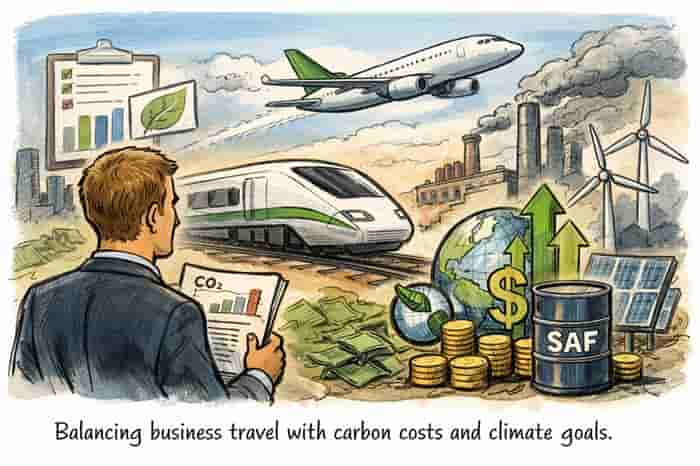
For years, sustainability in corporate travel was treated a bit like the office recycling bin. Everyone supported it in principle; nobody wanted to ignore it outright, but it rarely changed how the day-to-day business of travel was actually done.
Those days, it seems, are over.
Across boardrooms, procurement departments and travel management teams, the conversation has shifted dramatically. Emissions reporting is no longer a polite add-on to a company’s ESG report. It’s becoming an operational requirement and in many cases, a financial one.
That’s why 2026 is shaping up to be something of a line in the sand.
Companies that once spoke about sustainable travel in broad terms are now being asked to produce accurate, traceable and defensible numbers that show what their travel programmes are actually doing to reduce emissions.
And that is precisely where BCD Travel believes the industry has reached its moment of reckoning.
“Sustainable travel is no longer a future ambition or a voluntary initiative, it’s a business imperative,” said Stephan Baars, chief executive officer at BCD Travel.
“Organisations need the data, solutions and strategic guidance to translate their commitments into measurable progress. Our integrated solution supported by SQUAKE’s emissions calculation and climate contribution capabilities removes complexity and helps companies take real action.”
It’s a neat summary of where corporate travel finds itself now: caught between rising expectations and the very real challenge of turning sustainability promises into something measurable.
The quiet complexity behind travel emissions
For travel managers, sustainability sounds straightforward until you try to measure it.
Flights vary in efficiency depending on aircraft type. Hotels measure emissions differently. Rail travel can dramatically reduce carbon output on some routes but not all. And then there are the reporting frameworks, an alphabet soup of regulatory and voluntary standards that continue to evolve.
In short, measuring travel emissions is messy.
That complexity is precisely what BCD’s Sustainability Solution, launched in late 2024, is designed to address.
The platform combines BCD’s travel technology with climate capabilities from SQUAKE, a specialist provider of automated emissions calculations and climate contribution tools. The aim is to give companies something they have struggled to achieve for years: a clear, integrated picture of travel emissions across their entire programme.
Instead of piecing together data from multiple suppliers, companies can track emissions in real time within the very systems employees use to book travel.
That means travellers see the environmental impact of their decisions while booking, not months later in a sustainability report.
One platform, fewer headaches
In typical BCD fashion, the system is designed to work inside existing travel programmes rather than forcing organisations to rebuild everything from scratch.
Under a single contractual framework, companies can integrate emissions reporting, traveller engagement and climate contribution tools into their travel management systems.
Behind the technology sits Advito, BCD’s consulting division, which helps organisations design practical sustainability strategies rather than theoretical ones.
The platform includes:
• real-time emissions data embedded in major booking tools
• dynamic carbon pricing that highlights environmental cost
• centralised reporting aligned with methodologies used in CSRD reporting
• curated portfolios of Sustainable Aviation Fuel (SAF) and certified carbon projects
• automated emissions fee allocation across business units
• behaviour-change campaigns encouraging smarter travel choices
• tokenised emissions verification through the Carbon Verification Protocol
It may sound technical, but the principle is simple: if companies want to manage emissions, they first need reliable data.
Sustainability that actually saves money
There is another reason sustainability has suddenly moved up the corporate agenda, and it has little to do with regulatory pressure.
In many cases, sustainable travel simply costs less.
BCD’s research suggests that shifting appropriate routes from air to rail can reduce emissions by up to 92 per cent and cut travel spend by as much as 47 per cent.
Choosing newer aircraft types or energy-efficient hotels can deliver similar benefits.
For finance departments watching travel budgets climb again after the pandemic years, those numbers have a certain appeal.
Sustainability, in other words, is increasingly aligning with good old-fashioned cost management.
Corporate expectations are rising fast
The pressure to act isn’t just coming from regulators.
Investors, employees and customers are all paying closer attention to environmental claims. Companies that cannot demonstrate credible sustainability strategies are finding themselves asked some uncomfortable questions.
Travel programmes are no exception.
Executives want evidence that emissions are being managed responsibly. Procurement teams want suppliers who can provide transparent data. And travellers themselves, particularly younger employees, increasingly expect the companies they work for to take sustainability seriously.
This has quietly changed the role of the travel manager.
Where once the job centred on negotiated fares and traveller safety, it now includes emissions strategy, sustainability reporting and cross-department collaboration with ESG teams.
Not exactly the travel industry job description of ten years ago.
The race toward 2030
Another factor sharpening the urgency is the calendar.
Many organisations have committed to 2030 climate targets, and travel emissions are a meaningful part of those calculations.
That means corporate travel managers suddenly find themselves sitting at the sustainability table alongside logistics, supply chain and energy teams.
Those who can present credible emissions data and reduction strategies are gaining influence within their organisations.
Those who cannot may find their travel budgets and programmes facing greater scrutiny.
The moment for action
Which brings us back to 2026.
After years of industry discussion, pilot programmes and sustainability pledges, corporate travel has reached the point where action matters more than ambition.
Companies need tools that simplify emissions reporting, encourage smarter travel choices and provide transparency that can withstand regulatory scrutiny.
BCD believes its Sustainability Solution can help companies make that leap.
Whether the wider corporate travel sector is ready for the challenge is another question entirely.
But one thing is increasingly clear.
The era of “we’ll get to sustainability eventually” has quietly slipped into the past.
by Sandra Jones – (c) 2026.
Read Time: 5 minutes.
About the Writer.
 Sandra has spent a working lifetime quietly rescuing journeys, one itinerary, one anxious caller, one impossible connection at a time. Years in Australia’s finest travel agencies taught her the art of calm, how to find a flight in a fog of cancellations, how to soothe a traveller when luggage wanders, how to turn nine frantic days in Europe into something resembling sense. Qualified, seasoned, endlessly patient, she learned that good travel advice is part logistics, part listening.
But the storyteller in her was always waiting its turn. Writing offered a new map, a way to turn experience into reflection, detail into delight. At Global Travel Media, Sandra now writes the truths only insiders know: the mishaps, the laughter, the grace found between gates and goodbyes. She reminds us that travel, for all its fuss, is still one of life’s better ideas.











