

Thailand has never struggled to sell itself as a place to switch off. Beaches, temples, and massages on every corner, that story has been told for decades. But what’s emerging now is something far bigger than the usual “land of smiles” narrative.
New figures from the Global Wellness Institute suggest Thailand’s wellness sector has quietly shifted from a lifestyle add-on to a serious economic engine, and the numbers are starting to make the industry sit up and take notice.
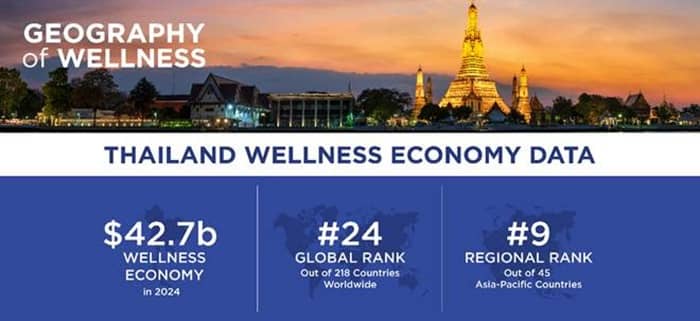
The country’s wellness economy has climbed to US$42.7 billion in 2024, up from US$38.8 billion in 2023. That’s solid growth on paper. But look a little closer, and the real story emerges: momentum.
Thailand ranked seventh globally for wellness market growth between 2023 and 2024, clocking a 10.1% increase. More telling again is wellness tourism, where spending jumped 36.4% in just twelve months, roughly three times the global average.
In travel terms, that’s not a trend. That’s velocity.
A familiar destination, now playing a different game
Thailand currently ranks as the world’s 24th-largest wellness economy and ninth in the Asia-Pacific region, respectable, but not dominant. Yet anyone watching the region closely knows these rankings rarely stay still for long.
The shift is less about size and more about direction. Thailand is no longer relying purely on its natural advantages. It’s actively professionalising wellness investing in infrastructure, research and high-yield experiences that go well beyond spa brochures.
Susie Ellis, Chair and CEO of the Global Wellness Institute, pointed directly to that blend of heritage and strategy.
“Thailand’s continued rise as a global wellness leader reaching a $42.7 billion market and achieving double-digit recent growth reflects both the country’s deep cultural commitment to wellbeing and its forward-thinking investments in innovation and preventive health,” she said.
It’s a neat summary of what the country does well: tradition doing the heavy lifting, with modern medicine stepping in to scale it.
Wellness tourism is doing the hard yards
Of the headline figures, the US$14 billion wellness tourism segment is the one most travel professionals will clock immediately. That’s where product meets passengers.
Across Phuket, Koh Samui and Chiang Mai, the evolution has been visible for a while now. Yoga retreats have grown up. Detox packages have become structured programs. Medical screening is now bundled with beach time.
The formula is simple but effective: credible healthcare, competitive pricing and a hospitality culture that understands service at a granular level.
Dr Tanupol Virunhagarun, CEO of BDMS Wellness Clinic, framed it in practical terms.
“At BDMS Wellness Clinic, we believe that a strong wellness economy must be built on credible data, evidence-based insights, and a long-term vision,” he said.
“Our continued collaboration with the Global Wellness Institute underscores our commitment to supporting preventive healthcare and positioning Thailand as both a regional and global wellness hub.”
Strip away the corporate language, and the message is clear enough: Thailand wants ownership of the wellness conversation in Asia.
The parts you don’t see on the brochure
While spa imagery still dominates marketing, some of the fastest growth is happening off-stage.
Wellness real estate is expanding at nearly 23% annually, driven by demand for residences built around longevity, preventive care and lifestyle medicine. The spa sector itself is still surging too, with destination and resort spa spending up more than 20% year-on-year.
That combination suggests Thailand is maturing into a full-spectrum wellness ecosystem, not just a holiday add-on, but a place people increasingly travel to recalibrate.
It’s a pattern we’ve seen before in other sectors. Once infrastructure follows demand, the narrative changes quickly.
Cultural credibility still matters
For all the glossy investment, Thailand’s biggest advantage remains its authenticity.
Wellness isn’t being invented here; it’s been part of daily life for generations. Buddhist mindfulness, herbal remedies, Muay Thai discipline, food rooted in freshness and balance. These aren’t new inventions for Instagram. They’re cultural muscle memory.
That authenticity resonates, particularly as travellers grow more suspicious of manufactured wellness experiences elsewhere.
It also explains why Thailand keeps pulling repeat visitors, Australians included. Once travellers experience the depth of the offering, they tend to return often with slightly different intentions each time.
Phuket’s moment in the spotlight
The timing of the data release is unlikely to be a coincidence. Phuket is set to host the 20th-anniversary Global Wellness Summit from 10–13 November 2026, bringing the industry’s heavy hitters into Thailand’s orbit.
Events like that rarely exist in isolation. They attract investors, policymakers and operators and tend to accelerate whatever trajectory a destination is already on.
In other words, Thailand isn’t just riding the wellness wave. It’s positioning itself at the centre of the conversation.
What it means for the trade
For airlines, tour operators and hoteliers across Asia-Pacific, Thailand’s trajectory is worth watching closely.
Wellness is no longer a niche vertical quietly tucked into luxury brochures. It’s edging into the mainstream of travel demand, particularly among higher-yield travellers who are increasingly trading bucket lists for better sleep and longer lives.
Destinations that can deliver credible, integrated wellness experiences will likely capture that spend. Those who can’t may find themselves stuck selling yesterday’s travel dreams.
Thailand, for now at least, seems to understand the shift.
And if these latest numbers are anything to go by, the country’s wellness story isn’t peaking, it’s just settling into a longer, steadier climb.
by Kanda Limw – (c) 2026.
Read Time: 4 minutes.
About the Writer.
 Kanda Limw is one of those rare people every office quietly depends on. She doesn’t fuss or fanfare her way through the day; she simply notices what needs doing and gets on with it, often before anyone else has drawn breath.
Years behind the scenes have taught her that good administration isn’t about control; it’s about care. Diaries align, tensions soften, loose ends disappear. When the day threatens to tilt, Kanda steadies it without drama.
There’s something reassuringly old-fashioned about her reliability. She listens properly, remembers the small things, and does what she says she will.
Kanda has no appetite for the spotlight. Yet ask anyone who works alongside her, and they’ll tell you that when she’s there, everything runs just a little smoother.
====================================











