

There’s an old saying in travel economics: if the planes are full both ways, someone’s balance sheet will blink first. In December 2025, it was America’s.
Fresh data from the U.S. National Travel and Tourism Office (NTTO) shows the United States closed the year with a travel trade deficit, as outbound American travel once again outpaced inbound visitor spend. The numbers are sober, even if the skies remain crowded.
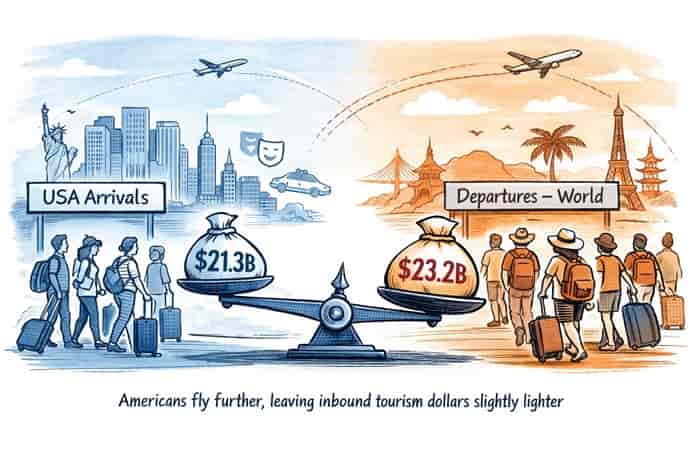
International visitors spent more than US$21.3 billion travelling within the United States in December, down 3 per cent year-on-year. Meanwhile, Americans shelled out more than US$23.2 billion overseas during the same period, leaving the U.S. with a US$1.9 billion tourism trade gap.
For an industry still rebuilding its international mojo, the optics matter.
Visitors are still spending, just not quite as much
Dig beneath the topline, and the picture is nuanced rather than alarming. International travellers still injected enormous value into the U.S. economy, with year-to-date visitor spending topping US$250.2 billion. That’s only a fractional dip of 0.6 per cent, compared with 2024, which was effectively flat in real-world terms.
Put another way: foreign visitors pumped roughly US$686 million a day into the American economy throughout 2025. Hardly loose change.
As usual, traditional travel spending formed the backbone of exports. Purchases across accommodation, dining, entertainment and domestic transport totalled US$12.0 billion in December, accounting for 56 per cent of tourism exports. That figure was down modestly from US$12.3 billion a year earlier.
Airlines felt a similar pinch. Passenger fare receipts collected by U.S. carriers from foreign travellers came in at US$3.2 billion, about 2 per cent lower than December 2024, representing 15 per cent of the export mix.
Education and medical travel soften
One of the more telling shifts came from the high-value segment often overlooked in glossy tourism campaigns: education and medical travel. Spending tied to study, healthcare and short-term work totalled US$6.0 billion, down 4 per cent year-on-year and accounting for 28 per cent of exports.
That category has long been a quiet powerhouse for the U.S., particularly for international students and medical tourists, who deliver outsized economic returns. Even a marginal dip tends to catch economists’ attention.
A familiar post-pandemic pattern
The broader trend will look familiar to anyone watching global travel flows. Outbound markets, especially affluent ones, have rebounded faster than inbound recovery in many destinations. Australians saw it, Europeans saw it, and now the U.S. is living it.
For travel businesses, the takeaway is less about alarm and more about calibration. Demand remains strong, but the competition for international visitors is tightening. Every destination is back in the ring, and travellers once again have choices.
And in tourism, choice is the ultimate disruptor.
For the full dataset and methodology, see the official NTTO release: https://www.trade.gov/national-travel-and-tourism-office.
by Jason Smith – (c) 2026.
Read time: 3 minutes.
About the Writer.
 Jason Smith was educated in terminals, taxis and hotel corridors, the sort of schooling no classroom could hope to provide. Half American, half Asian, he grew up inside the quiet machinery of tourism, watching his family send strangers into the world long before he travelled himself.
Bangkok came first, then the Asian Institute of Hospitality & Management, followed by a career stitched together across Singapore, Malaysia and Vietnam. Each city left a mark. Thailand eventually claimed him, along with a corner office, as Director of Sales for one of the country’s leading hotel groups.
Then the world paused. Borders closed, skies emptied, and Jason returned to America carrying time, memory and a lifetime of stories.
Now at Global Travel Media, he writes the human side of travel check-ins, departures and everything between with warmth, clarity and an instinct for connection.
=====================================











