

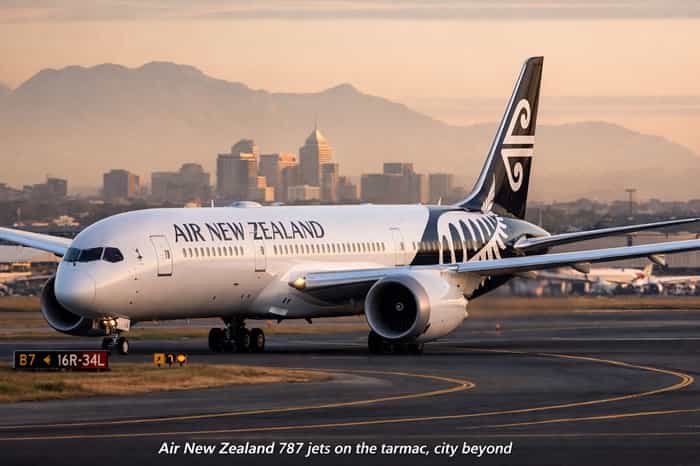
Air New Zealand has never been a carrier to panic mid-flight. But its interim result for the 2026 financial year reads less like smooth cruising and more like a seasoned captain navigating persistent headwinds with a steady hand on the controls.
The Kiwi flag carrier reported a loss before taxation of $59 million, swinging from a $144 million profit in the same period last year. The net loss came in at $40 million, underlining the very real structural challenges facing airlines globally, not just those south of the Tasman.
Yet if the numbers look sobering at first glance, the broader story is more nuanced. This isn’t a collapse. It’s a recalibration.
A perfect storm of industry pressures
Air New Zealand’s interim performance reflects the kind of multi-layered turbulence now familiar across global aviation.
Fleet constraints remain the most visible challenge, driven largely by ongoing global engine maintenance delays that have grounded aircraft and disrupted network planning. At times, as many as eight aircraft were sidelined, a material blow for a carrier that relies heavily on fleet efficiency.
Add to that a slower-than-expected recovery in domestic demand, rising aviation system costs and a weaker New Zealand dollar, and the airline’s earnings trajectory was always going to feel the strain.
Fuel didn’t help either. While prices softened slightly year-on-year, averaging about US$88 per barrel, currency weakness and carbon costs more than offset any relief. The result: fuel expenses climbed to $774 million, up four percent.
In aviation terms, this is death by a thousand incremental cuts.
Compensation cushions, but doesn’t solve the problem
The airline did receive $55 million in compensation from engine manufacturers during the first half. However, Air New Zealand estimates that as much as $90 million in additional earnings could have been realised had the fleet operated normally.
In other words, compensation helps soften the landing, but it doesn’t restore lost altitude.
Negotiations with manufacturers are ongoing, with the timing and scale of future compensation still uncertain. That uncertainty alone is enough to complicate forward planning, particularly when fleet availability underpins everything from route strategy to yield management.
Strategic reset underway
Recognising the structural nature of the challenges, the airline has pressed the reset button.
Chair Dame Therese Walsh confirmed the Board has commissioned a full strategic review, spearheaded by Chief Executive Officer Nikhil Ravishankar, who stepped into the top job in October.
Her message was unmistakably clear: volatility isn’t going away anytime soon.
She noted the airline’s national role, emphasising that Air New Zealand remains central to the country’s export economy and tourism recovery, a sentiment that resonates strongly across the Australasian travel trade.
The review is expected to examine everything from cost structures to growth pathways, with the goal of restoring sustained profitability in an environment that is structurally more expensive than pre-pandemic aviation.
Ravishankar’s pragmatic playbook
If Walsh set the strategic tone, Ravishankar provided the operational texture.
The CEO confirmed a comprehensive business review is already underway, aimed at sharpening operational performance, unlocking growth and accelerating cost transformation.
Encouragingly, not everything is in a holding pattern.
Product upgrades are already in motion, including plans to refresh the interiors of the airline’s Boeing 777 fleet to ensure a consistent widebody experience, a move that will resonate with premium travellers and corporate buyers alike.
Operational reliability is also improving, particularly in domestic punctuality, a key battleground for customer trust in New Zealand’s highly competitive regional market.
Fleet relief on the horizon
Perhaps the most compelling forward signal lies in the fleet pipeline.
Air New Zealand expects four grounded Airbus neo and Boeing 787 aircraft to progressively return to service throughout 2026. More importantly, the airline will take delivery of two new GE-powered Boeing 787s by year’s end, the first of ten on order.
Those aircraft alone are expected to drive widebody capacity growth of 20 to 25 percent over the next two years, a material lever for long-haul recovery and premium revenue growth.
For travel advisors and network planners, that’s the number worth circling.
Revenue resilience beneath the surface
Despite the headline loss, revenue trends tell a more encouraging story.
Passenger revenue rose four percent to $3 billion, buoyed by strong Tasman and Pacific demand and a richer premium cabin mix on long-haul routes.
International markets remain the airline’s strongest pillar, supported by sustained offshore demand. Premium cabins, in particular, continue to perform well, a pattern echoed across global network carriers.
Domestic travel, however, remains softer than hoped, reflecting broader economic caution among Kiwi travellers.
The cost equation remains the real challenge
Where revenue has shown resilience, costs continue to misbehave.
Non-fuel operating cost inflation added roughly $75 million in additional pressure, driven by higher passenger levies, engineering expenses and airport charges.
The airline’s concern isn’t merely the current level of costs, but the trajectory of costs. Persistent inflation across the aviation ecosystem threatens not only profitability but also the long-term viability of regional connectivity, a familiar refrain across smaller aviation markets.
It’s a point likely to resonate strongly with policymakers in Wellington and Canberra alike.
Transformation continues, but more is needed
Air New Zealand’s Kia Mau transformation programme delivered about $45 million in incremental benefits during the half, taking cumulative gains to $145 million since inception.
But even meaningful internal transformation can only offset so much external inflation.
That reality explains why the strategic review feels less like optional housekeeping and more like essential structural engineering.
No dividend, no surprises
Given the result, the Board opted not to declare an interim dividend, consistent with the airline’s Capital Management Framework.
In the current climate, preservation of balance sheet strength is less a defensive move and more a necessary discipline.
Investors may not cheer, but they will understand.
Outlook: steady but cautious
Looking ahead, the airline expects second-half earnings to broadly mirror, or slightly trail, the first half, assuming an average jet fuel price of around US$85 per barrel.
Capacity should increase modestly as aircraft return to service and new deliveries arrive, but Air New Zealand has been candid: more planes don’t instantly translate into more profit.
Schedules take time to rebuild. Markets need time to absorb capacity. And disruption costs linger long after operational stability returns.
It’s a sober but realistic outlook.
The bigger aviation story
Air New Zealand’s interim result is not an isolated narrative. It mirrors a broader global aviation reset where airlines are grappling with post-pandemic realities: fragile supply chains, engine reliability issues, labour inflation and evolving demand patterns.
Yet if there’s a defining takeaway, it’s this: resilience remains the airline’s most valuable currency.
The strategy reset now underway is less about firefighting and more about positioning the airline for its next chapter, one defined by smarter growth, sharper execution and, ideally, fewer surprises from the global supply chain.
A familiar industry truth
Seasoned observers of this industry will recognise the pattern. Aviation has always been cyclical, occasionally unforgiving, but rarely lacking in comeback stories.
Air New Zealand has navigated storms before, from oil shocks to border closures and emerged intact, often stronger.
This interim result may not sparkle on paper, but beneath the numbers lies a carrier recalibrating with intent rather than retreating in panic.
And in aviation, that distinction matters.
by Christine Nguyen – (c) 2026.
Read Time: 6 minutes.
About the Writer.
 Christine’s story is one of quiet courage, told without fuss and lived with remarkable grace. She arrived in Australia as a young refugee from Vietnam, carrying little more than hope, family, and a curiosity that refused to be extinguished. Sydney became home, built patiently, brick by careful brick.
She studied Tourism at TAFE and soon found her place in inbound travel, working with one of the city’s leading destination companies. Christine loved showing visitors the Australia that lives beyond postcards, warmer, truer, and far more interesting.
When the sea began to whisper, and life asked for a gentler rhythm, she listened. Designing brochures and writing blogs, she discovered storytelling quietly waiting inside her.
Today, at Global Travel Media, Christine writes with warmth and wisdom, reminding us, softly and persuasively, why travel still matters.











