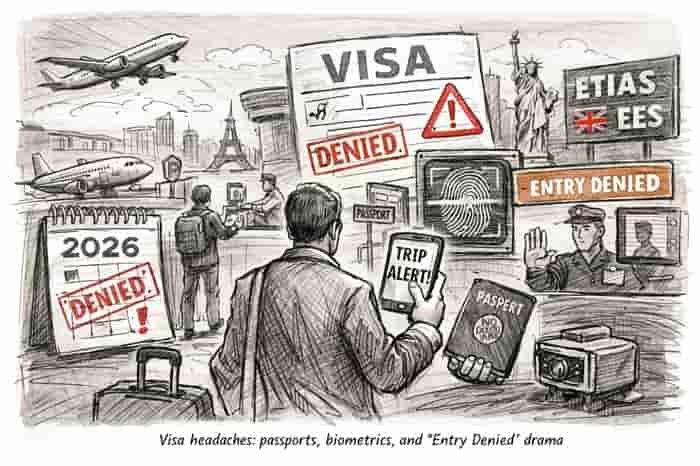
There was a time when visa checks sat somewhere between packing adapters and printing itineraries, important, yes, but hardly headline material.
Not anymore.
As global business travel powers back toward pre-pandemic strength, forecast to hit US$1.69 trillion next year, the paperwork side of travel has quietly morphed into one of the biggest operational risks on the boardroom radar.
And it’s catching people out.
Miss a digital authorisation today, and you’re not just delayed, you’re denied boarding. Entire trips are unravelling at departure gates, not border counters. Deals fall through, conferences lose speakers, and travel managers get those dreaded 2 am calls.
Laura Welsh from Riskline sums it up with disarming clarity:
“We are living in an extremely volatile period, with geopolitical risks, regulatory changes and global disruptions affecting travel, immigration and security. In the complex world of travel, the word VISA is now daunting due to rules and regulations changing rapidly. Our mission remains to support traveller preparation, embracing these shifting regulations while reducing risk through a human-authored approach.”
Strip away the corporate language, and the message is simple: borders are changing faster than habits.
Europe: Familiar continent, unfamiliar rules
Europe has always felt easy for Australians, with long stays, open borders, and a rhythm travellers know by heart.
That comfort blanket is about to be pulled away.
The new Entry/Exit System (EES), due by April 2026, replaces passport stamps with biometrics. Faster queues, yes. But it also means overstays won’t slip through unnoticed. Machines don’t forget.
Then comes ETIAS later in the year. For travellers used to breezing into Europe visa-free, pre-travel approval will suddenly become part of the ritual.
And Britain? Already there.
As of 25 February 2026, turn up without an approved ETA, and you simply won’t board. No desk negotiations, no airport heroics, just a polite refusal and a very awkward phone call home.
For a region Australians think they understand, Europe is quietly rewriting the playbook.
The US: Still open, but watching closely
If Europe is digitising, the United States is tightening.
Visa scrutiny is ramping up, with more interviews, deeper background checks, and, yes, the much-discussed social media trawls. Processing times are stretching again, and some visa classes have been paused entirely for certain nationalities.
Even seasoned travellers are noticing the shift. Entry feels less transactional, more investigative.
Programs like Global Entry are expanding, but even fast-track passengers are encountering biometric scans and occasional device inspections.
None of this screams “closed door”, but it does signal a new reality: friction has returned to the world’s busiest inbound market.
The Americas: Small changes, real impact
Away from the spotlight, quieter shifts are rippling through the Americas.
Cuba has gone fully digital, scrapping its old Tourist Card in favour of an eVisa. Mexico is widening digital access. Nicaragua has tightened entry routes. Bolivia, interestingly, has gone the other way, reintroducing visa-free access for some travellers.
Individually, they’re footnotes. Collectively, they’re a reminder that nowhere stands still.
And in business travel, death by a thousand policy tweaks is still death.
Asia: Efficiency with a digital edge
Asia rarely waits around for consensus, and visa policy is no exception.
Vietnam’s expanded e-visa access is now available across 83 entry points. It’s classic Southeast Asian pragmatism: make entry easier, grow arrivals faster.
But there’s a harder edge too.
Singapore’s no-authorisation, no-boarding stance is already setting a tone that other countries are watching closely. Compliance is moving upstream, solved before the traveller even reaches the airport.
China has nudged the dial as well, widening visa-free access for select markets while introducing digital arrival cards to streamline the arrival experience.
The direction of travel is clear: fewer paper forms, more pre-clearance.
The Middle East: Simplifying at scale
If there’s a region betting big on frictionless travel, it’s the Gulf.
The long-awaited GCC Unified Tourist Visa, essentially a Schengen-style permit for six countries, could reshape how travellers move through the Middle East.
One visa, multiple borders, seamless itineraries. For business travellers bouncing between Dubai, Riyadh and Doha, that’s a serious shift.
Elsewhere, digitisation continues. Israel’s ETA-IL, Egypt’s electronic arrival systems, Iraq’s eVisas, it’s all pointing toward a region that wants to be both secure and seamless.
Africa: Opening doors, tightening checks
Africa’s visa story has always been nuanced, and that hasn’t changed.
There’s real progress. Kenya’s electronic authorisation model is streamlining arrivals. Mozambique’s unified visa platform is simplifying what was once a bureaucratic maze. Pan-African mobility is slowly, steadily improving.
But there’s tightening too.
Namibia and Malawi have pulled back visa-free schemes. Cabo Verde has scrapped visa-on-arrival for dozens of nationalities. And in some corners, travellers are discovering their social media history suddenly matters.
The pendulum swings both ways often at speed.
The new job description for travel managers
Put all this together, and the conclusion is unavoidable: visas are no longer an admin task.
They’re risk management.
The old approach, spreadsheets, bookmarks, and last-minute embassy checks, belongs to a slower era. Today’s environment demands real-time intelligence and proactive oversight.
Because when things go wrong now, they go wrong earlier. At check-in. At boarding. In front of clients.
That’s reputational risk, not just operational inconvenience.
From firefighting to foresight
This is where tools like Riskline’s Visa Check platform are finding their moment.
The pitch is straightforward: live visa intelligence across 220+ countries, human-verified, searchable by trip length and purpose. Less guesswork, fewer grey areas, stronger duty-of-care compliance.
It’s not about replacing travel expertise; it’s about giving it better instruments.
For travel programs managing global footprints, that kind of foresight is fast becoming table stakes.
(Those curious can explore further via Riskline’s demo portal: https://riskline.com/get-demo/).
Borders are back, and they’ve evolved
Business travel is undeniably back. Aircraft are full, trade shows are buzzing, and the human side of commerce has returned with a vengeance.
But the borders those travellers are crossing aren’t the same ones they left behind in 2019.
They’re smarter, stricter and far less forgiving of complacency.
For an industry built on movement, that’s the real story. Not just that people are travelling again, but that the rules governing that movement are evolving in real time.
And in this new era, preparation isn’t just best practice.
It’s survival.