

Every so often, the travel trade gets a reminder that the real architecture of the industry isn’t built on aircraft or brochures, it’s built on trust.
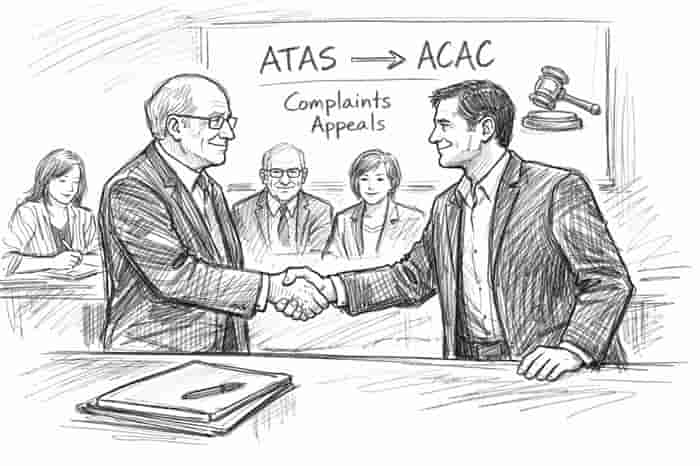
This week’s confirmation from the Australian Travel Industry Association that Michael Terceiro has taken over as Chair of the ATAS Complaints Appeals Committee (ACAC) is one of those moments. Quiet news on the surface. Meaningful underneath.
From 1 February, Terceiro replaces Hank Spier, whose steady stewardship has helped shape the appeals body into something far more consequential than many outside the accreditation ecosystem realise.
For those operating under ATAS, ACAC is where the hardest conversations end up. Not the everyday grumbles, but the complicated disputes, the ones where principle, process and commercial reality collide. It’s the final internal circuit-breaker before lawyers start billing by the hour.
And in a post-pandemic market where consumer expectations remain high and margins remain tight, that circuit-breaker matters more than ever.

Hank Spier
Spier understood that. The former ACCC chief brought a regulator’s composure and a long memory of how systems fail when confidence erodes. Under his watch, ACAC matured alongside ATAS itself, less theoretical, more grounded, and increasingly trusted by both members and consumers.
“It has been a privilege to chair the ACAC during a period where the accreditation framework has continued to mature and adapt,” Spier reflected.
“The Committee’s role in balancing consumer expectations with the operational realities of travel businesses has never been more important.”
That balance of fairness without naivety is precisely what ATIA is trying to preserve as it hands the baton to Terceiro.
If the name feels familiar, it should. Terceiro isn’t arriving cold. As a General Member of the NSW Civil and Administrative Tribunal’s Consumer and Commercial Division, he’s spent years sitting at the intersection of law, commerce and human behaviour, which is exactly where travel disputes tend to live.
More importantly for the trade, he recently served as Independent Reviewer for the 2025 ATAS Charter Review. In other words, he already knows the machinery from the inside.
ATIA CEO Dean Long framed the appointment as continuity rather than change, signalling that the association seeks evolution rather than upheaval.
“Hank Spier has provided principled, steady leadership through a period of meaningful reform, helping ensure the complaints framework remains fair, credible and workable for accredited businesses,” Long said.
“Michael Terceiro’s appointment builds on that momentum.”
Long has been consistent in his messaging around Project A30: strengthen trust, but don’t bury members in the process. This transition fits neatly into that narrative: governance tightening in quiet increments rather than grand reinventions.
For Terceiro, the tone is similarly pragmatic. No sweeping promises, just a focus on keeping the system credible.
“The ATAS framework plays a vital role in maintaining trust in Australia’s travel industry, and ACAC is a key safeguard within that system,” he said.

Michael Terceiro
“I look forward to working with ATIA, committee members and stakeholders to ensure the appeals process remains independent, transparent and fit for purpose.”
Importantly, ATIA has been quick to reassure stakeholders about structural change. The committee itself remains untouched, still comprising an independent Chair alongside consumer and industry voices. No new layers. No surprise redesigns.
That will reassure agents who have spent the past few years navigating constant flux. In a sector that has absorbed everything from border closures to refund wars, stability, even in governance plumbing, carries weight.
And that’s really the subtext here. This isn’t about personalities. It’s about institutional confidence.
Planned handovers tend to indicate a framework that knows where it’s heading. There’s a quiet assurance in that. No urgency, no theatre, just another adjustment in a system that appears to be settling into its post-recovery shape.
For accredited businesses, the practical takeaway is simple: the guardrails remain, the tone remains measured, and the people overseeing the hardest calls remain independent.
In an industry where reputations can turn on a single dispute, that’s not small news even if it arrives without fanfare.
by Octavia Koo – (c) 2026.
Read Time: 4 minutes.
About the Writer.
 Octavia Koo arrived in Australia from Indonesia in the early eighties, drawn by Sydney’s creative pull and a place at UNSW. Studying Arts, she quickly developed an eye for visual storytelling, starting in graphic design before naturally moving into digital building websites and crafting copy that invited people in and kept them there.
Singapore came next. There, she ran blogs for tourism platforms and developed an instinct for SEO well before it had a name, working the corridors of ITB Asia and learning how stories travel online. There, she met Stephen, who suggested Global Travel Media.
A few years later, she joined.
Today, Octavia is part of GTM’s editorial family, bringing a quiet brilliance to every piece, blending art, technology and intuition to make travel stories both charming and effective, much like their author.











