

There was a time when Africa sold itself easily.
Big wildlife, golden light, and lodges that photographed well. For years, that formula did the heavy lifting at the sales desk.
But listen carefully to how experienced agents are talking about Africa now, and you’ll hear a shift. Less about sightings. More about substance.
As Phoenix Collective marks 15 years representing a tightly curated portfolio across Southern and East Africa, the timing feels less celebratory and more instructive. Because many of the properties now gaining traction with high-value clients are the same ones that were once considered “slow sellers”.
Only the client has changed.
The Safari Client Has Matured
In the Eastern Cape, Shamwari remains one of the most reliable entry points into safari, and that’s precisely why it still matters.
For agents, its biggest strength isn’t novelty. It’s confidence. Malaria-free, easily slotted into Garden Route itineraries, and now supported by private air access that trims hours off transfers from Cape Town and Johannesburg.
But the real evolution is in positioning.
The formalisation of the Shamwari Foundation gives agents a stronger narrative for second-time Africa travellers, those who’ve “done safari” but are now asking deeper questions about impact.
That shift alone can move a booking from price-driven to purpose-driven, which is where yield improves.
South Africa’s Self-Drive Renaissance
Graaff-Reinet and the Drostdy Hotel speak directly to a segment of Australian agents: confident self-drivers who want Africa without convoy travel.
The Karoo sells differently. It’s slower, more textural, and appeals strongly to clients who’ve already done Europe’s backroads and are ready for something less polished.
For agents, this is itinerary gold. It extends beyond the Cape Town, Winelands loop and adds emotional depth without increasing logistical complexity.
In other words: high perceived uniqueness, low operational friction.
Conservation Now Converts
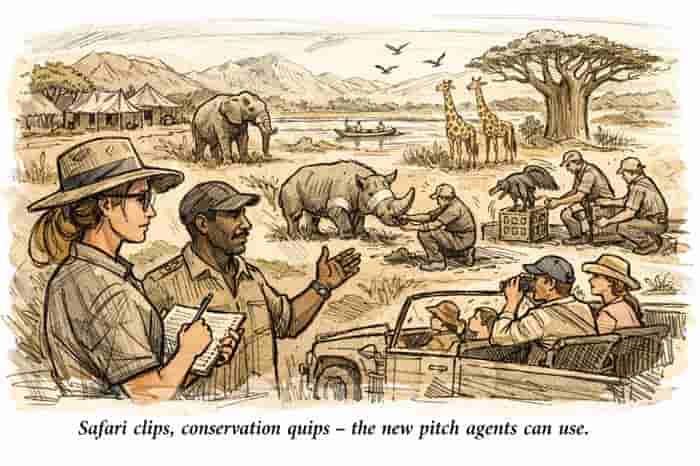
At the Cape Vulture Nature Reserve, the product is unapologetically niche, which is precisely why it works.
There’s a growing cohort of premium travellers who actively seek experiences with visible conservation outcomes. Not abstract sustainability claims, but tangible stories they can retell at dinner parties.
From a sales perspective, that storytelling currency matters.
It gives agents something powerful: differentiation without discounting.
Resilience Sells If You Frame It Right
Grootbos offers another lesson for the trade.
Post-fire recovery could have been a difficult narrative. Instead, it has become a resilience story of regeneration, rare flora, and scientific discovery.
Handled well, that kind of framing resonates strongly with well-travelled clients who are increasingly sceptical of manufactured luxury.
It also creates a natural layering of itineraries: marine safaris, fynbos landscapes, and conservation storytelling. Multiple hooks, one property.
That’s brochure efficiency agents can work with.
The Rise of “Quiet Africa”
Properties like Mosaic Lagoon Lodge and the Hermanus coast tap into a subtle but growing demand: Africa without intensity.
Not every client wants dawn game drives and rigid schedules, particularly those combining Africa with long-haul journeys or milestone travel.
These quieter properties allow agents to control trip pacing, inserting pauses between headline experiences. It’s a simple technique, but one that often lifts overall trip satisfaction.
And satisfied clients, as every agent knows, are the ones who come back asking, “Where next?”
Coastal Product Is Undervalued
KwaZulu-Natal’s Thonga Beach Lodge remains one of the most underutilised products in the South African mix.
For agents willing to move beyond default itineraries, it offers a rare combination: marine wildlife, strong community credentials, and genuine off-grid appeal.
Importantly, it pairs beautifully with a safari without feeling repetitive, helping to avoid the classic Africa planning trap of “too many lodges, too little contrast”.
Further south, Sala Beach House caters to a different luxury language, design-forward, wellness-led, and increasingly attractive to younger premium travellers.
That demographic shift is worth watching.
Africa Beyond Animals
One of the more commercially useful shifts is Africa’s diversification beyond wildlife density.
Farmhouse58 and Nirox Sculpture Park open the door to art, heritage and design-led travel, ideal for clients who want Africa’s cultural depth without committing to another safari circuit.
For agents, this extends sellable inventory without extending travel fatigue.
It also creates a compelling re-sell narrative: Africa as a repeat destination, not a once-in-a-lifetime trip.
High-Impact, Low-Volume Properties
Tsowa Safari Island is a good example of where exclusivity still holds weight.
Private-use potential, boat-only access, and a sustainability story that feels practical rather than performative are all strong signals for high-net-worth travellers seeking privacy over opulence.
These are the bookings that may take longer to land but deliver disproportionate value when they do.
And importantly, they create advocates.
Big Brands, Smarter Stories
Even global players are adapting.
The JW Marriott Masai Mara Lodge demonstrates how international brands are recalibrating for the modern safari client, with solar-heavy infrastructure, strong local employment, and structured cultural immersion.
For agents with brand-loyal clients, this type of property reduces perceived risk while maintaining authenticity.
That’s a powerful combination at the premium end.
What This Means for Australian Agents
So, where does this leave the trade back home?
In a stronger position than it might appear.
Australian travellers are among the most confident long-haul travellers globally. They’re also increasingly values-driven, particularly at the top end of the market.
That aligns neatly with the type of properties gaining traction across Phoenix Collective’s portfolio.
The opportunity for agents isn’t just selling Africa.
It’s reframing how Africa is sold, less checklist, more context.
The Real Takeaway
Fifteen years on, Phoenix Collective’s anniversary feels less like a milestone and more like a signal.
The kind of travel it has consistently represented, slower, grounded, quietly purposeful, is no longer a niche sell.
It’s moving into the mainstream of premium long-haul demand.
And for agents willing to lean into that shift, the upside is clear:
Stronger narratives.
Higher-value bookings.
And clients who come home already planning the next trip.
Because if Africa’s next chapter has a defining trait, it isn’t spectacle.
Its substance.
by Bridget Gomez – (c) 2026.
Read Time: 5 minutes.
About the Writer.
 Bridget has never been built for stillness. Of Portuguese heritage, she began as a nurse, tending veterans at the Repatriation Hospital, listening to stories as colourful as the life she was yet to live. It was worthy, steady work, but wanderlust, as always, proved louder than routine.
So she traded starch for a backpack and disappeared for a year, chasing trains, sunsets and the occasional regrettable glass of wine. She wrote everything down: the dust, the laughter, the missteps, the magic. Those notebooks became a travel blog, then a habit, then a calling.
Eventually, she found Global Travel Media, or perhaps it found her.
Today, Bridget writes with heart, humour and a dash of mischief, still travelling, just now with words.











