Airlines love to talk about “enhancing the passenger experience,” usually while handing over something that looks suspiciously like reheated compromise. Every now and then, however, one gets it right.
Enter Vietjet.
Timed neatly for the annual migration north when Australians swap late summer barbecues for Vietnam’s lantern-lit streets, the airline is introducing a Lunar New Year Business Class menu from 10–20 February 2026 across its Sydney, Melbourne and Brisbane services to Ho Chi Minh City, along with selected domestic routes.
And rather than tinkering politely around the edges, Vietjet has gone straight for the heart of Tết.
The menu is unapologetically traditional, which is precisely the point.

Tết flavours cruising high, airline dining worth photographing.
Think steamed pork balls with wood ear mushrooms, properly braised pork served with rice, vermicelli with chicken and bamboo shoots, and a Hanoi-style chicken noodle soup that sounds far too comforting to be consumed in a pressurised cabin.
Then comes red sticky rice with chicken sausage, a dish whose colour alone signals prosperity, followed by bitter melon soup with fish paste, long associated with leaving last year’s troubles firmly in the rear-view mirror.
Not a bad philosophy at cruising altitude.
Dessert leans equally nostalgic, with green rice and lotus seed sweet soup alongside lotus seed and longan, the sort of flavours that tend to transport travellers faster than the aircraft itself.
Importantly, this is not fusion food attempting to impress a focus group. It is heritage cooking, layered with symbolism. Braised pork speaks of reunion meals. Sticky rice whispers good fortune. Bitter melon, despite its edge, carries the hopeful message that hardship passes.
Food matters during Lunar New Year arguably more than at any other time, and Vietjet appears to understand that authenticity travels further than novelty.
The timing is commercially astute as well.
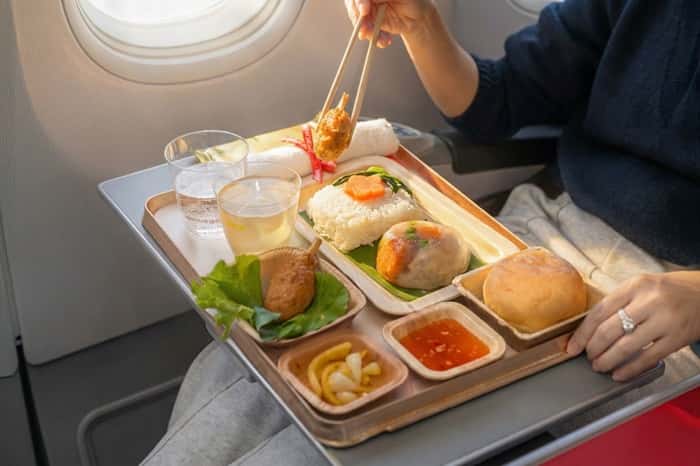
Tết traditions taste better somewhere above Darwin.
Vietnam continues to climb the charts for Australian travellers, with visitor numbers edging towards the half-million mark annually, according to recent reports. Direct routes have matured, confidence in the destination is strong, and the country’s culinary reputation has quietly become one of its most persuasive ambassadors.
Meanwhile, Australia’s Vietnamese community celebrates Tết with characteristic energy, from bustling markets to family tables stretched to improbable lengths. For many passengers, boarding a flight at this time of year is less about escape and more about return.
A menu like this recognises that emotional geography.
Business Class, of course, is where airlines increasingly wage their most visible battles. Seats flatten, doors slide shut, and champagne flows, yet travellers remember the details. A thoughtfully prepared meal still carries enormous persuasive power.
Pair that with attentive service and the disarming warmth Vietnamese hospitality is known for, and suddenly the journey begins well before touchdown.
There is also something reassuringly confident about an airline leaning into its cultural identity rather than sanding it down for international neutrality. In a global industry that can occasionally become indistinguishable, personality is a competitive advantage.
Vietjet’s Lunar New Year offering may not change aviation history, but it does signal maturity, the kind that understands premium travel is as much about storytelling as it is about seat pitch.
And for Australian travellers heading north in February, the message is clear:
Your first Tết meal might arrive somewhere over the Timor Sea.
Not a bad way to start the year.