

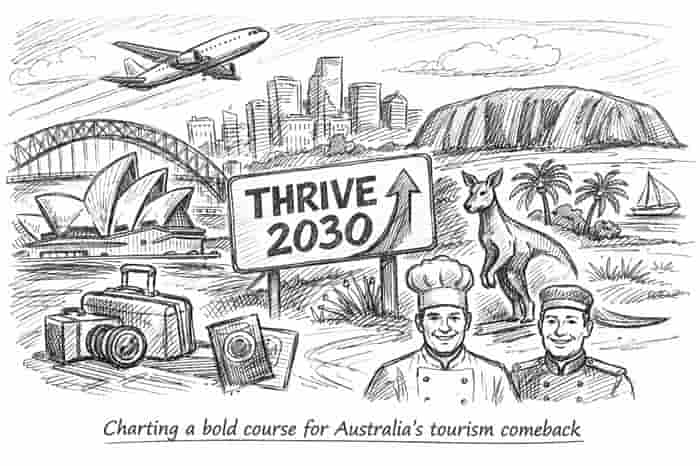
If tourism is theatre, then the Federal Government has just lifted the curtain on what it hopes will be a long-running blockbuster.
Australia’s peak accommodation body has warmly welcomed the Albanese Government’s newly unveiled THRIVE 2030 strategy, a national tourism action plan designed to lure international travellers back in meaningful numbers and, ideally, with wallets at the ready.
At its heart lies an ambitious target: $230 billion in visitor expenditure by the end of the decade. Lofty? Certainly. Impossible? Not according to industry leaders, who see the blueprint arriving precisely when the sector is ready to shift from recovery mode to growth.
Accommodation Australia CEO James Goodwin described the initiative as a long-awaited “whole-of-government approach”, bureaucratic shorthand for everyone rowing in the same direction rather than circling the harbour.
“This is the right plan at the right time to help achieve our common tourism goals and to build towards $230 billion in visitor expenditure by 2030,” Mr Goodwin said.
After several years spent shaking off the stubborn dust of pandemic disruption, the industry appears eager to embrace a strategy that looks forward rather than back.
“THRIVE 2030 not only acknowledges the tourism sector is finally out of the COVID recovery period, but that we need the right settings in place for long-term, sustainable growth to make Australia an attractive choice for international tourists.”
Few would argue with that sentiment. In global tourism, standing still is simply another way of moving backwards.
Aviation, diversification and telling Australia’s story
Improved aviation access sits near the top of the priority list, and for good reason. Aircraft seats are the lifeblood of inbound tourism; without them, even the most dazzling marketing campaign struggles to convert interest into arrivals.
Yet the strategy stretches beyond flight paths. Diversifying into international markets and reducing reliance on traditional visitor sources are viewed as essential insurance against geopolitical tremors and economic volatility.
“The way to do this is not only through improved aviation access which is key but through international diversification – for too long Australia has relied on traditional markets, this plan is a blue-print to spread our wings,” Mr Goodwin noted.
There is also a renewed emphasis on dispersal, encouraging travellers to venture beyond Sydney Harbour and the Gold Coast skyline.
“Another important feature is to encourage the increased dispersal of tourists throughout Australia once they have arrived in the gateway cities Australia is unique and full of natural wonder and we need to tell that story overseas.”
Indeed, from the ochre sweep of the Red Centre to Tasmania’s windswept drama, Australia has never suffered from a shortage of scenery, merely, at times, from insufficient storytelling.
Funding, workforce, and the practical realities
Promotion, of course, requires resources. Ensuring Tourism Australia is adequately funded will be critical if campaigns are to resonate across both established and emerging markets. (Further details on the national tourism strategy can be found via the official government portal: https://www.austrade.gov.au).
Still, even the most persuasive advertising cannot check guests into hotels or cook their dinners.
Mr Goodwin was quick to remind policymakers that staffing shortages remain stubbornly persistent.
“The chronic shortage of workers such as chefs and cooks right across Australia needs to be addressed and we will continue to push for the right training, apprenticeship and migration settings to fulfill our industry’s needs.”
In other words, the welcome mat must be matched by capable hands ready to greet those who cross it.
He added:
“I congratulate Tourism Minister Don Farrell on THRIVE 2030 and look forward to working with him and the Government to bring even more tourists to our shores.”
A plan with momentum
Tourism strategies are plentiful; successful ones are rarer. Yet THRIVE 2030 carries a reassuring tone of pragmatism, aviation, workforce, funding, diversification, and the unglamorous mechanics that quietly determine whether grand visions translate into hotel bookings.
For an industry that has weathered its share of turbulence, the message is refreshingly clear: Australia is open, ambitious, and once again ready to compete for the world’s travellers.
And if the plan delivers as intended, the next decade may well see the nation’s visitor economy not merely recover but positively flourish.
by My Thanh Pham – (c) 2026.
Read Time: 3 minutes.
About the Writer.
 My Thanh Pham has led a more travel-intensive life than most people. After studying tourism, she went straight into the work of building journeys across South-East Asia, temples, beaches, night trains, and all, quietly fixing the messy bits so others could enjoy the ride.
She was never meant to stay behind a desk. Airline life followed, dividing her days between reservations and the airport floor, right where travel shows its true colours. Missed flights, tight hugs, frayed tempers, sudden joy, she saw it all, close up.
Now at Global Travel Media, My Thanh has traded ticket stubs for a keyboard. She writes the way she once worked: steady, clear-eyed and respectful of the road’s unpredictable rhythm, guiding readers through a world she knows from the inside.











