


As Thailand strides into 2026, the country’s business events calendar is already locked in with the kind of precision that only the meetings industry understands. In MICE, you do not plan next quarter. You plan years ahead, sometimes decades in ambition and months in sleepless preparation.
The forthcoming IMF and World Bank Group Annual Meetings, scheduled for 12–18 October 2026 at the Queen Sirikit National Convention Centre, are not simply another date on the diary. They are a statement of confidence in Thailand’s operational capability, infrastructure, and maturity as a global host.
The symbolism is not lost on those of us with long memories. The original Queen Sirikit National Convention Centre was built in a remarkable 18 months to host the same meetings in 1991. At the time, it marked Thailand’s arrival on the world stage of international congresses. It was ambitious, bold, and, by the standards of the day, impressively efficient.
I remember 1991 rather well. It was my first year living in Thailand. I was involved in itinerary planning and, in a moment of enthusiasm that seemed perfectly reasonable at the time, arranged what was believed to be the first helicopter transfer from Don Muang Airport to the Shangri-La Hotel. On paper, it reduced a four-hour road transfer to minutes. In practice, it required navigating layers of approval that tested everyone’s patience.
The Armed Forces were understandably cautious about helicopters circling above the capital. Final clearance came, quite literally, at midnight the day before. We conducted a test run to ensure nothing untoward would occur, and I invited. I invited well-respected journalist Don Ross of TTR to join me. It was, in its own modest way, a historic flight and a reminder that Thailand has long combined improvisation with determination.
Three decades later, the new Queen Sirikit National Convention Centre stands as a second-generation facility: larger, technologically sophisticated, and designed to meet the complex security, digital, and sustainability demands of modern multilateral events. Its evolution mirrors Thailand’s own journey in MICE from emerging contender to assured competitor.
Why MICE Matters Strategically
It is common to refer to leisure tourism when discussing Thailand. Beaches photograph well; boardrooms less so. Yet from an economic perspective, the Thailand meetings industry is one of the kingdom’s most strategically valuable pillars.
MICE visitors typically spend more per capita than leisure travellers. They favour higher-category hotels. They travel year-round, cushioning low seasons. They support airlines, transport operators, production companies, caterers, interpreters and an entire ecosystem of professional services.
One substantial congress can support thousands of direct and indirect jobs. More importantly, it reinforces Thailand’s brand as a confident, competent international partner.
Few countries in Asia can credibly host small executive retreats, mid-sized regional congresses and very large global conventions within a single national framework. Thailand can and does regularly.
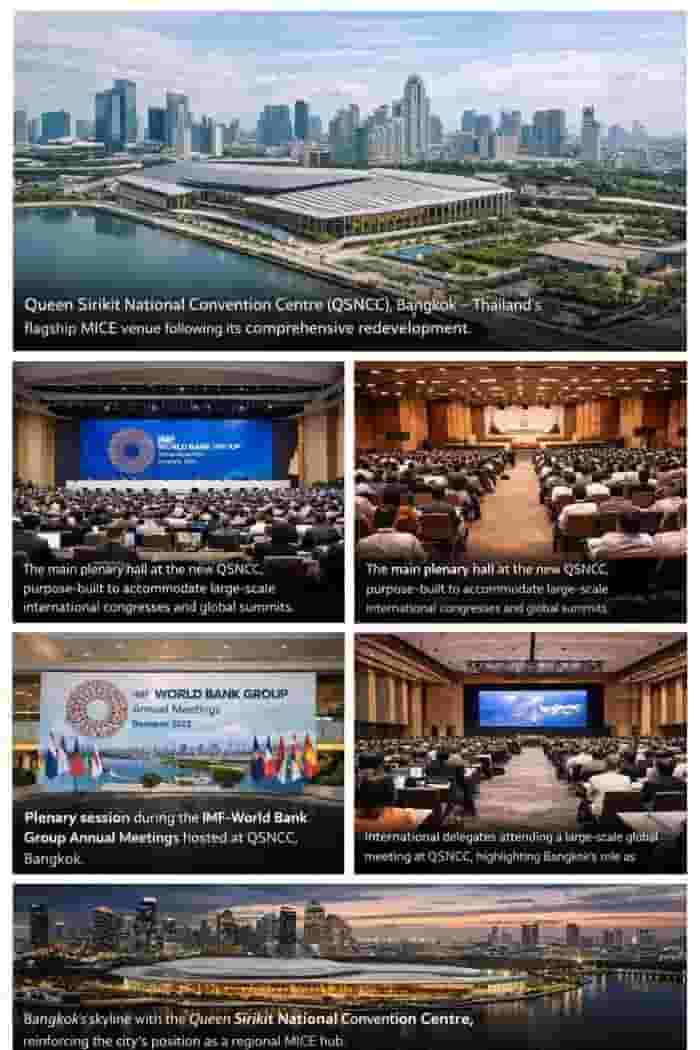
Thailand has the scale, infrastructure and organisational depth to host some of Asia’s largest and most complex business events
The Backbone: National Convention Venues
Bangkok remains the gravitational centre of the industry. Alongside the QSNCC, facilities such as IMPACT Muang Thong Thani and Bangkok International Trade and Exhibition Centre provide scale that rivals many regional competitors.
To the north, the Chiang Mai International Exhibition and Convention Centre anchors the meetings economy of Northern Thailand, capable of accommodating up to 10,000 delegates and offering a distinct atmosphere.
These venues collectively enable Thailand to host:
-
International medical and scientific congresses attract 8,000–15,000 delegates
-
Major trade exhibitions drawing 20,000–40,000 visitors
-
Regional association congresses of 3,000–8,000 participants
-
Government and multilateral meetings ranging from 1,000 to 5,000 attendees
At peak capacity, events exceeding 30,000 delegates are within reach, particularly in Bangkok’s large exhibition complexes.
Beyond Bangkok: A National Advantage
Thailand’s true competitive advantage lies not merely in scale, but in geographic diversity.
Bangkok is the obvious choice for large conventions requiring air connectivity, extensive hotel inventory and experienced professional conference organisers. Its infrastructure is proven, its supply chain deep, and its institutional support robust.
Yet the kingdom offers alternatives within comfortable reach.
On the Eastern Seaboard, Pattaya is home to the purpose-built Pattaya Exhibition and Convention Hall (PEACH), which can accommodate more than 12,000 delegates. Resort-style environments in Hua Hin and along the Gulf coast offer discretion and calm, making them well-suited for board retreats and high-value incentive programmes.
In the north, Chiang Mai delivers cultural depth and a gentler tempo. Academic, creative and sustainability-focused events thrive in this setting, where a sense of place adds intellectual texture.
Further south, Phuket complements Bangkok with resort-based meetings, incentive appeal and international air access. Delegates can combine business sessions with wellness, leisure and networking in environments that encourage informal engagement, often where the most productive conversations occur.
Hotels as Integrated Event Platforms
For organisers seeking integrated solutions, Bangkok’s leading MICE hotels operate at an impressive scale. Properties such as Bangkok Marriott Marquis Queen’s Park, Centara Grand at CentralWorld and the riverside Shangri-La Bangkok provide ballrooms capable of hosting thousands, alongside a comprehensive accommodation inventory.
This vertical integration venue, accommodation, catering and technical services under one roof simplifies logistics and reduces risk, something international planners appreciate more than glossy brochures.
Outlook: Quality Over Volume
Thailand’s future in MICE is not about chasing ever larger numbers. It is about intelligent positioning.
Global competition is intense. Destinations across Asia are investing heavily in infrastructure. What differentiates Thailand is not simply square metres of exhibition space. It is operational experience, cultural fluency and a hospitality ethos that feels authentic rather than rehearsed.
The return of the IMF and World Bank meetings in 2026 underscores international confidence in Thailand’s security standards, professionalism and delivery capability. It also signals continuity, a reminder that the foundations laid in 1991 were not temporary.
As 2026 progresses, Thailand’s MICE strategy rests on a balanced equation: scale with flexibility, infrastructure with warmth, ambition with humility.
The country can host one of Asia’s largest conventions one week and a discreet executive retreat the next. That adaptability is not accidental. It is the product of decades of refinement.
In a region where many aspire to be hubs, Thailand remains one because it understands that success in MICE is earned quietly, event by event, relationship by relationship.
And occasionally, though perhaps less often now, with a helicopter or two.
by Andrew J Wood and edited by Stephen Morton – (c) 2026.
Read Time: 8 minutes.
About the Writer.
 Andrew J. Wood has lived in Thailand since 1991. He is a former Director of Skål International and a Past President of Skål International Asia, Past President of Skål International Thailand, and a two-time Past President of Skål International Bangkok.
A former hotelier with senior management experience at leading hospitality groups including Shangri-La, Minor International, Landmark and Royal Cliff, he writes regularly for international travel and hospitality publications.
His work focuses on tourism trends across Asia, sustainable tourism development, and the future of travel and hospitality in the Asia-Pacific region.











