British border rules rarely arrive with fanfare. They tend to slip in politely, like a neighbour changing the locks and assuming everyone will notice in time.
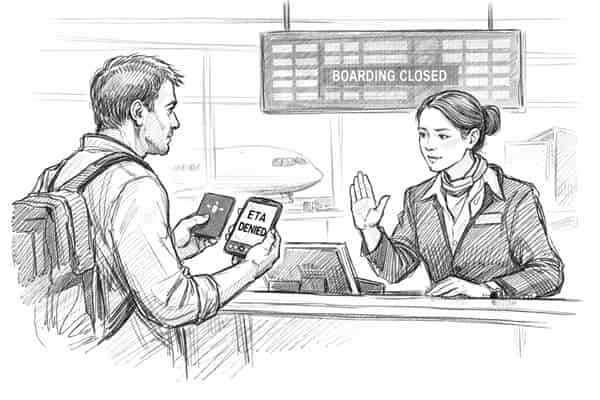
From February 25 next year, millions of travellers who’ve long treated the UK as an easy landing will discover that assumption no longer holds. A new Electronic Travel Authorisation, or ETA, will become mandatory for visitors who don’t need a visa for short stays. Miss it, and the argument won’t happen at passport control. It will happen at check-in, or more likely, it won’t happen at all.
No ETA. No boarding.
The change is being rolled out by the UK Home Office as part of a broader shift towards pre-screening travellers before they reach the border. It is not a visa, officials are quick to say, and it doesn’t guarantee entry. It quietly moves the point of refusal away from Heathrow arrivals and back to the departure lounge in Sydney, Melbourne, or Singapore.
For travellers, the difference matters. For airlines and travel agents, it matters even more.
A digital permission slip until it isn’t optional
An ETA is best thought of as a digital permission slip. It allows eligible visitors to travel to the UK for stays of up to six months, multiple times, over a two-year period or until the traveller’s passport expires.
At present, it costs £16, though the Home Office has already flagged a future increase to £20. Applications are made through an official app or the government website, and most applicants receive approval within minutes.
Most, but not all.
That caveat is why travellers are being advised firmly to apply several days before travel. A small number of applications are pulled aside for further checks, and those checks don’t respect departure times.
This is not theoretical. Since the scheme began in late 2023, nearly 20 million ETAs have been issued. The system works, but it works on the government’s clock, not yours.
Australians won’t need to think about it until they do
For Australian passport holders, the ETA requirement is straightforward: apply online, pay the fee, and proceed.
But border changes have a habit of exposing complications travellers didn’t realise they had.
Dual British citizens, for instance, cannot apply for an ETA. They must travel on a British passport or carry a certificate proving their right of abode. From February next year, turning up with an Australian passport and an unverified British claim will no longer be a minor inconvenience. It will at best mean additional checks and delays.
The advice from officials is blunt: sort it out before you travel. Airports are not the place to discover your paperwork isn’t as tidy as you thought.
Transit rules that depend on which corridor you walk down
The ETA rules extend beyond simple point-to-point travel.
Passengers transiting through the UK who pass through passport control will need an ETA. Those transiting airside through Heathrow or Manchester, without clearing border checks, currently do not.
“Currently” is doing a lot of work in that sentence.
Transit rules are among the most common sources of traveller confusion, and airlines carry the liability if someone is denied boarding. Expect staff at check-in counters to err on the side of caution.
That caution will not be negotiable.
Airlines, agents and the shifting point of failure
What the ETA really does is move responsibility.
In the past, a traveller without the right documents might discover the problem at the border. Now the onus is squarely on airlines and travel agents to ensure passengers are authorised before travel.
That is not a small operational shift. Denied boarding carries costs, and airlines have no incentive to argue on a traveller’s behalf once the system says no.
Industry groups have been pressing for clarity during the transition period, particularly around dual citizens and transit passengers. VisitBritain, while not responsible for the policy itself, has been fielding questions from travel partners and relaying their concerns to the government.
The message coming back is consistent: the system is staying. Get used to it.
Northern Ireland and the fine print that travellers skip
Northern Ireland adds another layer of nuance.
There are no routine immigration checks on the land border between Ireland and Northern Ireland, and that remains unchanged. But travellers entering Northern Ireland are still required to comply with UK immigration rules, including holding an ETA if their nationality requires one.
Legal residents of Ireland from visa-exempt countries may be exempt when travelling within the Common Travel Area, provided they can prove residency.
That final condition is where most misunderstandings begin.
Passport timing: four weeks, unless it isn’t
Adding to the pressure is passport processing.
According to His Majesty’s Passport Office, UK passport renewals lodged from Australia currently take around four weeks, assuming no additional information or identity interview is required.
If further checks are needed, applicants will be informed within that window. Which is fine, unless your flight leaves in three weeks.
It’s a familiar pattern. Policy changes expose procrastination.
Border security by stealth
From the government’s perspective, the logic is straightforward. Collect traveller information earlier, assess risk earlier, and stop problems before they reach the border.
The approach mirrors systems already in place in Australia and the United States. The UK is not out on a limb here. It is catching up.
What has changed is where travellers feel the impact. Instead of a stamp and a question on arrival, there is a silent database check long before the suitcase is packed.
For most people, it will pass unnoticed. For a small number, it will be decisive.
The quiet warning
There will be no dramatic launch. No television ads. No loud announcements.
Travellers will learn about the ETA the same way they learn about most modern border rules when a screen flashes red at check-in, and someone behind a counter shakes their head.
The fix is simple. Check your passport. Apply early. Use official channels. Don’t assume past travel habits still apply.
Britain isn’t closing its doors. It’s just asking, politely but firmly, to see the paperwork first.
And from February next year, it won’t ask twice.
Official Resources
- UK ETA information: https://www.gov.uk/eta
- ETA guidance for dual citizens: https://www.gov.uk
- Check British citizenship status: https://www.gov.uk
- UK Visas & Immigration webchat: https://www.gov.uk
by Michelle Warner – (c) 2026.
Read Time: 5 minutes.
About the Writer.
 Michelle Warner has always carried stories the way others carry passports lightly, faithfully, and with purpose. She learned her craft in newsrooms, shaping sentences with care, before swapping deadlines for departures as a flight attendant with some of the world’s great airlines. Years aloft sharpened her eye for character and deepened her fondness for the small, dignified rituals of travel, the quiet kindness of strangers, the poetry of arrival, the patience learned between time zones.
Now grounded by choice, Michelle has come home to writing with the same calm authority she once brought to turbulent cabins. Her prose blends an editor’s discipline with a traveller’s wonder, tinged with humour and reverence for the golden age of travel. Each piece feels like a handwritten boarding pass, gracious, observant, and unmistakably alive.