

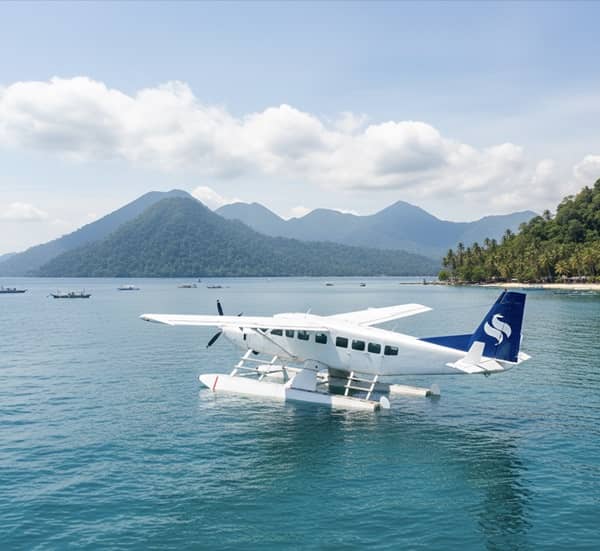
Indonesia’s push toward smarter, greener aviation has gained a distinctly nautical edge, with Santai Seaplane confirming Banyuwangi Airport as the strategic operational hub for its forthcoming amphibious aircraft services around Bali and eastern Indonesia.
The announcement marks a decisive step for the boutique aviation operator formally known as PT Santai Seaplane Aviation and backed by the Hong Kong-based Seaplane Asia Group, as it prepares to launch premium, low-impact air connectivity linking Java, Bali, and the Lesser Sunda Islands.
Supported by InJourney Airports and Akademi Penerbang Indonesia Banyuwangi, the move shifts months of consultation into execution mode, signalling that Santai’s water-landing ambitions are no longer theoretical.
A hub that makes geographic and commercial sense.
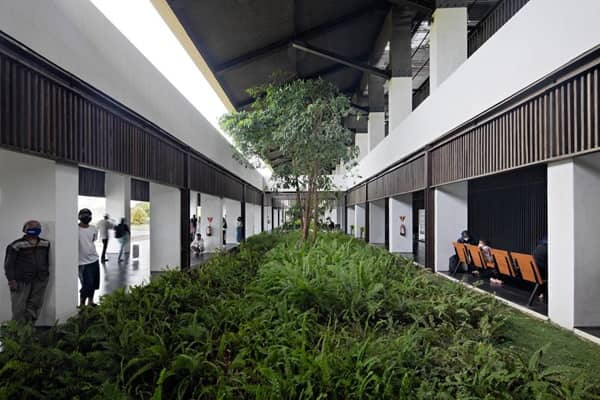
Banyuwangi Airport in East Java is the first green airport in Indonesia
and was recognised with an award from the Aga Khan Award for Architecture (AKAA) in 2021-22.
Banyuwangi’s appeal is less about novelty and more about sound old-fashioned logic. Sitting at Java’s eastern tip, the airport operates as a natural bridge between Java and Bali, while offering proximity to high-value tourism destinations without the congestion and cost structures of Indonesia’s larger gateways.
Chief executive Wirmandi Sugriat described the decision as both strategic and philosophical.
“Banyuwangi offers the rare combination of forward-thinking airport infrastructure, environmental leadership, and an ideal geographic position,” he said. “Establishing Banyuwangi as our first base allows us to move beyond conventional aviation models and create a gateway to several of Indonesia’s most popular but also remote and ecologically significant destinations.”
Under a Build-Operate-Transfer framework, Santai Seaplane will develop a dedicated operations and sales centre within the airport precinct, reinforcing a long-term commitment rather than a seasonal experiment.
Amphibious aviation moves from concept to concrete
Initial services will operate under existing permits for water landings at Banyuwangi’s designated water aerodrome, Menjangan in North Bali, and selected southern Bali locations. Together, they form the first phase of a broader network of certified water aerodromes designed to integrate land- and water-based aviation.
Commercial flights are slated for early 2026, with demonstration services and technical feasibility studies for new sites to be completed within the same timeframe. It is a deliberately staged rollout—measured, compliant and quietly ambitious.
According to Michael Aumock, Banyuwangi provides the operational backbone needed to do this properly.
“From a commercial and operational standpoint, Banyuwangi provides the scale, tourism access and institutional support required to responsibly grow amphibious aviation in Indonesia,” he said.
Routes that sell the view before the runway
From its Banyuwangi base, Santai Seaplane is developing a route portfolio that reads like a greatest-hits list of Indonesian landscapes. Planned connections include Wisnu Airport, Denpasar, Lombok and the ultra-exclusive Moyo Island.
Passengers can also expect curated scenic flights over Mount Ijen and Mount Bromo, two of Java’s most photogenic volcanoes, alongside tailored aerial tours of Bali’s coastline. For those less interested in sightseeing and more focused on speed, the fleet will also service bespoke charter routes to Surabaya, catering to corporate and high-net-worth travellers.
Cruise passengers arriving through Benoa and East Java ports are firmly in Santai’s sights, with shore-excursion flights designed to turn tight port schedules into premium, time-efficient experiences.
More than tourism: connectivity with purpose
Beyond luxury travel, the Banyuwangi hub unlocks practical capabilities often overlooked in glossy route maps. Inter-island charters will improve access to high-growth destinations such as Mandalika and Bangko Bangko in Lombok, supporting sports tourism and events.
There is also capacity for cargo delivery, medical evacuations, and corporate mobility services, making amphibious aviation not just glamorous but genuinely helpful.
As Rahmat Adil Indrawan, Regional Commercial Deputy overseeing Banyuwangi, Denpasar, Lombok and Kupang, noted:
“By integrating amphibious operations, we are expanding the airport’s role as a vital link between East Java and the surrounding archipelagos.”
A green airport meets green aviation
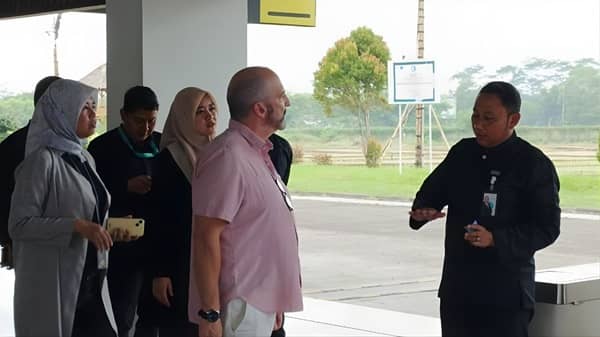
Mr Michael Aumock, Chief Commercial Officer of Seaplane Asia (middle) and Mr Mohamad Holik Muardi,
General Manager of Banyuwangi Airport, during a recent visit
for partnership finalisation between Santai Seaplane and Banyuwangi Airport
Banyuwangi Airport’s sustainability credentials are not window dressing. Designed by acclaimed architect Andra Matin, the terminal’s naturally ventilated structure and grass-covered roof have made it a global reference point for low-impact airport design.
For Santai Seaplane, the alignment is seamless. Low-altitude operations, water landings and short-haul routes dovetail neatly with the airport’s “nature-first” philosophy.
General Manager Mohamad Holik Muardi said the partnership enhances the airport’s role as a centre of excellence.
“As Indonesia’s first ‘Green Airport’, we are proud to host an operator that shares our commitment to environmental sustainability and innovation.”
A quiet shift with loud implications
Santai Seaplane’s choice of Banyuwangi may not carry the headline heft of a Jakarta expansion. Still, it represents something arguably more important: a more innovative way of connecting Indonesia’s islands without overwhelming them.
In an industry long obsessed with scale, Santai’s amphibious strategy favours precision. And in a region where the journey is often as valuable as the destination, Banyuwangi has just become one of Indonesia’s most interesting departure points.
by Octavia Koo – (c) 2025
Read Time: 4 minutes.
About the Writer.
 Indonesian-born Octavia Koo arrived in Australia in the early 1980s, drawn by the creative promise of Sydney and a place at UNSW, where she studied Arts and soon discovered her flair for visual storytelling. She began as a graphic designer, quickly turning her sharp eye for detail towards the digital frontier, designing websites and crafting polished descriptions that draw people in—and keep them reading.
Her next chapter took her to Singapore, where she built and managed blogs for several tourism platforms, uncovering a natural gift for SEO long before the term became fashionable. There, amid the buzz of ITB Asia, she met Stephen, who suggested she consider Global Travel Media. A few years later, she did just that.
Now part of GTM’s editorial family, Octavia brings a quiet brilliance to her work. She merges art, technology, and intuition to tell travel stories that charm and perform, much like their author.











