

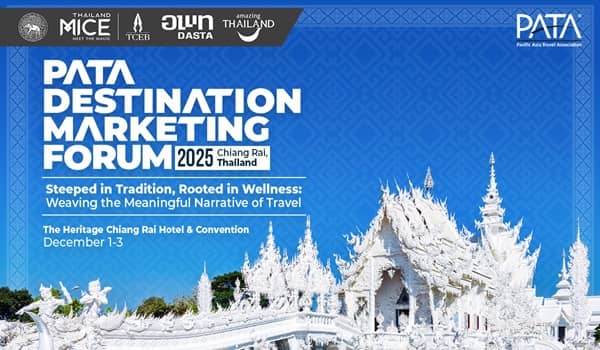
By any measure, Chiang Rai has always been the gentle achiever of northern Thailand, a place where mist-covered hills, temple-dotted skylines and a famously warm local welcome have long been its calling card. But come December, the province intends to trade its quiet confidence for centre stage as it hosts the PATA Destination Marketing Forum 2025, an event now shaping up to be one of the Asia-Pacific tourism sector’s most anticipated annual gatherings.
For a region built on centuries-old craftsmanship and deep-rooted tradition, the decision to host the three-day forum is more than a logistical win; it’s a statement of intent.
And a crowd has certainly taken notice. With over 300 delegates from 19 destinations confirmed, Chiang Rai is preparing for what organisers describe as a genuine “full house”, with global tourism leaders descending on the city to explore how the future of travel can be built on cultural pride, inclusivity and integrity.
A Ministerial Opening with Symbolic Weight
The event’s significance is underscored by the decision to formally open the conference by Mr Napintorn Srisunpang, Minister Attached to the Prime Minister’s Office of Thailand. It’s a gesture that signals national confidence in the region’s potential as a model for sustainable tourism development and one that sits comfortably within the nation’s broader strategic agenda.
The Pacific Asia Travel Association (PATA), working in collaboration with the Thailand Convention and Exhibition Bureau (TCEB), unveiled the full programme this week. The forum will run from 1–3 December at The Heritage Chiang Rai Hotel & Convention, with a curated mix of panels, workshops and cultural showcases designed to highlight the Asia-Pacific region’s most compelling tourism narratives.
“A destination that treasures its heritage while confidently embracing innovation holds the key to enduring success,” PATA CEO Noor Ahmad Hamid said. “We are deeply grateful to our hosts, partners, and especially the warm and resilient people of Chiang Rai for showcasing this spirit so beautifully. PATA is delighted to bring the world to Chiang Rai, and the PATA Destination Marketing Forum 2025 has been thoughtfully designed to reflect this balance, offering experiences and insights that inspire tourism leaders to shape their destinations with cultural pride and a forward-looking vision.”
Hamid went on to acknowledge the depth of collaboration behind the scenes: “It has been a pleasure to work closely with Chiang Rai Province, the Thailand Convention and Exhibition Bureau, the Designated Areas for Sustainable Tourism Administration, and the Tourism Authority of Thailand in preparation for PDMF 2025. Their steadfast support is what makes this event possible.”
His remarks carry the tone of a seasoned diplomat who knows that tourism is never just about visitor numbers; it is about stewardship.
Culture First, Today and Tomorrow
This year’s theme, “Steeped in Tradition, Rooted in Wellness: Weaving the Meaningful Narrative of Travel,” reads almost like a mission statement for the region.
For Chiang Rai, a UNESCO Creative City of Design, the theme isn’t mere marketing polish. The city has spent years building a reputation around local artistry, Lanna heritage and nature-based experiences that avoid the clichés of mass tourism. The forum’s agenda reflects this, bringing together thought leaders and innovators whose work nudges the industry toward a more mindful, less disposable tomorrow.
Delegates can expect deep-dive discussions across wellness, hyper-local travel, cultural identity, destination reinvention and the delicate dance between tradition and technology.
Among the stellar speaker line-up are business leaders, professors, sustainability advocates, creative directors, city governors and regional tourism chiefs. The ensemble includes Ms Aoranich Saleewong of Sawanbondin Group, Dr Supawan Teerarat of TCEB, Mr Paul Pruangkarn of PATA, Ms Hannah Pearson of Pear Anderson, Mr Kenji Kondo of KIITO in Kobe, Mr Hyun-chul Shin of the Jeju Tourism Organisation, Mr Julinus Jeffery Jimit of Sabah Tourism Board, and more than two dozen others whose credentials cover everything from creative economies to regenerative tourism.
It’s a line-up that wouldn’t look out of place at a global innovation summit.
A Welcome That Starts With the Senses
The forum begins with a flourish on 1 December, with the “Chiang Rai WOW Market & Famous Food Festival” hosted at Chiang Rai Rajabhat University. Featuring seven zones and 100 stalls, the event will showcase the region’s moreish specialities, the sort of dishes that food writers describe with dangerous abandon.
From local snacks to artisan crafts and cultural performances, it’s designed as an immersive introduction to Chiang Rai’s identity. Delegates will have barely shaken off their jet lag before they’re handed something fragrant and slow-cooked.
On 2 December, delegates choose from three DASTA-curated technical tours, each with its own flavour:
-
Creative City of Design for Sustainability
-
Cave, Coffee and Contemporary Culture
-
History, Locality and Artisans
These journeys go beyond scenic views, taking visitors into the fabric of communities from Akha tribal performances in Pha Mee Village to hands-on craft experiences in Chiang Saen. The idea is simple: if you want the world to understand a destination, let the people who shape it tell the story.
There’s also a touch of friendly competition: delegates are invited to post creative content to their social media channels, with a prize announced at the final conference.
And as every seasoned conference-goer knows, nothing builds camaraderie like a shared meal. The evening welcome dinner at Singha Park promises a spread of Lanna favourites, including Mini Rice Cracker with Nam Prik Ong, Hung Lay Pork Curry, and Phulae Pineapple Fritters A-La-Mode.
A Day of Ideas, Artistry and Ambition
The leading conference on 3 December begins with a cultural performance and opening remarks from PATA Chair Peter Semone, TCEB President Dr Supawan Teerarat, and senior representatives from TAT, DASTA and Chiang Rai Province.
Then the heavy lifting begins. Sessions include:
-
Traditions Replanted: The Transformation of A Destination
-
Wellness: Taking a Holistic Approach to Travel
-
Attracting the International by Focusing on the Hyper-local
-
A Destination from the Artists’ Perspective
-
From Creative Economy to Future MICE Setting
-
Tech with a Soul
-
A New Paradigm for Regenerative Destinations
Coffee and tea, Chiang Rai’s pride and joy, will also get their moment in the spotlight. Delegates can expect tastings, stories and a reminder that good ideas always flow more freely with a warm cup in hand.
The day concludes with a farewell reception themed “The Taste of Wellness, Experience WOW Market”, extending the spirit of opening night with more local fare and artisanal celebrations.
For visitors who wish to linger a little longer, PATA and local partners are also offering optional self-pay tours, with itineraries ranging from one-day excursions to three-day cultural immersions.
A Thoughtful Touch in a Time of Respect
With Thailand observing national mourning following the passing of Her Majesty Queen Sirikit, the Queen Mother, attendees have been asked to dress in muted, respectful colours. TCEB has provided guidelines on the event’s official page, a reminder that travel doesn’t occur in a vacuum and that cultural sensitivity is not a footnote but a responsibility.
A City Ready for Its Close-Up
To ensure global audiences can access reliable information in English, PATA has also published an “About Chiang Rai” digital guide at www.pata.org/about-chiang-rai. The page showcases Chiang Rai’s creative districts, natural landscapes, digital nomad appeal, and cultural legacy, a timely resource for delegates planning their itineraries.
The event’s supporter roster is equally impressive, including Chiang Rai Province, TCEB, DASTA, TAT, Vietjet, Thai Airways International, HotelPlanner, The Heritage Chiang Rai Hotel & Convention, and youth partners including Mae Fah Luang University and Wanasom MFU.
In an era when global tourism is grappling with sustainability, authenticity and post-pandemic recalibration, Chiang Rai’s approach feels refreshingly grounded: invest in people, honour your heritage, and let the storytellers, artists, elders, innovators, and growers lead the narrative.
It’s a philosophy as old as travel itself, and as relevant as tomorrow’s headlines.
By Octavia Koo – (c) 2025
Read Time: 7 minutes.
About the Writer
 Indonesian-born Octavia Koo arrived in Australia in the early 1980s, drawn by the creative promise of Sydney and a place at UNSW, where she studied Arts and soon discovered her flair for visual storytelling. She began as a graphic designer, quickly turning her sharp eye for detail towards the digital frontier, designing websites and crafting polished descriptions that draw people in—and keep them reading.
Her next chapter took her to Singapore, where she built and managed blogs for several tourism platforms, uncovering a natural gift for SEO long before the term became fashionable. There, amid the buzz of ITB Asia, she met Stephen, who suggested she consider Global Travel Media. A few years later, she did just that.
Now part of GTM’s editorial family, Octavia brings a quiet brilliance to her work. She merges art, technology, and intuition to tell travel stories that charm and perform, much like their author.











