

Global leisure travel, long regarded as the world’s favourite discretionary pastime, is now gearing up for an economic era that economists describe — with rare enthusiasm — as nothing short of transformative. New analysis from Boston Consulting Group projects global leisure spending to hit US$15 trillion by 2040, tripling its 2024 value and cementing travel as one of the planet’s most enduring economic engines.
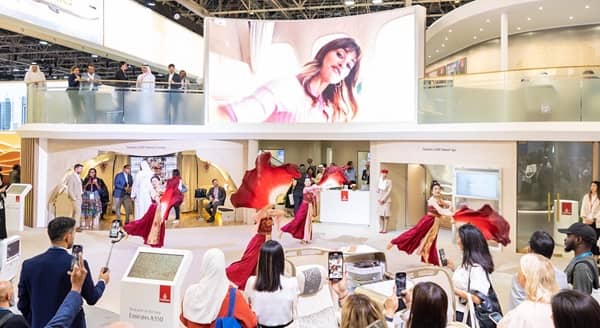
If the numbers sound bold, the Middle East seems determined to make them look modest. The region, already one of the fastest-growing tourism markets, is expected to post annual leisure-spending growth of 7% between 2025 and 2030, a rate second only to the Asia-Pacific. It is this momentum that will take centre stage at Arabian Travel Market (ATM) 2026, returning to the Dubai World Trade Centre from 4–7 May.
This year’s theme, “Travel 2040: Driving New Frontiers Through Innovation and Technology”, may sound suitably futuristic, but for industry leaders preparing for a sharply different travel landscape, 2040 feels closer than the calendar suggests.
A leisure landscape reshaped
ATM’s Travel Trends Report — produced with Tourism Economics — forecasts that the Middle East will record 1.5 billion international tourism nights by 2030, up 90% from 2024. Europe remains the region’s largest source market, accounting for half of current leisure arrivals, but the next five years are expected to bring accelerated growth from Africa and the Asia-Pacific.
In the language of economists, this is “structural trend acceleration”. In the language of hotel general managers, it means “get the rooms ready”.
Leisure travellers — no longer conveniently grouped by age, income or favourite pool temperature — are splintering into dozens of niches. Tourism Economics found Millennials and Gen Z, unsurprisingly, are planning more trips, embracing digital tools, and seeking experiences tailored to their personal values. Multigenerational travel, once a logistical novelty, is now standard fare. Solo travel, meanwhile, has moved from fringe to firmly mainstream.
And if industry sentiment is any guide, leisure events are emerging as the next major growth engine. Half the experts surveyed rated them the single strongest opportunity, pointing to the global appetite for culture, sport, wellness, and the occasional splash of Instagram-approved adventure.
“A defining moment” for the region
Danielle Curtis, Exhibition Director ME for Arabian Travel Market, says the numbers reflect more than cyclical recovery. They speak to a region that has “deliberately and decisively repositioned itself” at the heart of global tourism.
“By 2030, there are expected to be nearly 30 billion tourism nights globally, with the Middle East accounting for around 8% of those nights,” Curtis said. “During the same period, leisure nights in the region are expected to grow by 87%, reflecting the region’s rapid infrastructure development, and its expanding experiential and cultural offerings. ATM 2026 will bring together the destinations, attractions, brands and innovators shaping this US$15 trillion opportunity.”
Her point is difficult to dispute. The Middle East’s investment in airports, resorts, cruise terminals, cultural districts and mega-events has repositioned its cities as year-round global gateways — and, in Dubai’s case, as a highly efficient one. The emirate now connects travellers to more than 240 destinations across six continents, reinforcing its role in a travel ecosystem that increasingly prizes connectivity above all.
A global industry takes notice
With 2,600 exhibitors from 161 countries and more than 47,000 attendees expected, ATM 2026 is shaping up as one of the most closely watched editions in the event’s 33-year history. The scale alone signals where global confidence is gathering: squarely in leisure.
Exhibitors are preparing to showcase everything from ultra-luxury desert resorts to city-break experiences, wellness retreats, cruise line expansions, sustainable tourism models, and next-generation aviation technology. In short, a global industry keen to capture a slice of the US$15 trillion future.
The growth projections come at a time when travellers are more values-driven, more digitally enabled and considerably more selective than they were a decade ago. For destinations, this means sharper storytelling; for airlines, broader networks; and for hotels, greater investment in experience over square metres.
In the Middle East, the strongest demand continues to come from beach escapes, urban exploration and desert-nature experiences. Sports tourism — powered by new events calendars and year-round facilities — is accelerating rapidly, while wellness retreats and cultural immersion experiences are moving into mainstream demand.
A future built on innovation and tradition
This dual focus on cutting-edge innovation and a deepening sense of cultural heritage mirrors the broader shift in global leisure travel. Travellers are seeking authenticity, but not at the expense of comfort. They want cultural meaning, but also seamless logistics. They want tradition, but not inconvenience.
Curtis says the region is exceptionally well-positioned to achieve this balance.
“Leisure tourism can no longer be defined by a single demographic or travel style. Today’s travellers are seeking authentic, personalised experiences that reflect their values,” she said. “For this reason, the Middle East is ideally placed to play a defining role in the coming era of global tourism, and we look forward to welcoming the international travel industry to Dubai in May to explore these opportunities together.”
Showcasing the next chapter
ATM 2026 will also shine a spotlight on industry developments across the Middle East, North Africa and South Asia (MENASA). Returning features such as the ATM Ultra Luxury Lounge, IBTM @ ATM, and the co-located ATM Travel Tech, now expanding to two halls, will demonstrate how new traveller segments are reshaping demand and how destinations are responding.
From emerging tech to heritage tourism, from new aviation partnerships to the revival of slow travel, the conversations in Dubai this May will reflect a sector not merely rebounding but re-inventing itself.
In an industry where cycles once defined strategy, the coming decade and the path to US$15 trillion will favour those who can read the cultural winds, embrace innovation, and deliver the kind of leisure experiences the modern traveller now expects as standard.
And if the forecasts hold, the Middle East will not just be part of the story; it may well set the pace for everyone else.
-
ATM Exhibitor Enquiry: https://www.wtm.com/atm/en-gb/forms/exhibitor-enquiry.html.
-
ATM Information: https://www.wtm.com/atm/en-gb.html.
By Stephen Morton – (c) 2025
Read Time: 6 minutes.
About the Writer
 Stephen Morton has spent nearly five decades shaping how the travel industry works, talks, and sells itself. From the family-run agency of 1976 to today’s digital frontier, Morton has been at the front of the queue, often long before anyone else knew there was a queue.
By the mid-nineties, he was dragging Agents Support Systems online while the industry still worshipped the fax machine. In 2001, he launched e-Travel Blackboard (eTB), a daily newsletter that became Australia’s most read industry bulletin and expanded across New Zealand, Asia, the Americas, and into MICE.
In 2009, Global Travel Media came, going on to scoop multiple international awards, including Best Travel Industry Website and Outstanding Digital Media Service. Later came Destination Thailand News, Global Cruise News, and now, in 2025, GTM Holidays and the forthcoming GTM Mall.
Whether lecturing students or launching titles, Morton has always been ahead of the curve, a travel industry stalwart who has turned instinct into impact.











