

If you’ve ever wondered what keeps a hotel manager awake at three in the morning, it’s not always the minibar audit. More often, it’s the hotel’s technology stack, an invisible web of systems meant to keep everything humming from booking engines to revenue forecasts.
Now, a new report from the NYU Jonathan M. Tisch Centre of Hospitality, produced with Stayntouch and IDeaS Revenue Solutions, confirms what many in the industry have long whispered over conference coffees: the once-trendy all-in-one hotel platform is losing its gloss, and the cool kids are moving to Best-in-Class systems.
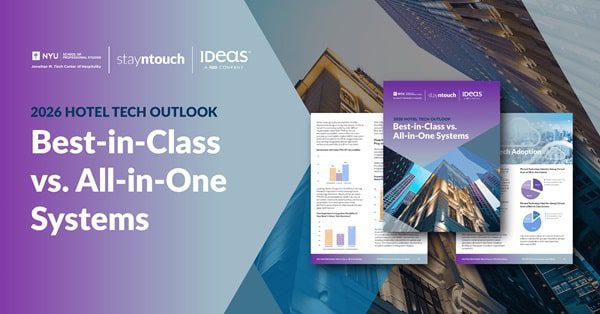
The 2026 Hotel Technology Outlook: Best-in-Class vs. All-in-One Systems surveyed more than 300 hotel professionals around the globe. Its findings are as clear as a freshly polished lobby floor: flexibility and function are trumping simplicity and sameness.
The ‘everything box’ loses its shine.

Front desk harmony – where better tech meets that old-fashioned personal touch.
Not so long ago, all-in-one systems were hailed as the future, sleek, single-dashboards that promised to run an entire property from one screen. For smaller hotels, it was technology’s Swiss Army knife. But somewhere along the line, the knife started to blunt.
According to the NYU study, 30 per cent of all-in-one users are preparing to switch to Best-in-Class solutions, while only 14 per cent of the latter are moving the other way. In other words, the migration has a distinct direction away from the one-size-fits-all and toward tailored toolkits.
“The findings are clear,” said Jacob Messina, CEO of Stayntouch. “Hoteliers are choosing Best-in-Class solutions for their specialised functionality and flexibility. At Stayntouch, we’ve built a partner ecosystem that makes integration easy giving hotels tools that work together seamlessly to drive both guest satisfaction and operational performance.”
It’s a polite way of saying that hotels have grown tired of trying to make a single platform juggle revenue management, housekeeping schedules, guest messaging, and spa bookings and still smile about it.
When one system does too much
The data behind the discontent are revealing. All-in-one users report significantly more guest-facing mishaps: 57 per cent admit to booking errors, 51 per cent to missed preferences, and nearly half to check-in delays.
That last one, incidentally, is the sort of statistic that makes front-desk staff sigh audibly.
Hotels using Best-in-Class systems, on the other hand, report smoother sailing. Satisfaction scores run higher across the board, 70 per cent approval for property management systems and 59 per cent for revenue management tools, compared with 55 and 51 per cent respectively for the all-in-one camp.
One might say that the era of the monolithic “everything” system is beginning to look like the fax machine of hotel tech, a fine idea in its day, but not something you’d rely on in 2026.
Size matters (but so does ambition)
The report found that large independents and mid-sized properties (those with 101–250+ rooms) overwhelmingly prefer Best-in-Class setups, with 68 per cent already using them. The smaller outfits, those with under 100 rooms, remain loyal to all-in-one systems, mainly for cost reasons and the promise of simplicity.
That’s understandable. For a boutique operator, the thought of managing ten different vendors might feel like hosting ten weddings at once. But as one hotelier quipped during the survey interviews, “simple doesn’t mean painless, it just means you’re stuck with whatever you’ve got.”
And what they’ve got, increasingly, is less than ideal.
The human element behind the tech
“We’re proud to share this research, especially at a time when hoteliers rely on technology to enhance efficiency and profitability,” said Vanja Bogicevic, Clinical Associate Professor at NYU’s Tisch Center. “This collaboration reflects our mission to expand experiential learning and foster innovation.”
There’s something quietly encouraging about that statement. Amid all the data points and dashboards, it’s a reminder that hospitality remains a human craft. Technology isn’t replacing the human touch; it’s being asked to behave more like one.
The report shows that hoteliers value usability and support above all else. Only 34 per cent of those planning to switch from all-in-one systems say they’re satisfied with their current level of training and support. Translation: too many operators feel like they’re managing the system rather than the other way around.
Integration: the final frontier
Every hotelier, regardless of system, agrees on one thing: integration is the bane of their digital existence. Thirty-eight per cent listed it as their top frustration.
“Hoteliers want consistent, effective technology that allows for future growth and innovation,” said Klaus Kohlmayr, Chief Evangelist and Development Officer at IDeaS. “With 51 per cent of respondents planning upgrades within two years, collaboration between tech providers is crucial.”
It’s a diplomatic way of saying the industry needs to talk to itself more often. The average hotel tech stack resembles a mismatched collection of puzzle pieces: a PMS from one company, a booking engine from another, a guest app from a third, and none of them quite lining up.
The opportunity, as the report makes clear, lies in open APIs and stronger partnerships, the sort that let systems share data cleanly and let hoteliers spend less time playing digital plumber.
From philosophy to practice
The broader message of the NYU report is less about software and more about mindset. Hotels are no longer chasing the illusion of one perfect platform; they’re building ecosystems that fit their own rhythm.
In Peter’s parlance, it’s not about buying one orchestra; it’s about choosing the right players and making sure they’re in tune.
Best-in-Class isn’t just a buzzword; it’s a recognition that the hotel business has grown too complex, too data-driven, and too guest-centric to rely on one tool for everything. It’s also a nod to the future of hospitality, where success will hinge less on the tech itself and more on how it complements the human experience.
Where from here?
As we edge toward 2026, the hotel industry is at a digital crossroads. The pandemic may have accelerated automation, but what’s emerging now is a more mature understanding of technology, one that values integration, insight, and individuality over convenience.
For some, that means a re-education in what technology is for. It’s not about replacing front-desk charm with silicon efficiency; it’s about ensuring the charm doesn’t get lost in translation between systems.
And if that means a few more vendors, a few more API calls, and a little more learning along the way well, that’s the price of staying in tune with the times.
Download the full report.
By Prae Lee – (c) 2025
Read time: 6 minutes.
About the Writer
 You can tell a lot about a person by how they handle a busy Bangkok morning. Prae Lee doesn’t rush; she glides through it. There’s a calm certainty about her, the sort that comes from knowing where you come from and where you’re going.
Educated at Chulalongkorn University, she took her business degree with the quiet pride of someone who believes in doing things correctly. Her travels for further study in Singapore and Australia didn’t change her; they polished what was already there: curiosity, discipline, and grace.
She returned to her family business in Bangkok, breathing a little modern life into it. She handled social media with the intuition of someone who listens and sells with the gentle persistence the Thais do so well.
Prae doesn’t make a fuss, but everything she touches shines brighter.
Now part of the Global Travel Media family, Prae brings authenticity and quiet confidence to her writing, drawing from a life steeped in culture, travel, and connection.











