

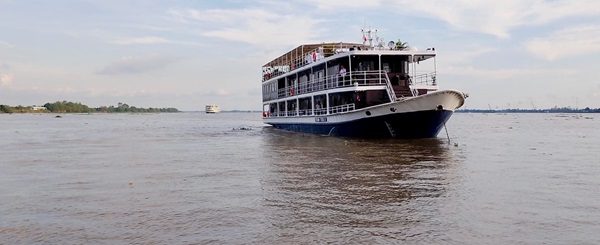
A hearty, foaming stein of fine pilsner in a German-Vietnamese brewery bar; an ascent to the top of a mountain by Austrian cable car; a bird-watching trip on a jungle waterway and a placid cruise with a friendly crew down one of the world’s great rivers.
Those are just some of the ingredients that make for a highly enjoyable visit to Vietnam. Sail down the Mekong from Cambodia on the good ship Toum Tiou II, operated by CroisiEurope’s CF Mekong River Cruises.
There are plenty of other little touches to the trip: a speedboat excursion; a perfectly presentable impromptu haircut for just $4; roadside snacks of every description; salty smoked cheese like thick string at the breakfast table (apparently Armenian/Georgian and introduced by the Russians); carrot and winter melon soup (which is delicious); biking and kayaking, pagodas and temples, fine meals aboard and camaraderie all the way.

Convivial companions aboard Toum Tiou II
I’ve visited Vietnam before, over the years – the first time just a few years after the end of the Vietnam War (which the Vietnamese, with justification, call “the American War”). Vietnam’s infrastructure continues to improve while the sights and flavour of the country – the essence that makes you want to visit and re-visit – remains undiminished.
The legions of bicycles that used to swish around Saigon’s city streets have long since given way to mopeds, cars, and (increasingly) stylish Vinfast electric taxis, GrabBikes, and GrabTaxis—but Vietnam’s pulse and soul are intact.
In many cases, roads are better. The highway between Saigon (officially Ho Chi Minh City) and Phnom Penh is so smooth these days, and the coaches are such excellent value (US$35 one-way), you would hardly bother to fly the route, unless you’re in a hurry. You can fly into Ho Chi Minh City (plenty of flights there from Australia), and the excellent state of the road to Cambodia lets you take a coach to Phnom Penh to start your Mekong cruise.
The road between Ho Chi Minh and Phnom Penh is flat and straight, and the Giant Ibis coach is so plush (complete with WiFi and air conditioning) you can even read a book while travelling. Most people prefer to gaze at the passing view, but being able to read gives an idea of the smoothness of the journey. (Compare that to trying to read on a Sydney bus!)

Sa Dec, Mekong Delta, Vietnam
But enough about road travel. The Mekong is the star, aboard the river cruise vessel Toum Tiou II, operated by CroisiEurope’s CFMekong River Cruises. This boutique 38-metre ship suits the river, being in scale with local infrastructure and culture, which can’t be said for the ostentatious, Danube-cruise-style vessels plying the same waterway, some with their own swimming pools. These seem highly incongruous on this working river, fringed with little villages and fish farms.
By contrast, Toum Tiou II is at home in its surroundings. It sleeps just 28 passengers, maximum, in 14 berths, plus the crew. A six-day/five-night cruise gives plenty of time to meet your shipmates. The food, prepared by trained chefs, is superb, with cooked breakfasts, à la carte lunches and four-course dinners. Cooking for a limited number of guests lets the chefs excel. The result is evident every day.
The nights are lively. One of the crew members on my cruise was an outstanding dancer. After a few drinks, we made comparisons with Michael Jackson.
Sights and experiences roll along with the wide brown Mekong. A motorboat and rowing boat tour winds through verdant Tra Su Forest, full of floating lotus blossoms and visiting birds. Then there’s the cable car ride to the summit of Sam Mountain, a spectacular experience gliding to the heights on a 900-metre-long cable car system installed by Austria’s Doppelmayr. Take in sweeping vistas of Chau Doc City, the distant border of Vietnam and Cambodia, rice paddies and Hang Pagoda, perched on a cliff.
-
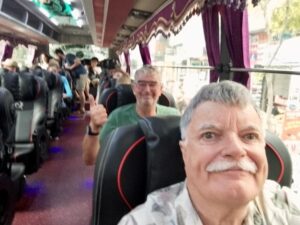
- The author aboard the Giant Ibis bus, about to depart Saigon for Phnom Penn
-
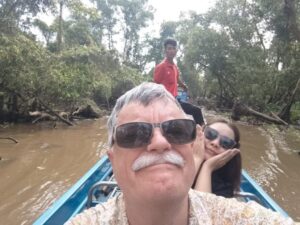
- The author cruising waterways off the Mekong
My cruise ended at Saigon docks, Ho Chi Minh City. Delicious, cheap eateries abound in this city, and there is much variety. While enjoying breakfast on the streetside one morning, I ordered chicken pho, a Vietnamese specialty. My dining companion chose a pepperoni pizza and a banana milkshake. Why not?
Saigon is huge – the city’s population is generally estimated to number just over 14 million. That’s bigger than Sydney and Melbourne combined. With 70% of the Vietnamese aged under 35, Saigon caters to all ages, with bars and dance-floors, more sedate entertainment, and even a German beer hall.
Don’t miss Hoavien Craft Brewery, which purveys fine beers, steak, and wine for an evening style change from Vietnamese fare. You can sink German-style steins and devour great grills here – hearty beefsteak, lamb ribs, Russian salad. There’s even an Argentine steakhouse in this city, named El Gaucho. Be advised: it isn’t cheap and, when I visited, waiters outnumbered diners. Maybe I chose the wrong day.
As for hotels, I stayed at the Liberty Hotel Saigon Parkview in Ho Chi Minh City and the Anik Palace Hotel in Phnom Penh. Both are fine, comfortable establishments, well situated and very moderately priced by Australian standards.
Anik Palace Hotel in Phnom Penh is a luxurious and friendly Western-style property. Try its excellent rooftop swimming pool!
-
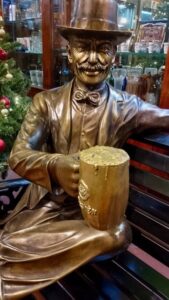
- Bronze statue captures the spirit of Hoavien Craft Bewery in Saigon
-

- The author cooling down at a streetside cafe
-
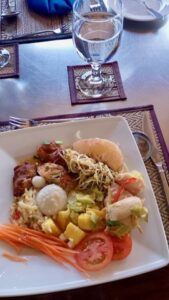
- Delicious and healthy fresh fare aboard Toum Tiou II
Liberty Hotel Saigon Parkview faces a pleasant park and is a short stroll (just a few minutes) down some fascinating alleys to Bui Vien Street, which comprises three main streets: Bui Vien, De Tham, and Pham Ngu Lao. By night, this becomes a fascinating walking precinct, a perfect place to catch the passing parade; backpacker heaven, crammed with restaurants, coffee shops, hostels, pubs, and bars. This was where I obtained my haircut for four Australian dollars. A snip!
The author was a CF Mekong River Cruises guest, and the tour was the TOUM TIOU II New Discovery Tour.
Tips, tricks and advice on gaining entry to Vietnam
Vietnam is an excellent destination, friendly and generally safe. If it introduced a visa-waiver, or simple visa-on-arrival system for tourists, like Thailand and Indonesia, tourist numbers from Australia to Vietnam would rocket.
In June 2025, 31,840 Australian residents visited Vietnam—impressive but nothing like the 149,260 Aussies who visited Indonesia (almost entirely Bali) in the same month.
My advice is to check the visa requirements carefully before departure for Vietnam, and if you need a visa, apply months (yes, months) in advance.
The embassy advises that travellers should apply for e-visas months before their travel. Always remember to put your full name, double-check every piece of information before submitting, and recheck the e-visa after receiving it. The processing time may vary from case to case, and many e-visa applications are rejected.
Speaking personally, I applied for a Vietnam tourist visa in an Australian passport on 7 November 2024. Almost a year later (27 October 2025), it is still listed as “in processing”.
During that time, I enjoyed an excellent trip to Vietnam.
So, how did I do that without a visa?
It happened this way: Shortly before departure, I discovered that certain nationalities are exempt from requiring visas to visit Vietnam. Australia is not one of those countries, but the United Kingdom is, and it so happens that I also hold a British passport. I am one of the dreaded “dual nationals” who are not allowed to stand for election to Australia’s parliament. (Which suits me!)
At the last minute, I decided to use the British passport instead. This secret weapon saved my trip. I dropped into the Vietnam Airlines office in Sydney, which was extremely helpful, switching my booking from my Australian passport to my British passport in just a few minutes.
To enter Vietnam, you must hold a valid passport for at least six months between your entry and expiration dates. If your nationality is not on the visa exemption list, you must obtain a valid e-visa.
Check before departure (obviously), but Vietnam’s visa waiver program this year covered citizens of Germany, France, Italy, Spain, the UK, Russia, Japan, South Korea, Denmark, Sweden, Norway, Finland, and Belarus, with a stay of up to 45 days from the date of entry.
I found the Cambodian visa much easier to obtain, but once again, check and check again.
By Peter Needham – (c) 2025
About the Author
 With more than 35 years in travel journalism, Peter Needham has filed stories from Fleet Street to Fiji and almost everywhere. As Managing Editor (Australasia) for Global Travel Media, he shapes the site’s industry coverage while continuing to write with the flair and authority honed over decades.
Since turning freelance in 1993, Peter’s byline has graced mastheads ranging from the Sydney Morning Herald and Australian Financial Review to Reader’s Digest and Qantas’ inflight magazines. He edited Inside Tourism for seven years, contributed a long-running “Travel Tales” column to Vacations & Travel, and even penned copy for Tourism Australia ahead of the Sydney 2000 Olympics.
Peter has travelled widely, a Reuters, Guardian, and AAP veteran, from South American backpacking trails to a Saudi Arabian military hospital, collecting stories as only a true newspaperman can.











