

For all the talk about open skies, modern air travel has become a curiously closed affair.
Behind the glossy websites and frequent-flyer promises, a quiet war is unfolding not in the air, but online, and the casualty may be your right to find a cheap ticket.
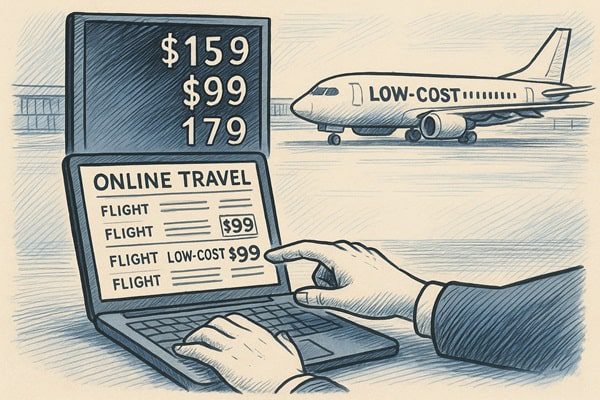
That’s the warning from the Travel Technology Association, whose new white paper, The Role of Online Travel Platforms in Supporting Low-Cost Travel, argues that the digital marketplace once designed to empower travellers is slowly fenced off by the airlines dominating it.
Their conclusion lands with the sting of irony: while technology was meant to democratise airfare shopping, legacy carriers use that technology to restrict visibility, steer bookings, and squeeze out smaller rivals.
“Online travel platforms play a vital role in maintaining a competitive air transportation ecosystem,” the paper says before explaining how that ecosystem is quietly eroding.
The invisible hand that hides the bargain
When online travel agencies first arrived, Expedia, Kayak, Skyscanner, and others promised transparency. For the first time, a traveller could compare a half-dozen airlines at a glance and book without surrendering to a single brand’s sales pitch.
Now, that promise is dimming.
The report says legacy airlines are restricting data access to those platforms. The result: fewer visible fares, fewer genuine comparisons, and more travellers herded toward airline-owned sites where “choice” is an illusion wrapped in loyalty points.
In economic terms, it’s a neat sleight of hand. In human terms, it’s like turning on the lights in a market only to have the biggest stallholders dim them again.
Why cheap seats need clear skies
For ultra-low-cost carriers (ULCCs) like Spirit, Frontier, and in Australia, Bonza or Jetstar, visibility is oxygen. They rely on online platforms to reach travellers who may never have heard of them.
Unlike legacy carriers, they don’t have billion-dollar advertising budgets or deep frequent-flyer databases. Their entire model depends on appearing in the digital shopfronts’ comparison grids, where a $79 fare can outshine a $279 one.
Travel Tech puts it bluntly: without those listings, ULCCs “would struggle to reach a broad audience, market their differentiated pricing strategies, and maintain competitive pressure.”
That pressure matters. It’s the quiet force keeping airfares honest. Remove it, and prices float upward faster than a balloon at an aviation expo.
How legacy airlines tilt the screen
The tactics, according to the report, are subtle but effective.
Legacy carriers share route and fare data selectively, withholding cheaper classes or ancillary fees from online platforms. Some impose surcharges on tickets sold through intermediaries. Others quietly encourage “direct-only” sales by offering bonus miles or small discounts, the digital equivalent of whispering, “You’ll get a better deal if you come to us.”
The cumulative effect? Travellers searching online see a curated version of reality that flatters the big players and leaves the budget airlines looking patchy or invisible.
“Consumers cannot compare the full range of fares, routes, and availability,” the report notes, “making it harder to identify the lowest-cost option.”
In other words, comparison shopping, that great equaliser of capitalism, is being selectively dismantled by the companies that fear it most.
The consequences ripple far beyond America.
While the report examines the U.S. market, anyone familiar with Australia’s aviation landscape will find the parallels unsettling.
Here too, the dominance of Qantas and Virgin Australia leaves little oxygen for newcomers. Regional carriers and budget entrants often rely on online travel platforms to survive, yet those platforms are increasingly limited in what they can display or sell.
It’s a pattern with global implications. If the trend continues, air travel could shift toward a two-tier system: those who can afford brand loyalty and those who can’t afford to fly.
And with every restriction on fare data, the line between transparency and manipulation blurs a little more.
The innovation tax
Online platforms have long been the quiet innovators of the travel industry.
They pioneered real-time price alerts, dynamic search filters, and itinerary apps that sync across devices. They also funnel millions of marketing dollars into promoting budget airlines that otherwise couldn’t compete.
Travel Tech estimates its members collectively spend billions on global advertising, far outstripping the modest three per cent of revenue that ULCCs can allocate.
When legacy carriers choke that ecosystem, they don’t just limit competition; they throttle innovation itself. Features travellers now take for granted include flexible search, carbon tracking, and multi-carrier bookings, which depend on access to the very data being withheld.
The report urges regulators to pay attention. “Policymakers should closely examine these behaviours,” it warns, “to safeguard competition, innovation, and affordability in air travel.”
The traveller’s quiet disadvantage
For consumers, the damage is less dramatic but more insidious.
Each slight restriction, missing fare, hidden baggage fee, or surcharge for booking through a third party chips away at trust.
The once-simple ritual of finding the cheapest flight becomes a scavenger hunt through half-truths and branded portals. The cheapest ticket might still exist, but you’ll need time, patience, and divine intervention to find it.
“When consumers are funnelled toward legacy airline websites,” the report adds, “ULCCs lose visibility, making it more difficult for them to attract new customers.”
That’s one way to keep a secret in plain sight.
A call for altitude – not attitude
Ultimately, Travel Tech’s argument is as much about fairness as economics. Transparency isn’t a luxury feature; it’s the backbone of a healthy market.
When data becomes a private asset instead of a public standard, consumers lose leverage. Prices creep upward, competition withers, and the sky narrows.
The Association’s plea is simple: Treat online visibility as a public good, not a bargaining chip. Regulators in Washington and perhaps Canberra will have to decide whether booking platforms’ digital airspace deserves the same oversight as the physical airspace above them.
Because if travellers can’t see all the options, they don’t have a choice.
A closing note from the ground
The irony is almost poetic.
For all the talk about open skies, the real turbulence happens on the ground in the algorithms, contracts, and quiet deals that shape what we see when we search for a flight.
The white paper ends with a warning that reads like a plea:
“The consequences are clear for consumers: higher prices, fewer options, and reduced quality of booking tools and customer service.”
If airlines are determined to play hide-and-seek with their fares, someone may check who’s turning down the lights.
By Susan Ng – (c) 2025
🕒 5-minute read












