

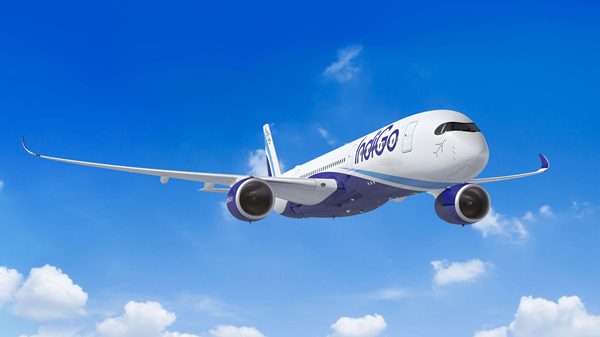
If there were ever a moment when the aviation gods nudged the chessboard, it happened when IndiGo, India’s once-humble, low-cost carrier, doubled down on its widebody ambitions, signing a firm order for 30 additional Airbus A350-900s. That brings its total to 60, and the signal could not be clearer: the subcontinent’s biggest airline intends to play in the long-haul league.
And if you’re Singapore Airlines, Emirates, or even Qantas, that sound you just heard was the distinct click of a seatbelt being fastened a little tighter.
A New Contender in the Long-Haul Club
IndiGo’s expansion from domestic champion to long-haul challenger is one of the most audacious pivots in modern aviation. The airline that once prided itself on selling Rs 5,000 fares between Delhi and Goa is now eyeing London, Sydney, and San Francisco not as connecting markets but as its own frontiers.
“Today is a special day for IndiGo,” declared Pieter Elbers, the airline’s CEO and former KLM veteran. His emphasis on India’s vision of becoming a global aviation hub is telling. Elbers knows a hub when he sees one. After all, he built his reputation in Amsterdam and clearly believes India’s time has arrived.
It’s hard to argue. India’s outbound travel has surged beyond pre-pandemic levels, with the nation poised to become the world’s third-largest aviation market by 2030. If IndiGo can capture even a modest share of that international pie, its A350 fleet could become the subcontinent’s most profitable export since Bollywood.
Singapore Airlines and Emirates: Watching Closely
Singapore Airlines and Emirates have long ruled Asia’s premium skies like seasoned monarchs. Emirates, with its oil-rich opulence and sprawling Dubai hub, and Singapore Airlines, with its Swiss-watch precision and almost spiritual devotion to service, have built empires on connecting Indian travellers to the world.
Now, IndiGo threatens to rewrite that script.
It won’t do it overnight, far from it, but the symbolism matters. Once Indian travellers book connecting flights through Dubai, Doha, or Changi, they may soon have the option of boarding a direct IndiGo flight to London or Sydney. And for the business-class traveller tired of waiting in Dubai queues, the idea of a seamless, full-service Indian carrier with competitive fares might prove irresistible.
Emirates, for one, will not take this lightly. Its India network is among its crown jewels, feeding six daily A380s worth of high-yield passengers through Dubai. A thriving IndiGo widebody operation could chip away at that dominance.
Singapore Airlines, meanwhile, has quietly hedged its bets. Its partnership with Tata-owned Air India through the newly merged Vistara–Air India entity gives it a foot inside the Indian market. However, IndiGo’s new Airbus fleet places it in direct competition, at least on long-haul routes where yield meets prestige.
Air India vs IndiGo: The Family Feud We Were Promised
The real dogfight, though, will be domestic.
Air India, freshly rebranded, flush with Tata capital, and armed with its own mega-order of 470 aircraft (including 70 widebodies), sees itself as the rightful flag carrier of the Indian diaspora. IndiGo, never one for pomp or politics, sees itself as something better: the people’s airline that happens to fly further.
The irony is delicious. Having spent decades dozing through inefficiency, Air India now finds itself chasing the very upstart that once leased its cast-off aircraft. The difference? IndiGo’s balance sheet hums like a Pratt & Whitney turbine: profitable, disciplined, and free of legacy clutter.
With the A350’s fuel efficiency and IndiGo’s legendary cost control, Air India’s relaunch may suddenly seem like an expensive hobby compared to IndiGo’s steely pragmatism.
The Australian Angle: Sydney, Melbourne, and Beyond
Here’s where Australia gets interested.
India–Australia travel is booming. Trade, tourism, and tertiary education have made the route one of the fastest-growing corridors in the Indo-Pacific. Yet for years, direct connectivity has been patchy at best, with Qantas and Air India running limited schedules.
IndiGo’s A350 fleet changes that calculus. With a range north of 15,000 kilometres and operational costs 25 per cent lower than older widebodies, non-stop routes from Delhi or Mumbai to Sydney, Melbourne or even Brisbane are well within reach.
For Qantas, that means a potential shake-up. The Flying Kangaroo’s India play has been cautious, with a few weekly flights and many codeshares. But IndiGo, with its domestic reach across 80 Indian cities, could deliver what Qantas can’t: seamless one-ticket connectivity from, say, Chandigarh to Cairns.
Australia’s tourism sector will quietly cheer this on. More seats, lower fares, and direct flights mean inbound travel growth. For students, business travellers, and the ever-growing Indian diaspora, an IndiGo A350 at Sydney Airport might soon be as familiar a sight as a Singapore Airlines tail at Kingsford Smith.
Qatar Airways and the Middle East: Feeling the Heat
The other potential casualty of IndiGo’s widebody expansion sits further west in Doha.
Qatar Airways has long positioned itself as India’s gateway to the world. But with IndiGo now armed for long-haul combat, those connecting passengers may prefer to skip the transfer and fly direct.
There’s irony here, too. Qatar Airways’ CEO Akbar Al Baker once dismissed low-cost long-haul models as “a fantasy that never works.” He may soon have to eat his words with an Indian curry on the side.
If IndiGo maintains its no-frills, pay-for-what-you-use philosophy even on long-haul routes, it could attract value-driven passengers without undercutting quality. It’s a delicate balance, but Elbers’ KLM pedigree suggests he understands the economics of comfort better than most.
Airbus: The Quiet Winner
While the airlines jostle for supremacy, the real winner may be Airbus.
By locking in IndiGo’s 60-jet commitment, Airbus cements its dominance in the Indian market. The A320 family already powers most of the country’s domestic growth; the A350 now completes the picture at the top end.
And there’s a neat symmetry to it all. The European planemaker’s relationship with India spans half a century, evolving from supplier to strategic partner. Airbus’s current push towards 100 per cent sustainable aviation fuel (SAF) compatibility by 2030 fits neatly with India’s green-growth agenda.
For Toulouse, this isn’t just another sale; it’s the cornerstone of a decades-long partnership that keeps Boeing nervously pacing the tarmac.
A Calculated Risk with Global Ripples
Let’s be clear: IndiGo’s A350 expansion isn’t without risk. Long-haul operations are notoriously complex. Crew training, maintenance, catering, slot access, and bilateral rights carry hidden costs. Many airlines, Norwegian, AirAsia X, and Jet Airways, have learned that long-haul low-cost can be more of a nightmare than a nirvana.
But IndiGo has built a business on doing the improbable efficiently. Its punctuality is almost Japanese, and its margins are enviable. If anyone can scale the unforgiving economics of long-haul with a low-cost backbone, it’s this lot.
And with the A350’s blend of fuel efficiency and range, it might just pull it off.
The View from the Tower
So what does this mean for the aviation world order?
In a nutshell, there is turbulence for the old guard and opportunity for the bold.
Singapore Airlines, Emirates, and Qatar Airways may soon find their once-captive Indian market fragmenting. Air India, long the sleeping giant, now faces a wake-up call it can’t snooze through. And Qantas, the Flying Kangaroo, might have to hop a bit faster if it wants to keep pace with the new elephant in the sky.
IndiGo’s A350 gamble isn’t just about planes. It’s about positioning a confident declaration that India will no longer be merely a feeder market for global carriers. It will be the hub itself.
As for Pieter Elbers, he might go down as the man who helped India do what it has always dreamed of: move from the tarmac to the top tier. And if his 60 new widebodies arrive on time, you can bet the champagne (or at least the masala chai) will flow freely at IndiGo headquarters.
In short, the next decade’s most fascinating aviation rivalry won’t be played out between Dubai and Doha, or London and New York. It will unfold between Delhi and Singapore, Mumbai and Sydney and the underdog now looks ready to fly.
By Kanda Limw
BIO
 Kanda Limw is a self-motivated administrative professional with a strong track record of supporting business operations efficiently and precisely. Highly organised and adaptable, she brings a wealth of skills to the table, from multitasking and prioritising competing demands to managing complex filing systems and ensuring smooth office workflows.
Her background spans professional secretarial work, customer relations, and project planning, where her critical thinking and proactive approach have consistently delivered results. Kanda is experienced in managing directors’ schedules, coordinating meetings, and streamlining administrative processes while maintaining the highest standards of professionalism.
With progressive experience in office management, she has developed a reputation for reliability and attention to detail. Colleagues value her calm under pressure, her ability to anticipate needs, and her dedication to keeping operations on track. Kanda continues to build on her diverse skill set, driving efficiency and excellence in every task she undertakes.











