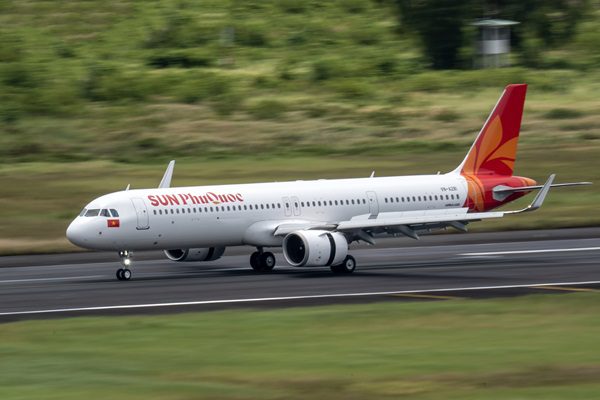
In a move that reads like a page out of a bold travel-business playbook, Sun Group has formally launched Sun PhuQuoc Airways, inaugurating Vietnam’s first “resort airline” and putting the finishing touch on its tourism empire. The debut unfolded on 15 October in Hanoi, at a gala affair worthy of a blockbuster premiere.
The timing is impeccable. Phu Quoc—recently elevated to a special administrative zone—has been tapped to host the 2027 APEC Summit, and demand for air connectivity is poised to explode.
A name that carries weight
It is significant: the first Vietnamese airline is named after an island. Such symbolism is not vanity it’s strategic branding. The branding stakes a claim: that Phu Quoc is not just another destination but the pivot of a vision.
Dang Minh Truong, Chairman of Sun Group, didn’t mince words: “Sun PhuQuoc Airways was created to expand opportunities for travel, leisure, and discovery of Phu Quoc — not only for Vietnamese people but also for international visitors through direct flights, reasonable fares, and a seamless experience from the sky to the ground.”
The airline, he added, is “the final pair of wings completing our comprehensive tourism ecosystem.”
A launch like no other: Symphony of the Sun
If you expected a dry, button-pushing event, think again. The unveiling was staged under the “Symphony of the Sun” banner, a sensory experience. From the check-in counters to boarding bridges, from a choreographed safety demonstration to in-flight dining theatrics, every detail was scripted to evoke a flight’s emotional trajectory.
Uniforms drew on the elegant northern Vietnamese áo ngũ thân tradition and Empress Nam Phuong’s refined aesthetics, reinterpreted with a modern palette: chocolate browns, crisp white, deep crimson accents, and pearl embellishments. Not just garments, but cultural ambassadors in fabric.
Unveiled that evening, the logo comprises nine stylised petals around a sun motif symbolic of radiance, continuity, and progress.
From paper to runway: operations, fleet & routes
Sun PhuQuoc Airways didn’t merely show up for show. On 25 September, it secured its Air Operator Certificate (AOC) and Approved Training Organisation (ATO) licence from the Civil Aviation Authority of Vietnam.
The carrier already controls three Airbus A321NX and A321CEO models and plans to grow to eight in 2025. By the end of 2026, the aim is 25 aircraft, and in 2027, around 30–35.
On 13 June, it was disclosed that the airline is in talks to acquire Boeing 787-9/10 Dreamliners to expand its international ambitions.
Ticket sales opened officially via www.sunphuquocairways.com and authorised agents. Commercial flights launch on 1 November 2025.
Initial routes (Nov 2025) will connect Phu Quoc with Ho Chi Minh City, Hanoi, Da Nang, and link among those mainland hubs (Hanoi ↔ HCM City, HCM City ↔ Da Nang). From December 2025, the network will expand to include Hanoi ↔ Da Nang and Cam Ranh ↔ Phu Quoc.
This “hub-and-spoke” blueprint places Phu Quoc at the centre, shortening travel times and bypassing transit choke points. Operational systems, safety protocols, crew training, and route planning are already in place.
A calculated leap in a competitive sky
Enter a landscape crowded with incumbents: Vietnam Airlines (flag carrier), VietJet (low-cost juggernaut), Bamboo Airways, Vietravel Airlines. Yet Sun PhuQuoc’s differentiator is its deep integration with Sun Group’s vast resort, entertainment, real estate and hospitality assets. Bundled travel + stays + leisure promises cross-sell synergies few pure-play airlines can match.
Seed capital is hefty: Reuters reported an initial investment of VND 2.5 trillion (≈ USD 96 million).
The Vietnamese prime minister’s approval of the establishment, backing Sun Group’s audacious plan, speaks to the government’s strategic alignment with tourism growth.
With Phu Quoc’s rise as a “Pearl Island” destination and APEC 2027 on the horizon, Sun PhuQuoc is positioning itself not as a passenger airline but as a destination catalyst.
Risks, hopes and the long view.
Of course, the skies are unforgiving. Setting up an airline is capital-intensive, margins are thin, and regulatory, fuel, talent or geopolitical shocks could derail even the boldest plans. But Sun Group’s internal verticals provide a buffer: captive demand, brand leverage, cross-promotion. The ability to channel passengers into its resorts or entertainment precincts is not an afterthought—it’s the business model.
If they pull it off, Phu Quoc may be reborn as an aviation node, not just a tourist island. The ripple effects would be increased foreign arrivals, stronger infrastructure investment, and job creation in hospitality, aviation, and logistics. The synergy is real.
As the aviation world watches, Sun PhuQuoc Airways is no mere new airline; it’s a statement, a daring bet that in Asia’s fast lanes of travel and tourism, the line between resort and runway is blurring.