

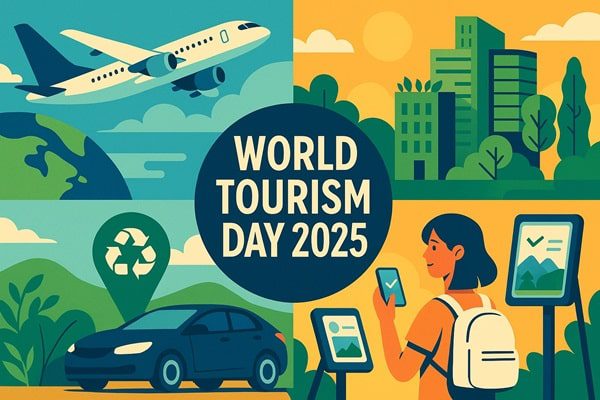
If there were ever a day for tourism to preen a little in front of the mirror, it’s 27 September World Tourism Day. This year, the industry strutted onto the global stage with a theme as bold as it was overdue: Tourism and Sustainable Transformation.
It’s not the catchiest slogan, perhaps, but behind the jargon lurks a genuine story: travel has finally woken up to the fact that it’s not just about serving mai tais on a sun lounger; it’s about what sort of planet is left once the cocktail glass is empty.
And here’s the kicker: it’s not the airlines, hotels, or governments leading this transformation. It’s the boffins in travel tech, the quiet coders, the startup hustlers, the engineers who’d rather be tweaking flight algorithms than checking in luggage. Believe it or not, they are the ones saving the planet from the excesses of its own holiday habits.
The Scale of the Beast
First, a reality check. Tourism is not a side hustle. It’s a USD 10.9 trillion colossus, generating 357 million jobs worldwide, according to the World Travel & Tourism Council (WTTC). In 2024 alone, it coughed up USD 3.3 trillion in taxes. And this year, international arrivals shot up another 5% to 690 million in just six months.
With that kind of economic muscle, the industry doesn’t just have a seat at the table; it built the table and chairs and probably owns the restaurant. When the United Nations starts talking about its Sustainable Development Goals, tourism is expected to listen and deliver.
From Flight Paths to Paperless Futures
Roman Townsend, Managing Director of Belvera Partners, knows better than most where the action is:
“From AI solutions that optimise flight paths and manage the flow of visitors, to digital apps that replace paper guides or support local creators, travel tech is transforming the industry, making it greener and driving social progress.”
Translation? The next time your plane lands bang on time, the guidebook is on your phone instead of dead trees, and your holiday snaps feature a local street artist rather than a souvenir shop, thank a technologist.
Aviation’s Balancing Act
Still, the aviation sector remains the elephant in the departure lounge. Daniel Boyle, General Manager of Transport at Terrapinn, doesn’t flinch from the challenge:
“Airlines and airports are investing heavily in predictive analytics, digital twins and AI-driven ops to optimise flight paths, cut contrails, burn less fuel and improve punctuality. It’s innovation and responsibility rolled into one.”
It’s not just about shaving costs, though no airline has ever sneezed at that. It’s about keeping planes in the air without frying the atmosphere. SAF, hydrogen aircraft, digital ops… the buzzwords are stacking up faster than frequent-flyer points, but at least the intent is genuine.
Hotels Declare War – on Bedbugs
Enter Valpas, a Finnish startup proving that sustainability can also be… itchy, or not. They’ve created a device that kills bedbugs without a whiff of pesticide.
Martim Gois, CEO and Co-founder, puts it bluntly:
“Sustainability too often means compromise. At Valpas, we prove you can have both. By replacing biodiversity-damaging pesticides with clean in-room tech, we keep hotels bug-free and deliver a climate impact twice as effective as skipping linen washes.”
In short, guests get a good night’s sleep, hotels keep their five stars, and the environment avoids another chemical hit. Not bad for a company most of us hadn’t heard of yesterday.
The GoNexus Gambit
Meanwhile, over at GoNexus Group, the calculator is out and the ambition is sky-high. President Rubén Gutiérrez has set his sights on banishing paper entirely by 2027:
“Technology enables us to be agile and sustainable, while driving recycling, carbon offsetting and animal welfare. We aim to be 100% paper-free by 2027.”
So far, they’ve scrapped 70 tonnes of paper annually, saved 1,200 trees, and cut nearly 4,000 tonnes of CO₂. In addition, they’re handing out tablets to schoolkids and organising beach clean-ups. It’s corporate sustainability with actual receipts.
Digital Tours With a Difference
Then there’s Civitatis, the platform that lets you book anything from a Madrid tapas tour to a hot-air balloon in Cappadocia. COO Enrique Espinel says the company’s 96,000 activities are about more than bucket-list bragging rights:
“We’re fostering a responsible model, promoting authentic experiences, spreading tourism throughout the year and giving visibility to less crowded destinations.”
In other words, don’t all flock to Barcelona in August; try Valencia in October. It’s better for everyone, not least the long-suffering locals.
The TikTok Test
Short-form video has long been accused of rotting our brains, but NaviSavi wants to prove it can also feed communities. CEO Sally Bunnell makes her case:
“True sustainability in tourism means giving back to the people who bring destinations to life. By hiring local creators and keeping dollars in the community, we’re building a circular digital economy.”
It’s not just about clicks; it’s about ensuring the kid filming their hometown with an iPhone is rewarded, not some faceless marketing agency.
Inclusion Is Non-Negotiable
Finally, the last word goes to TUR4all, which champions accessible travel experiences worldwide. Francisco Sardón, President of IMPULSA IGUALDAD, couldn’t be clearer:
“We reaffirm our commitment to a sustainable and inclusive tourism model that benefits people, communities and the planet. Purpose-driven tourism can transform how people travel and build a fairer, more responsible future.”
Because let’s be frank, if travel isn’t accessible, it isn’t sustainable, end of story.
Where the Journey Leads
World Tourism Day 2025 wasn’t just another industry jamboree. It was a line in the sand. Tourism, one of the world’s greatest economic juggernauts, finally admits it has skin in the game.
Technology isn’t a sideshow; it’s the main act, the key to making travel cleaner, fairer and more intelligent. From contrail-busting algorithms to bedbug-zapping IoT gizmos, the future of tourism is being written not in glossy brochures but in code.
The question is simple: will the industry keep up with its own rhetoric, or will this be another year of lofty promises? For the planet’s sake, let’s hope for the former because there’s no Planet B, and the departure gate for that flight closed a long time ago.
By Prae Lee











