

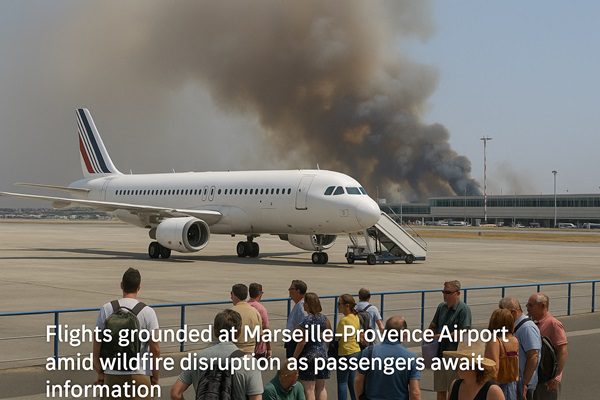
France’s summer has long been synonymous with rosé, Riviera glamour, and shoulder-to-shoulder jostling at the boulangerie. But this July, Marseille is feeling the heat in a way that has nothing to do with a summer baguette run. A fast-moving wildfire near France’s second-largest city has halted flights, blocked major transport routes and delivered a scorching blow to tourist sentiment, just as the Mediterranean holiday season hits full stride.
According to travel intelligence firm Mabrian, the unfolding crisis has thrown the proverbial croissant into the jet engine, with a potential 45,000 airline seats and 282 scheduled flights between 8 and 9 July left hanging in a smoky haze of uncertainty. Marseille-Provence Airport, a vital gateway for travellers pouring into the picturesque Provence region and the sun-drenched south of France, was temporarily shut as flames edged too close for comfort.
Carlos Cendra, the ever-articulate Partner and Director of Marketing at Mabrian, summed up the situation with classic Gallic understatement: “Marseille Airport is the main gateway to Provence and the South of France, which welcomes 30 million tourists annually—especially during the summer season. Any disruption to air traffic at this time of year is always a cause for concern.”
That, dear reader, may be putting it mildly.
Burning Bridges: Trains, Motorways and Sentiment Ablaze
The blaze, which has already consumed over 720 hectares of countryside, has rattled air traffic controllers and spread chaos across rail lines and major motorways. Tourists heading from Paris to Provence in pursuit of lavender fields and leisurely lunches are now facing evacuation orders, cancellations, and disrupted itineraries. The only thing arriving on time in Marseille this week is the smoke.
But the fire isn’t just licking the edges of transport infrastructure—it’s singeing France’s reputation as a safe and pleasant destination in the eyes of international travellers.
Mabrian’s latest data paints a sobering picture. Marseille’s once-inviting Perception of Climate Index (PCI) has nose-dived by 36.4% compared to last year, tumbling to 61.6 points out of 100. This is no slight wobble—it’s a meteorological free-fall regarding tourist sentiment.
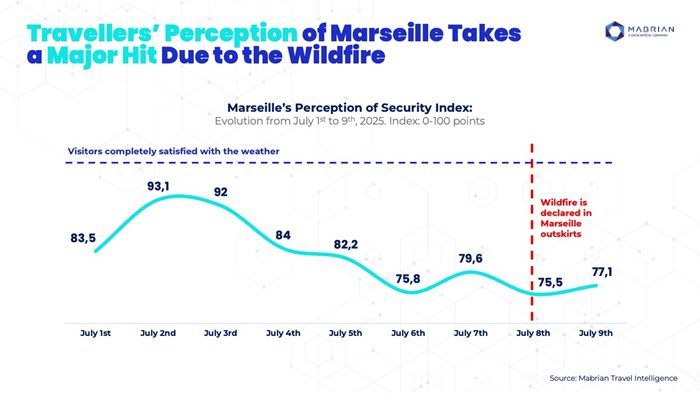
Meanwhile, the Perception of Security Index (PSI)—that delicate barometer of how secure a traveller feels—has dropped by more than 17 points since 1 July, now limping at 77.1 points. That’s a year-on-year decline of 5.1%. In short, Marseille has gone from magnifique to merde in the minds of many.
A Mabrian analyst diplomatically added:
“While sharp fluctuations in these two indexes are expected during such a significant natural crisis, it is essential to closely monitor their evolution in the coming weeks. As immediate concerns are addressed, it’s important to ensure that traveller perception—particularly regarding climate and safety—rebounds appropriately once the crisis stabilises.”
That was well said. However, one suspects the recovery may take more than a few Instagram posts of bouillabaisse and sunsets to complete.
Tourism in Turmoil: The Broader Cost
Let’s not forget that Marseille and the broader Provence-Alpes-Côte d’Azur region aren’t just destinations—they’re economic lifelines for countless businesses, from boutique hotels to beach cafés and vineyard tours. A prolonged hit to travel sentiment—especially during the peak July–August window—could send ripples well beyond the arrivals hall.
Mabrian’s analysis doesn’t just track what planes are doing—it taps into how tourists feel, using data from online reviews, social media chatter, and traveller behaviour. If you think data’s just for spreadsheets, think again: this insight is now essential for tourism boards scrambling to counteract a reputation crisis in real-time.
And while French officials race to contain the fire—with over 110 people already injured and hundreds evacuated—one can’t help but wonder what the psychological scars will look like, especially among international visitors who may now hesitate to return or even book Provence in the first place.
The Path Ahead: Containment and Confidence
What happens next hinges on whether Marseille-Provence Airport reopens in time to salvage the week’s flight schedule, and whether the flames can be beaten back before further damage is done to land, to infrastructure, and the all-important perception of France as a reliable, romantic escape.
Tourism, after all, is about more than sunshine and wine. It’s about trust—trust that your plane will land, that your train will run, and that the nearest fire won’t be closer than the one warming your crème brûlée.
There’s hope yet. France has faced its fair share of summer crises—from transport strikes to heatwaves—and always manages to emerge with its beret stylishly askew but intact.
As the air clears over Marseille, so too will the data—and with it, the opportunity for France’s tourism machine to prove its resilience once more. Until then, we may opt for a quiet week in Bordeaux.
By Susan Ng













