

Far above Sapa’s rice terraces, winter can leave Fansipan, Indochina’s highest peak, dusted with snow. Below, mist drifts through the Muong Hoa Valley, lifting to reveal hillsides traced with narrow terraces and paths winding between villages.
At around 1,500 metres above sea level, Sapa averages about 9°C in December and January, with colder conditions higher in the Hoang Lien Son mountains. Frost can whiten the higher slopes, while clouds gather below the ridgelines.
Japan and South Korea are familiar choices for a winter break in Asia, but northern Vietnam offers a less expected alternative. In Sapa, the season brings a mountain chill to a region better known for tropical warmth. Days are spent walking between villages and browsing market stalls, with warming meals made from produce grown in the surrounding hills.
In the centre of town, Hotel de la Coupole Sapa – MGallery Collection is Sapa’s only international five-star hotel. Recognised with One MICHELIN Key in both 2025 and 2026, it also ranked No. 4 among the Best Hotels in Southeast Asia in Condé Nast Traveler’s 2026 Readers’ Choice Awards. Inside, Bill Bensley-designed interiors combine French haute couture with the colours and textile patterns of the surrounding highlands.
From the ‘Roof of Indochina’ to village life
A cable car carries visitors across the Muong Hoa Valley and up the slopes of Fansipan. From the upper station, pagodas, terraces and steps lead towards the 3,143-metre summit, known as the “Roof of Indochina”.
On a clear day, views open across the Hoang Lien Son range. At other times, clouds close in on the temple buildings, and the valley disappears below. The cold is sharper at this altitude, so an extra layer is worth it even when the weather in town feels mild.
Down in Muong Hoa Valley, Lao Chai and Ta Van lie along routes linking villages and fields. A shorter outing covers one village and its surroundings; longer walks stretch farther along the valley, with time for lunch and stops along the way.
With the rice harvest over, winter exposes the contours of the terraces. Footpaths connect fields with homes and neighbouring settlements. Guides from the area explain how the fields are worked and which crops grow on the surrounding slopes, adapting routes when rain makes paths muddy or mist reduces visibility.
Chayote leaves are sautéed with garlic, tofu is made fresh and local trout appears in warming soups or grilled with spices. Markets bring together the produce of the surrounding countryside, alongside textiles that may have taken months to make.
Sapa’s Black Hmong textile makers begin with hemp, grown for around three months before harvesting. The stalks are cut, dried and stripped, and the fibres joined by hand into thread for weaving. Batik and embroidery follow. Workshops introduce those techniques, while buying directly from makers offers a chance to ask about the work behind a finished piece.
In Ta Phin, village visits include both Red Dao embroidery and herbal bathing. Leaves and bark gathered from the mountains are chopped, dried and boiled to prepare the bathwater, drawing on knowledge passed between generations.
Herbal baths and haute couture
At Nuages Spa, the Red Dao Healing Herbal Bath draws on the same tradition, using botanicals from Fansipan in a warm soak. The bath is offered as a 30-minute treatment or combined with rhythmic body massage in the
90–120-minute Nuages Spa Signature Massage.
At Le Grand Bassin, emerald marble columns and bronze statues surround the indoor pool. Beyond its
floor-to-ceiling windows lies the valley; beside the water, loungers provide somewhere to spend a misty afternoon with a book.
In the hotel’s public spaces, coloured spools of thread sit among paintings and antiques, while fashion imagery continues through the 249 individually decorated rooms and suites.
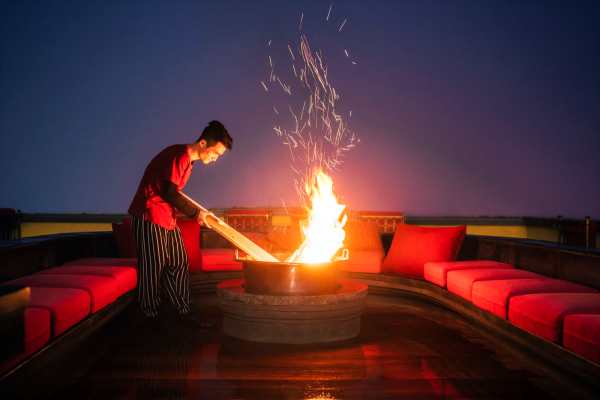
At Chic, lanterns glow along a raised catwalk as French classics made with seasonal local ingredients arrive at the table. Evenings, meanwhile, cosily unfold beside the outdoor fireplace at rooftop bar Absinthe.
The couture theme takes a festive turn in December, when L’Atelier de Noël transforms the hotel into a Christmas atelier. Students from local ethnic minority communities perform carols around the tree at the lighting ceremony on 5 December.
At Chic, Christmas Eve’s “From Paris to Sapa” buffet brings together French festive dishes and highland flavours, while “Around the World Feast” on New Year’s Eve celebrates Eastern and Western culinary traditions. The celebrations then move to the rooftop for a countdown to 2027, with views towards Sapa’s fireworks.
A winter stay within easy reach
Hanoi is the gateway, around two hours by direct flight from Bangkok or three and a half from Singapore, followed by approximately five to six hours by road to Sapa.
The hotel’s “Rejuvenate in Style” package starts at VND 3,770,000 per room per night, plus tax and service charge, and includes daily breakfast at Chic, VND 1,000,000 net in spa credit per room per night, and 20% off dining at the hotel’s restaurants. The package is available for bookings and stays from 20 October to 31 December 2026. Full details and conditions: www.











