

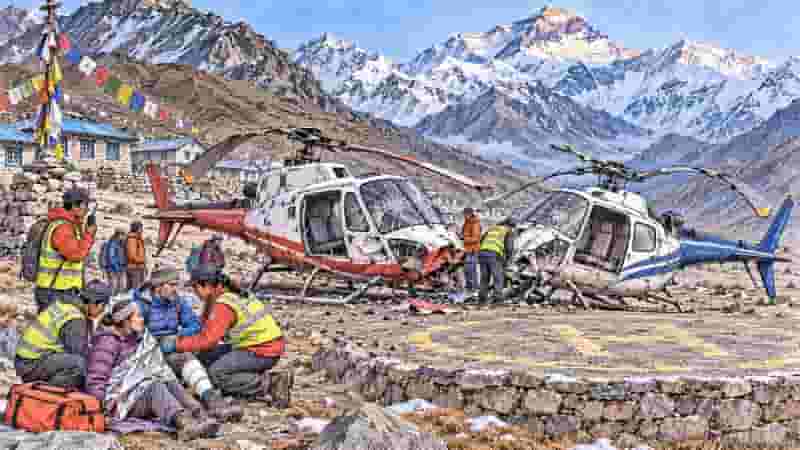
An Indian visitor is dead and a New Zealander injured after two helicopters collided near Everest Base Camp. A preliminary inquiry raises questions about how aircraft coordinate at remote Himalayan landing sites.
A tourist from India has died, and a New Zealand citizen has been injured after two helicopters collided while approaching a landing area in Nepal’s Everest region, bringing fresh scrutiny to the safety of high-altitude flying.
The accident occurred at approximately 8.12 am on Tuesday, 3 November 2026, at Pheriche in Solukhumbu district. The helipad stands about 4,300 metres above sea level, on the trekking route towards Everest Base Camp.
It was not a crash in Kathmandu, as some references to the capital might suggest. Kathmandu was the destination for medical transfers after the collision.
Authorities identified the deceased as Vasanth Kumar Balaramudu, 47, from Chennai, India. Shailesh Krishna Patel, a New Zealand citizen of Indian origin, was injured.
At that altitude, there is little room for complacency. There must still be plenty of room for two helicopters.
Conflicting accounts of the injuries
Initial reports from Nepalese police and the Civil Aviation Authority of Nepal (CAAN) said both helicopter pilots were injured, in addition to the New Zealand passenger. Air Dynasty later disputed that account, saying nobody aboard its aircraft was injured.
The discrepancy matters. The fatality and the New Zealander’s injury are confirmed, but the number of injured pilots should not be presented as settled while those accounts conflict.
Fishtail Air said the injured passenger and its pilot were in stable condition and out of danger. Both were taken to Nepal Mediciti Hospital in Lalitpur, in the Kathmandu Valley.
New Zealand’s Ministry of Foreign Affairs and Trade acknowledged reports of its citizen being injured but declined to provide personal information. Indian diplomatic officials have been involved in arrangements following the death of the Chennai visitor.
Two helicopters, one landing area
The aircraft were an Airbus AS350 operated by Fishtail Air, registration 9N-AJR, and another AS350 operated by Air Dynasty, registration 9N-AOD.
According to CAAN, the Fishtail helicopter had departed Gorakshep carrying two foreign passengers. The Air Dynasty aircraft was arriving from Lukla with cargo. Both were attempting to land at Pheriche shortly after 8 am.
Video circulated by Nepalese media shows a collision at very low altitude. Reports have differed over the precise approach sequence and which rotor blades struck which part of the other aircraft.
Those are details investigators must establish from evidence, not observers from a few seconds of footage.
The accident occurred during Nepal’s busy autumn trekking season. Recent heavy snow had disrupted the trail, but improved conditions had allowed trekkers to move again.
The communication question
CAAN has opened an investigation and promised to consider corrective measures based on its findings.
Its director-general, Mukesh Dangol, told The Kathmandu Post that “Preliminary reports suggest miscommunication between the pilots”. He explained that the area lies beyond the coverage of Lukla Airport’s air traffic control tower, leaving pilots to coordinate directly with one another.
At the time of publication, Nepalese aviation authorities had not established the cause of the collision. Suggestions of possible communication failures remain preliminary, and no findings of negligence or responsibility have been made against either helicopter operator or its pilots.
That distinction is essential. An early line of inquiry is not a verdict, however tempting the video may make one.
Aviation specialists cited in Nepalese reporting have also raised questions about sun glare and situational awareness. Neither has been established as a contributing factor. The investigation must examine the approaches, any available communications, ground assistance and relevant operating procedures.
An earlier warning from Lobuche
The collision follows a separate helicopter accident at Lobuche in the same mountain region on 29 October 2025.
An Altitude Air helicopter overturned while landing on a snow-covered helipad. The pilot escaped uninjured. Nepal’s government investigation, published on 23 March 2026, found that uneven ground and rotor-wash-induced whiteout contributed to the loss of control.
That investigation issued nine safety recommendations. They addressed matters including documented risk assessments for remote helipads, proper landing-site markings, crew briefings, ground assistance and operational oversight during busy periods.
The Lobuche accident was not an aircraft collision. Its findings must not be treated as an explanation for what happened at Pheriche.
Nevertheless, the recommendations show how seriously remote landing-site operations need to be managed. OnlineKhabar has reported that many of those earlier recommendations remain unimplemented. That is a published assessment, not a confirmed finding that any particular recommendation caused or contributed to Tuesday’s collision.
The test for regulators is whether useful recommendations become routine safeguards before another accident forces the issue.
A vital service, not an optional extra
Helicopters are essential to the Everest trekking economy. Roads do not reach the high routes. Aircraft transport supplies, move passengers and evacuate people who are ill, injured or unable to descend on foot.
The very terrain that draws visitors makes those operations demanding. High altitude reduces aircraft performance margins, weather can change quickly, and remote landing sites lack the infrastructure of major airports.
For Nepal, the challenge is to maintain a service that tourists and mountain communities rely on while demonstrating that its risks are understood and controlled.
What Australian travel advisors should check
Australia’s Smartraveller service advises travellers to exercise a high degree of caution in Nepal. It warns that aviation safety standards and weather conditions may differ from those in Australia and recommends researching air transport operators carefully.
For trekkers, insurance must cover the altitude they intend to reach, altitude sickness and emergency helicopter evacuation. Smartraveller says a safer round-trip trek from Lukla to Everest Base Camp generally takes 12 to 14 days, allowing time to acclimatise.
Travel advisors should also verify trekking operators, guide arrangements, route conditions and evacuation procedures. Clients should know how their insurer handles a helicopter rescue, particularly if an evacuation is suggested before a proper medical assessment.
A photograph of Everest can sell the dream. A well-checked insurance policy and a carefully planned itinerary are rather better company when the weather turns.
The test comes after the headlines
Nepal’s investigators now face the practical questions: how two helicopters came to occupy the same landing space, what each crew knew and whether existing procedures were adequate.
The answers will matter to operators, regulators, guides and visitors whose journeys depend on these aircraft.
One visitor has lost his life. Another is recovering from injury. The most meaningful tribute is not a dramatic theory about the crash, but a careful inquiry followed by whatever practical changes the evidence demands.
By: Jason Smith – © 2026.
Read Time: 6 minutes.
Author Bio:
 Jason Smith didn’t learn travel from textbooks. He learned it in airports, taxis and hotel lobbies, watching the business unfold long before he played his own part. Half American, half Asian, he grew up around the quiet workings of tourism, where people come and go, and stories rarely stand still.
Bangkok came first, then formal study, then a career that carried him through Singapore, Malaysia and Vietnam. Each place left something behind. In the end, Thailand felt like home, along with a senior role in hotel sales.
Then everything stopped. Borders shut, planes grounded, and Jason found himself back in America with time to reflect.
Now at Stephen’s EGT Media, he writes travel as it really is, not polished, not perfect, but human, and all the better for it.











