

The airline industry has discovered another expensive part of selling a ticket: collecting the money.
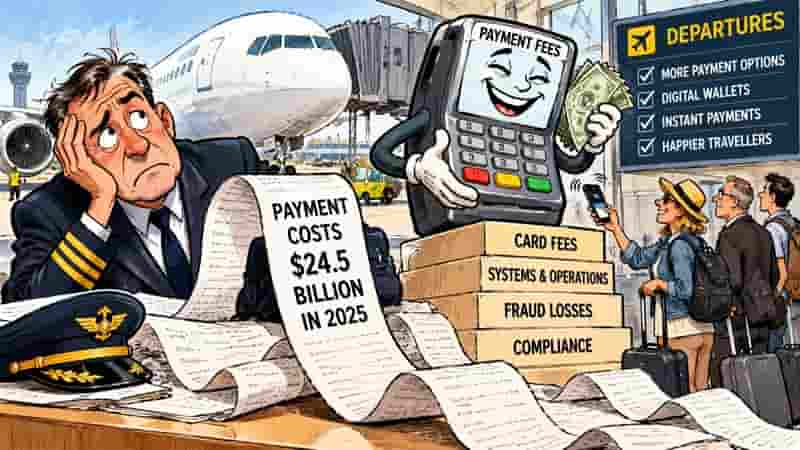
Airlines worldwide spent US$24.5 billion in 2025 just to process payments. The International Air Transport Association (IATA) reported that eye-watering figure. With fuel bills rising and profits thin, collecting a fare is now a problem of its own.
IATA released the figures in Macao on 27 October. Airlines took US$1.05 trillion in sales during 2025. But payment costs rose 10.4% from 2023, while sales grew just 7.7%.
In short, the cost of taking passengers’ money is rising faster than sales. That is hardly the sort of growth an airline finance chief dreams about.
A $5 bill before the aircraft leaves the ground
IATA puts the average payment cost at US$5 per passenger transaction. Yet its latest forecast puts net profit at just US$4.50 per passenger in 2026.
These figures measure different things. One is a 2025 cost; the other is a 2026 profit forecast. Even so, they show how little room airlines have to spare.
IATA’s Interim Director General and Chief Financial Officer, Sandrine Le Borgne, says the trend can’t continue. In her words: “The fact that payment transaction costs are increasing faster than industry revenues is unsustainable”.
Direct fees took the biggest bite: US$20.7 billion, or 84.5% of the total. Systems, staff, rules and slow cash flow added US$2.9 billion. Fraud and unpaid sales cost a further US$900 million.
Cards are among the dearer ways to pay. IATA puts the average fee at 2.53%, compared with 1.97% across all methods. The cheapest options cost as little as 0.01%. Yet what works in one market may not suit every traveller.
Digital wallets offer a way forward
IATA does not want to make booking a flight harder. Its answer is more choice at checkout, with lower fees behind the scenes.
Its 2025 survey found 29% of travellers favoured digital wallets. Another 8% preferred local instant payments. IATA Pay enables bank-to-bank payments. Its Financial Gateway helps airlines handle more than 300 payment methods in over 170 countries.
Travel agents also have a stake in this. IATA wants clearer agency card fees within its Billing and Settlement Plan. It also points to IATA EASY PAY as another option. Work is under way on new ways to handle corporate travel payments as airline retailing evolves.
There is more at stake than lower costs. IATA says about one in five attempts to buy extras ends without a sale because the first payment fails and no other option is offered. A second payment option might rescue the sale and spare a traveller some grief.
IATA sells payment services itself, so its proposed fixes deserve a fair look. Savings will depend on local fees, security, and customer preferences. A cheaper way to take money is a chance to improve margins, not a promise.
The next fight for airline profits may not take place in the cabin or on the fuel desk. It could be at the checkout, where everyone wants a cut before the aircraft has even pushed back.
By: Yves Thomas – © 2026.
Read Time: 3 minutes.
Author Bio:
 Yves Thomas has a quiet pull, the kind you only notice after a moment. It comes from living and travelling from both sides of the reception desk. A graduate of Bangkok University International, she stepped straight into Thailand’s tourism industry and quickly learned how much care goes into making someone else’s holiday feel effortless.
She worked with some of the country’s best destination management teams, polishing the details most travellers never see but always remember. Eventually, the road began calling louder than meetings and schedules. Yves packed a bag and went looking again, trading conference calls for compass points.
Somewhere between Chiang Mai and Copenhagen, she started writing it down. Those reflections became a warm, observant blog.
Now based in Hua Hin and writing for Stephen’s EGT Media, Yves shares travel not as a publicist, but as a traveller attentive, thoughtful, and deeply human.











