

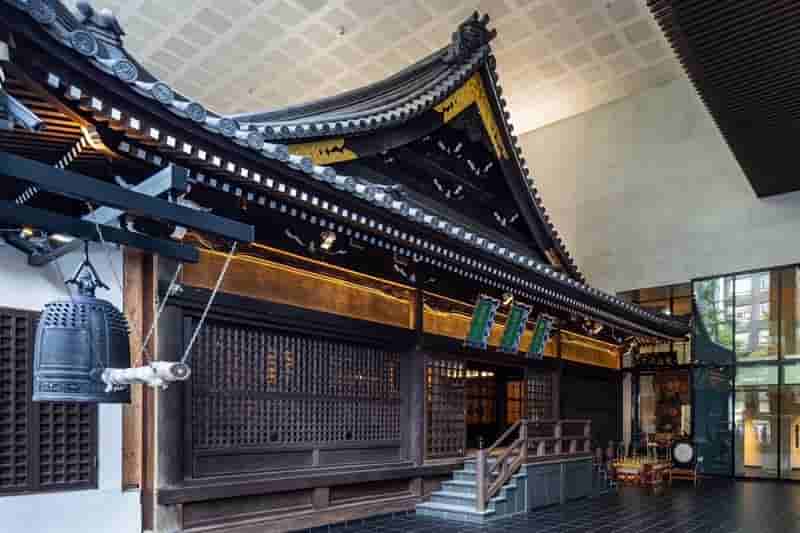
In the heart of Osaka, a 15-storey tower rises above a wooden Buddhist hall built in 1808. The clever part is that the hall remains, still in use.
Osaka has never been shy about building upwards. In the busy Minami district, shops, hotels and towers jostle for room. Yet on Midosuji Avenue, an old wooden hall still holds its own beneath a new tower.
The tiled roof belongs to Mitsutera Temple’s main hall, rebuilt in 1808. The rooms above belong to Candeo Hotels Osaka Shinsaibashi. The two share a site, but not a purpose. One welcomes hotel guests; the other remains a working Buddhist temple.
It is a meeting of old and new that could easily have gone wrong. Instead, the builders found a way to put the future overhead without sending the past to the tip.
A survivor with a remarkable new roofline
Temple tradition traces Mitsutera’s founding to 744. Its present timber main hall dates to the Edo period and survived the 1945 air raids that devastated much of Osaka. War spared it. Time, however, was proving less forgiving.

Candeo Hotels Osaka Shinsaibashi
The hall needed long-term care, while other buildings on the temple grounds were ageing. Land in this part of Osaka is valuable, but selling off history was hardly an attractive answer for a place still used for worship.
The solution emerged from talks that began in 2019. Mitsutera joined forces with property developer Tokyo Tatemono, hotel operator Candeo Hospitality Management and design-and-build firm Taisei Corporation. Their plan was bold: keep the old hall intact, make better use of the land above it, and create an income source to support the temple’s future.
There was one small problem. The old hall blocked construction.
How to move a temple without taking it apart
The team used hikiya, a traditional Japanese method of shifting a whole building after separating it from its foundations. According to an architectural report, the team moved the wooden hall, weighing about 150 tonnes, in three stages over 2020 and 2021. They didn’t pull it to pieces and rebuild it as a lookalike.
Anyone who has tried to carry a dining table through a narrow doorway will appreciate the difference in scale.
Once the hall was in position, the team built a new steel-framed structure around and above it. The result is the 15-storey Tokyo Tatemono Mitsutera Building, completed in September 2023. The temple sits in an open space three storeys high. A hotel and shops surround it.
The team also restored parts of the hall’s roof to its pre-1933 form. Inside, ornate timberwork, painted flowers, lacquer and gilded Buddhist fittings remain part of a living place of worship. This is no old facade stuck on the front of a new hotel.
The striking design later drew attention from architecture journal ArchDaily. In 2025, developer Tokyo Tatemono announced that the project had received a President’s Award from the Japan Association for Real Estate Sciences for its approach to preservation, commercial use and community life.
A hotel upstairs, prayers downstairs
Candeo Hotels Osaka Shinsaibashi opened on 26 November 2023. The four-star property has 180 rooms. Its upper level includes a spa with open-air bathing facilities, offering guests views of modern Osaka after a visit to the city’s much older side.
The shared path in from Midosuji Avenue is key to the plan. Travellers heading for reception pass through the temple grounds. People coming to pray use the same open space. Neither has to pretend the other is not there.
There is more here than an unusual photograph. Mitsutera offers a daily morning service from 7.30 am to 8 am, open to visitors without a booking. During the service, visitors may enter part of the hall that is normally closed to the public. Hotel guests can also choose a special stay package linked to the service, but attending the prayers does not require a room booking.
That matters. A temple is not a themed hotel lobby, and its ceremonies are not a floor show. It remains a religious site, with its own customs and community. Visitors should follow the temple’s guidance, including its rules on photography and quiet conduct.
Why the travel industry should pay attention
The scheme’s strongest part may not be the striking skyline. It is the business arrangement beneath it. A long-term land lease lets commercial activity help meet the cost of caring for the historic site. In return, the hotel gains a setting that no interior designer could sensibly invent.
For destinations grappling with ageing landmarks and costly repairs, the lesson is worth studying. Heritage need not be frozen behind glass, nor cleared away for the next hotel. The right plan can protect an old building, keep it in use and make its upkeep more viable.
That does not make Mitsutera a template for every temple, church or historic house. The engineering was complex, the land was valuable, and the partners had to agree on how worship and commerce would share space. Few sites will have the same mix.
Still, the outcome raises a useful question for developers who say conservation and growth cannot live together: have they tried giving each a floor?
For travellers, the answer is simpler. On a visit to Osaka, stop at Mitsutera, between Shinsaibashi and Namba stations. Look at the wooden roof, then look up. The city has added another tower, but this time it has kept something far more interesting underneath.
By: Anne Keam – © 2026.
Read Time: 5 minutes.
Author Bio:
 Anne Keam’s story begins in Queensland, on a grain farm in the state’s wide western reaches, where the days were long and the lessons simple: work hard, look after your own, and don’t make a fuss. Those early years left their mark.
She later studied Arts at the University of Queensland, before doing what felt natural at the time, heading back home to the family property. But the world was calling. Anne packed a backpack and went looking, spending years on the road and finding herself most alive in South America. She wrote everything down along the way. Those notebooks, full of dust, colour, and curiosity, eventually became her blog, a quiet, personal record of seeing the world and learning from it.











