

Asia Pacific tourism is almost back to its pre-pandemic peak. But while Vietnam and South Korea are flying high, the US and Thailand have hit turbulence, according to PATA’s latest tourism report.
Tourism has finally found its lost crowds. Planes are filling, hotel foyers have a pulse again, and tour buses are back on the road. Yet some of the world’s best-known holiday spots still await the good news at the front desk.
New figures from the Pacific Asia Travel Association (PATA) show travel across its markets is nearly back to normal. The catch? Growth has slowed. And while Vietnam and South Korea race ahead, the United States and Thailand have lost ground.
PATA’s Annual Tourism Monitor 2026, released on 22 October, counts 700.2 million international visitor arrivals across 46 destinations in 2025. That was 99.3% of the 2019 total. After years of closed borders and empty beds, that’s a strong result.
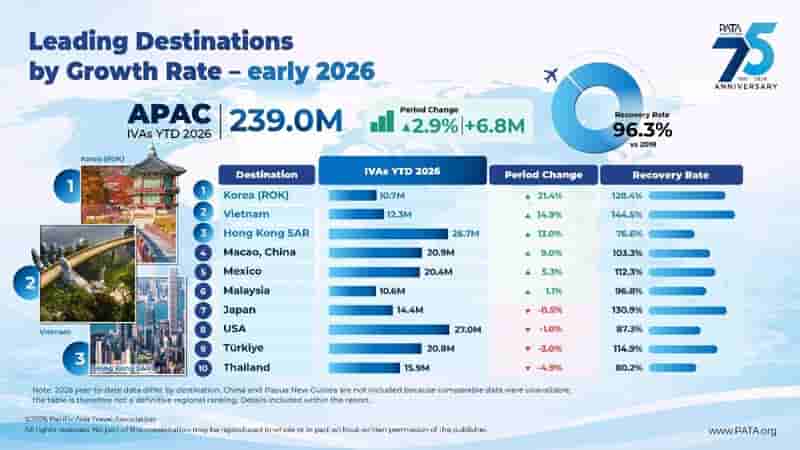
The first months of 2026 tell a more mixed tale. PATA counted 239 million arrivals across 44 destinations, up 2.9% on the same reporting period in 2025. That was 96.3% of the matching 2019 figure.
Those numbers hide a trap. One figure covers all of 2025 and 46 destinations; the other covers parts of 2026 and just 44. You can’t line them up to claim travel has slipped back. Doing so would be like judging a cricket match at tea against one that has gone the full five days.
Vietnam and Korea take the fast lane
If this were an awards night, Vietnam and South Korea would need an extra bag for the trophies.
Vietnam drew 12.3 million international arrivals in its reported 2026 period. That was up 14.9% in a year and reached 144.5% of its comparable 2019 tally. South Korea logged 10.7 million, up 21.4%, and reached 128.4% of its 2019 mark.
Both have done more than win back lost guests. They have grown well past their old highs. For agents, airlines, and hotel firms, that is a reason to look more closely at new tours and routes. There may be more to sell than the same trip in a shinier brochure.
Now for the less cheerful part.
The US still drew the most arrivals in PATA’s latest ranking. But its 27 million arrivals were down 1% on the same reporting period last year. Thailand saw 15.9 million, down 4.9%. PATA also noted softer 2025 results for the US, Thailand, India and Cambodia.
Thailand has not lost its beaches. Nor has America run short of sights. But a fine view will only go so far when fares bite, visas cause grief or travellers find a better deal elsewhere.
The Pacific still has work to do
Asia logged 523.1 million arrivals in 2025. That gave it 74.7% of the total in PATA’s study. The Pacific stood at 89.4% of its 2019 level. The Americas were at 94.2%.
One point needs care: PATA’s study is wider than Asia alone. It also counts places such as the US, Mexico and Türkiye. So the headline total should not be read as a count for Asian nations alone.
For the travel trade, the gaps are a warning. New flights may bring back seats. Fresh hotels may add rooms. Neither can make a guest book a trip if prices are too high or the journey is too hard.
That holds true for Australian sellers, too. A strong region-wide total doesn’t tell the story of every route, market or tour. It pays to watch where demand is rising, where it is soft and where the next wave of travellers may head.
Full planes are not the whole prize
PATA chief executive Noor Ahmad Hamid warned that “recovery does not mean that the environment has become predictable”. Wars, storms, high costs and shifts in border rules can still turn a sound travel plan on its head.
The group wants more than a race to break visitor records. It points to simpler entry rules, good flight links and a wider mix of source markets. It also expects to draw guests beyond the main hubs and busy peak dates.
The aim is plain enough. A town gains little from a record crowd if small firms miss out, public spaces bear the strain, and local residents see no reward.
As Hamid put it, “Success will not simply be measured by how many visitors we receive”. The harder test is what those visits mean for jobs, local firms and the places that host them.
For years the big question was when people would travel again. Now it is where they will go, how long they will stay and who gets a fair share of the spend.
The comeback is close to done. The next act will take more than a full plane and a ribbon-cutting speech.
Source: PATA Annual Tourism Monitor 2026.
By Kanda Limw – © 2026.
Read Time: 4 minutes.
Author Bio:
 Kanda Limw is one of those rare people every office quietly depends on. She doesn’t fuss or make a fuss; she notices what needs doing and gets on with it, often before anyone else has drawn breath.
Years behind the scenes have taught her that good administration isn’t about control; it’s about care. Diaries align, tensions soften, loose ends disappear. When the day threatens to tilt, Kanda steadies it without drama.
Her reliability feels reassuringly old-fashioned. She listens properly, remembers the small things, and does what she says she will.
Kanda has no appetite for the spotlight. Yet ask anyone who works alongside her, and they’ll tell you that when she’s there, everything runs just a little smoother.











