

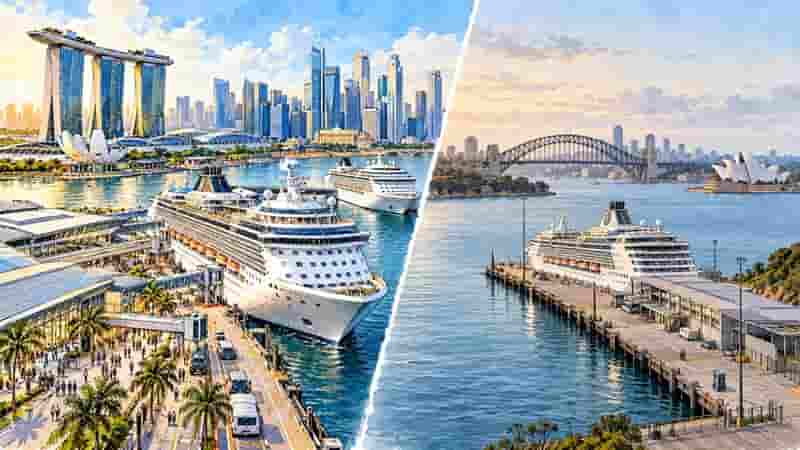
Singapore is landing new cruise ships and big-name deals. Australia still has plenty of keen cruise fans, but fewer ships at home. The stakes for ports, jobs and tourism are high.
Singapore is making a strong pitch to cruise lines worldwide. Its port is bigger. Its airport links are hard to beat. It has also signed deals that put new ships on its doorstep.
Australia has a fine pitch of its own: great ports, warm seas and some of the best views on earth. But a fine view, sadly, will not keep a ship tied to the quay.
That is the gap now facing the two cruise markets.
In 2025, Singapore had 375 cruise ship calls, up 10 per cent. Its ports saw more than two million passenger movements, up 9 per cent. Both figures come from the Singapore Tourism Board.
The news from Australia is more mixed. The number of Aussies taking a cruise is at a record high. But fewer ships are sailing in local waters, and the cruise trade is worth less to the local economy than a year ago.
Then came Carnival’s latest fleet news. It was hardly a cause to pop the champagne.
Aussies still love life at sea
A record 1.45 million Australians took an ocean cruise in 2025, up 9.5 per cent on 2024. That makes Australia the world’s fourth-largest market for cruise guests, says Cruise Lines International Association (CLIA).
Most stayed close to home. About 1.16 million cruised in Australia, New Zealand or the South Pacific. But 286,000 went beyond that region, a 17 per cent rise. The share who took a cruise farther afield grew from 18.5 per cent to 19.7 per cent.
Some sailed in Asia. Others chose Europe, Alaska or the Caribbean. It would be wrong to claim Singapore gained all those extra long-haul guests.
A second trap lies in the numbers. Singapore counts ship visits and the flow of passengers through its ports. Australia’s 1.45 million figure counts residents who took a cruise, no matter where in the world they joined the ship.
These are not two sides of the same ledger. Both sets of figures cover the 2025 calendar year, but they count different things.
The real test is how well each place can draw ships, keep them there and turn their visits into jobs and spending.
Singapore gives ships a better welcome
In October 2025, Singapore finished a major upgrade at Marina Bay Cruise Centre. The work cost about S$40 million. Its stated capacity rose from 6,800 to 11,700 passengers, and it can now serve two large ships at once.
The Tourism Board says the work added more check-in desks, improved road access, more space for coaches and taxis, and new ways to move bags to hotels or Changi Airport.
No one books a cruise for the thrill of a check-in desk. But after a long flight, a short queue can feel like a luxury suite.
Changi gives the city another edge. Guests can fly in, stay a few nights, take a cruise and then head home. Hotels, cafés and tour firms all stand to gain.
The map helps as well. Singapore is near ports in Malaysia, Thailand and Vietnam. Lines can sell short breaks or long trips through Asia, with the city as a handy start and finish point.
In short, Singapore makes it easy for ships to arrive and for guests to spend money before they sail.
Disney brings a dash of magic
A big vote of trust came on 10 March 2026. That was the day Disney Adventure set sail from Singapore on its first voyage. The ship is Disney Cruise Line’s first Asia-based vessel.
The ship runs three- and four-night trips from Singapore. Its first cruises focused on the fun aboard, rather than calls at other ports.
That will change on some trips. Selected four-night sailings from 31 December 2026 to May 2027 will call at Langkawi, Malaysia. Other voyages will still spend their time at sea. Disney has confirmed the new port stop.
It is a smart move. A family can enjoy a Disney ship and, on some trips, get a taste of the region too.
For Singapore, the gain goes well past Mickey Mouse. A well-known global brand has set up an Asian home base. It can draw flights, hotel stays and new cruise guests to the city.
Princess backs Singapore too
Disney is not alone. On 28 May 2026, the Singapore Tourism Board and Princess Cruises announced a three-year deal spanning 2027 to 2030.
The plan will bring Diamond Princess, Sapphire Princess and Grand Princess to Singapore for seasonal cruise programmes. Princess aims to double its sailings there by 2030. The planned trips range from 10 to 28 days.
The partners expect to serve more than 150,000 cruise guests over the deal’s term. That is a target, not a result. Nor will all three ships stay in Singapore year-round.
Yet the message is hard to miss. Cruise lines plan their fleets years ahead. They are choosing to give Singapore a larger role in those plans.
Australia’s cruise trade takes a hit
Now turn to Australia. The latest cruise impact study, paid for by CLIA and the Australian Cruise Association, paints a less bright picture.
It puts the total value of cruise trade at A$7.32 billion in the 2024–25 financial year. That is 13.2 per cent less than the A$8.4 billion put on the year before.
The study says the sector backed 22,720 full-time-equivalent jobs, down 13.8 per cent. The number of cruise ships in Australian waters fell from 75 in 2023–24 to 68 in 2024–25.
A note of caution is needed here. The A$7.32 billion is a modelled estimate of both direct spending and the wider flow-on trade. It is not a sum paid to the tax office. The jobs figure is an estimate of work equal to full-time roles, not a headcount of people with secure full-time posts.
These financial-year figures should not be treated as the same measure as the 2025 guest totals. They cover a different period and a different side of the cruise market.
Even so, the trend is concerning. The study points to fewer ship visits, less space for guests, higher costs, and uncertainty about future rules.
A ship based here can buy fresh food, hire local firms and fill hotel rooms. Ports of call can bring trade to cafés, guides, coach lines and shops. When ships spend less time here, towns have less chance to share the rewards.
Australia’s coast is still a drawcard. Sadly, great scenery does not sign a fleet contract.
Carnival makes the warning real
On 15 October 2026, Carnival Cruise Line announced that Carnival Luminosa and Carnival Adventure will leave Australia in March 2028.
Luminosa is due to make its last Australian voyage on 15 March 2028. Adventure is set to leave Sydney on 20 March 2028 and will not return as first planned.
Carnival said long-term fleet plans must weigh up costs, clear rules and the appeal of other markets. This is a choice made years ahead, not a sudden end to cruise holidays.
It is not a full Carnival exit. Carnival Splendor is set to stay in Sydney year-round and Carnival Encounter in Brisbane year-round.
And there is no sound basis for saying Singapore has taken the two ships. Carnival has not said they will move there. The story is about a wider fight for ships, not a confirmed swap between two ports.
Still, the loss will be felt. A ship can change its home base much faster than a tour firm can replace a season of lost trade.
Rules, costs and the rights of crews
Part of that fight is about the law.
On 2 October 2026, the Australian Government extended a special exemption for eligible cruise ships under the Coastal Trading (Revitalising Australian Shipping) Act 2012. It will now run until 31 December 2028.
New rules start on 1 January 2027. To use the exemption, shipowners must ensure their crew policies and work agreements do not limit seafarers’ right to bargain collectively. Eligible cruise firms must also report certain crew complaints under the Maritime Labour Convention to the Australian Maritime Safety Authority.
The Government says this is the last short-term exemption while it works on broader law reform. One exception still applies: the exemption does not cover trips between Victoria and Tasmania, where other licensed services run.
Cruise lines say they need rules they can rely on. They plan routes and port bookings years ahead. The Maritime Union of Australia says overseas crews need stronger rights and fair treatment. The union has made serious claims about poor work and living conditions on some ships, but those claims should not be read as proven against every cruise firm.
Both sides have a point. A sound cruise policy must protect people who work at sea and still give well-run firms a fair chance to trade.
Ports need a plan, not just a view
Signs of action are emerging in Australia. The NSW Government said in September 2026 that shore-power works at White Bay Cruise Terminal were nearly complete.
The aim is to finish the project by the end of 2026, with ships set to test the power link during the 2026–27 summer season. Ships that can plug in should be able to use shore power instead of diesel engines while in port. That means less noise and fewer fumes for nearby homes.
The dates are still plans, not proof the system is already in use.
Berth space, port fees, road links and local tours also matter. A cruise ship needs far more than a pretty place to dock. It needs a smooth, safe and cost-effective visit.
Singapore’s model cannot be copied word for word. Australia is vast. Its ports are far apart, and the weather can limit when some routes make sense. Singapore sits near many Asian ports and has extensive air links for guests from abroad.
But Australia can learn from its clear aims: make a plan, fund the right works and give cruise lines faith in the years ahead.
That means federal and state leaders, ports, unions, and shipping firms should work toward stable rules and fair costs. It also means protecting the places ships visit. Any growth plan must include clean air, healthy seas, and a fair deal for host towns.
The next ships are still up for grabs
Australia isn’t short on cruise fans. Its record guest numbers prove that. Nor has it lost the sights that make a sea trip special.
The risk is that more Aussies may need to fly abroad to find the cruise they want. If that happens, more hotel nights, port spending and tourism jobs may go with them. That is a risk, not proof Singapore has taken a set share of Australia’s lost trade.
Singapore has built a strong case for cruise firms to call and stay. Australia can do the same, but it needs a clear plan that lasts beyond the next press release.
Cruise ships are big, costly and mobile. They do not stay for old times’ sake.
Singapore is giving them reasons to come. Australia must give them reasons to remain.
By: Stephen Peters – © 2026.
Read Time: 8 minutes.
Author Bio:
 Stephen Peters has spent much of his career proving that the straight-and-narrow path is considerably overrated. Armed with a Bachelor’s degree in Technology from the University of Queensland and a Master’s in Management, he first ventured into hospitality, working in and helping open several five-star hotels across Sydney and Asia.
After deciding he’d had enough of five-star hospitality from the operational side of the desk, Stephen returned to technology, working with major US tech companies while based between Australia and Asia.
Then came the ultimate change of scenery. Stephen built his own yacht and, with his family aboard, sailed from Florida through the United States and its Great Lakes before crossing the Pacific to Asia. Several memorable years followed as they explored Indonesian waters before the Peters family eventually returned to Australia with far more sea miles, stories, and perspective than when they left.











