

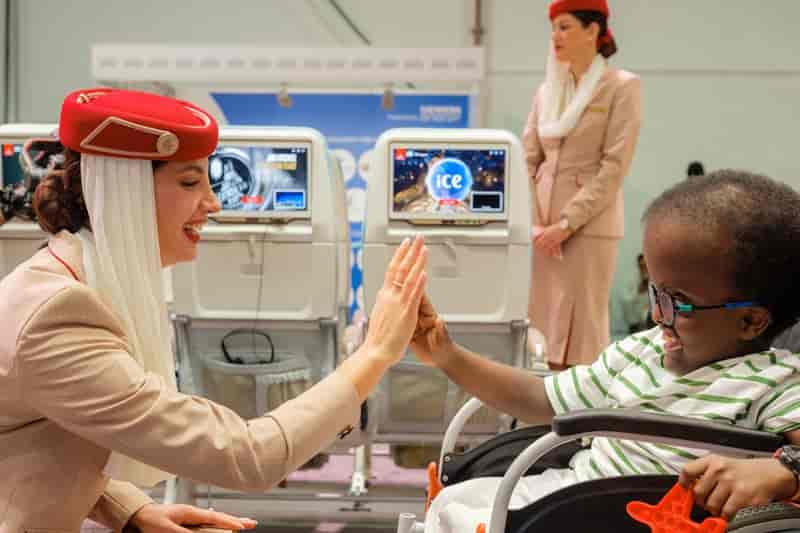
Dubai’s latest aviation showcase puts independence ahead of extravagance as Emirates tests smarter cabins, easier boarding and a lounge designed around real passenger needs.
A first-class lounge is not especially luxurious if a traveller cannot use it with ease. Nor is a dazzling airport terminal much use when the journey through it feels like an obstacle course.
Emirates appears to have taken the hint.
At the AccessAbilities Expo in Dubai, the airline is putting accessible travel under the spotlight, revealing ideas that could change how passengers with disabilities experience flying. Some are still prototypes. Others are already operating at Dubai International Airport or across the Emirates network.
The message is clear: good service should start long before the champagne trolley appears.
The eighth edition of AccessAbilities Expo runs from 19 to 21 October 2026 at Dubai World Trade Centre. Sheikh Ahmed bin Saeed Al Maktoum, Chairman and Chief Executive of Emirates Airline & Group and patron of the exhibition, opened the event.
For Emirates, the timing is significant. As airlines compete over seats, screens, and increasingly elaborate airport lounges, accessibility is becoming a practical test of what premium service really means.
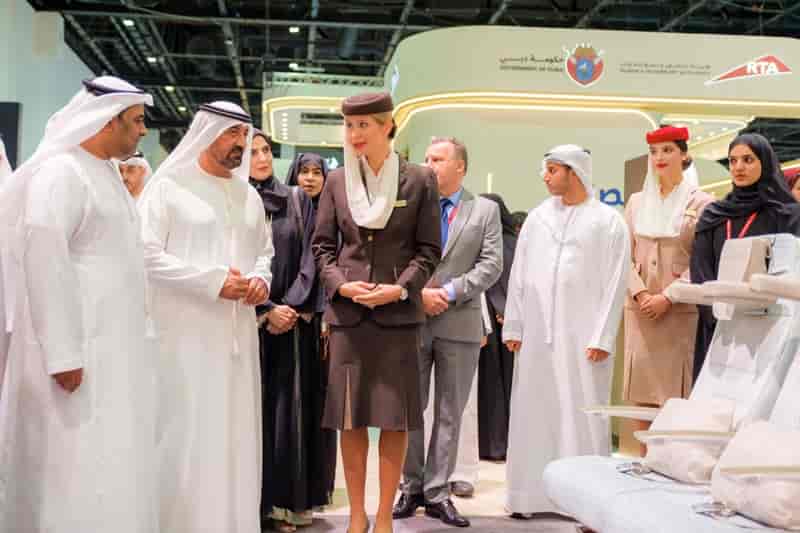
The Emirates exhibition revealed several innovative and future-focused ideas currently in development – including a cabin familiarization concept being explored for customers who are blind or have low vision, an accessible lounge suite for customers with reduced mobility, as well as biometric boarding gates for customers with accessible travel requirements.
A cabin you can discover before take-off
One of the most intriguing displays takes visitors into an aircraft cabin without requiring them to fly anywhere.
Emirates has created an immersive demonstration for people who are blind or have low vision. Visitors sit in a genuine Airbus A350 seat with a U-Dream headrest, while spatial audio describes the space around them.
They can explore the seat by touch and receive guidance from a host. The aim is to replace uncertainty with familiarity, giving travellers a better sense of where things are and how the cabin works.
It sounds simple. That may be precisely why it matters.
For a passenger who cannot rely on visual signs, knowing where a seat control, armrest, or nearby feature is can mean the difference between constantly asking for help and making independent choices.
The cabin familiarisation concept is being explored, not announced, as a standard service. Emirates has not supplied a network-wide launch date.
That distinction is important. An impressive demonstration on an exhibition stand is not yet a guaranteed feature on tomorrow’s flight.
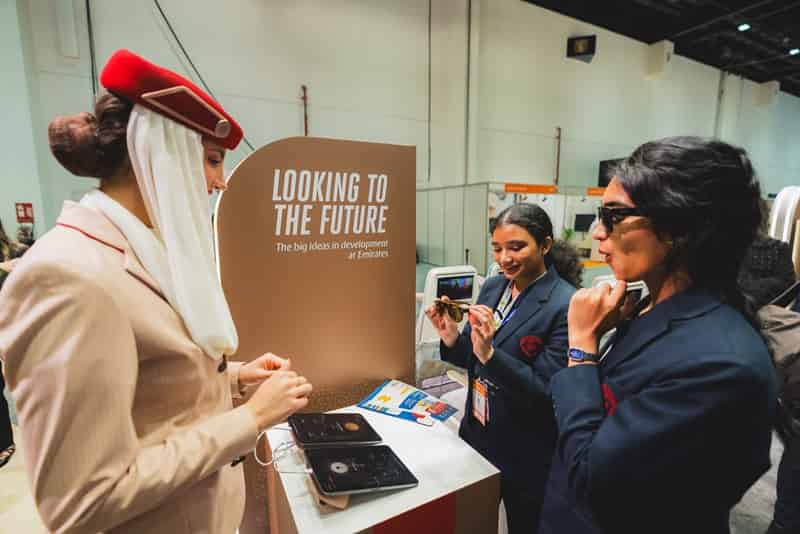
Emirates cabin exploration for low vision. On the stand, Emirates showcased an immersive accessibility-led experience into the onboard journey for passengers who are blind or have low vision. Through spatial audio, tactile seat exploration, and guided host interaction, the activation recreates key moments of the aircraft cabin experience in a calm, premium environment. Visitors are invited to immerse themselves in an audio-led experience while sitting in a real Emirates A350 seat with a U-Dream headrest, as the audio describes the cabin around them. Rather than focusing solely on technology, the experience highlights how thoughtful design can help passengers build confidence, understand their surroundings, and travel with greater independence, dignity, and ease.
A lounge where comfort is more than decoration
The airline’s Accessible Lounge Suite makes a similarly persuasive point.
Designed for customers who use wheelchairs or have reduced mobility, the prototype offers more space to rest, work, or dine in greater privacy. It includes a powered chair with lift, swivel, and recline functions, integrated grab bars, wheelchair storage, and room for safe transfers.
Emirates has retained the premium finishes of its existing lounge suites, which were introduced in First Class lounges in 2024. It includes the expected touches of wood, leather, and marble, along with technology such as entertainment screens and wireless charging.
But the real selling point is not the marble.
It is the decision to make space, support and choice part of the luxury experience, rather than an awkward addition squeezed into a corner.
The accessible version is still being developed for First Class. Emirates says it could consider other cabin classes in the future, but it has not confirmed any wider rollout.
That leaves an important question for the airline and the industry: when accessibility is good enough to design into the most expensive experience, how quickly can it become standard elsewhere?
Smarter gates without the gymnastics
At Dubai International Airport’s Terminal 3, Emirates is also demonstrating its biometric pathway and barrier-free boarding arrangements.
The design uses cameras that can adjust to different heights and angles. That matters for wheelchair users, who should not have to twist, stretch or position themselves to suit a machine.
Self-service check-in kiosks have also gained practical accessibility features. These include text-to-speech, Braille and tactile controls, headphone connectivity, more usable touchscreens and adjustable interfaces.
Unlike the lounge prototype, Emirates describes these airport improvements as existing facilities at its Dubai hub.
Biometric technology can speed up a journey, but accessibility depends on more than recognition software. Travellers must also be able to understand instructions, reach the equipment and access human assistance when they need it.
The best technology is often the kind nobody has to struggle with.
Rehearsing the journey before the real thing
Not every answer to an accessibility problem requires a new device.
One of Emirates’ most useful initiatives is decidedly old-fashioned: practice.
Its Travel Rehearsals programme allows children and young adults with autism, accompanied by families and support networks, to experience airport procedures before an actual trip.
Participants can become familiar with check-in, security, boarding and, at selected events, the aircraft cabin itself. The goal is not to promise a stress-free trip. It is to make an unfamiliar environment more predictable.
According to the airline’s October announcement, Emirates has conducted 80 travel rehearsals across six continents, reaching more than 400 families. It also says more than 35,000 employees have received training to support customers with autism.
Australia has already participated in the programme.
In September, Emirates reported rehearsal events in Brisbane, Melbourne and Perth, with plans at that time for Sydney and Adelaide. At Perth, participating families followed the airport journey and boarded an aircraft on the ground for a cabin introduction.
For Australian families planning long-haul flights through Dubai, that local connection is especially relevant. A rehearsal close to home may make the first international journey feel less like a leap into the unknown.
The programme is organised with airports and community partners; travellers should not assume that a rehearsal is available on demand at every destination.
Entertainment that reaches more passengers
The accessible travel push continues once customers are in the air.
Emirates says its ice entertainment system offers more than 850 films with closed captions and 200 with audio description. The latter provides spoken information about visual action, helping some passengers with vision impairment follow the story.
On the Airbus A350, an interface developed with technology company Thales and disability advocacy groups adds audio prompts, spoken content information, and touch-and-swipe navigation.
Passengers who use compatible hearing aids may also be able to listen through the airline’s headphones using the telecoil, or T, setting.
For travellers with sensory sensitivities, Emirates provides items such as fidget cubes, tactile aircraft-shaped stress relievers and popper toys across its cabin classes. The airline also offers wellbeing programmes and audio content intended to encourage calm.
These may seem like small additions beside the glamour of a new aircraft. Yet a useful screen interface, familiar object or clear instruction can mean far more to a passenger than another glossy menu.
The chauffeur service has an accessibility catch
On the ground in Dubai, Emirates says it now has 10 wheelchair-accessible vehicles within its branded chauffeur-driven offering.
The converted Mercedes-Benz V-Class vehicles feature lower floors, extra headroom, powered boarding assistance and suitable safety restraints.
However, the service has limits. The accessible vehicles are currently intended for eligible First and Business Class chauffeur-driven customers in Dubai. Emirates says it plans to consider wider availability, but it hasn’t specified when.
It is welcome progress, but it is not a universal airport transfer solution.
That qualification deserves to be made as clearly as the innovation itself.
A better booking experience starts with clear answers
Perhaps the most immediately useful development is one that travellers can access without visiting an expo.
Emirates’ Accessible & Inclusive Travel Hub brings support information together on its website. People can search by the assistance they require, their disability-related needs or the stage of their journey.
Guidance covers mobility assistance, travelling with wheelchairs, visual and hearing impairment, hidden disabilities, medical requirements and family travel. It also includes airport maps, sensory guides and information about the Be My Eyes support service.
The airline advises customers to arrange assistance when booking or contact it at least 48 hours before departure. Their travel agent can also help organise the request.
That advice matters because the journey often involves more than one airport, several service providers and rules that vary between countries.
The International Air Transport Association acknowledges that differences in national accessibility requirements can create confusion. It argues for greater consistency and better cooperation across aviation.
An airline can improve its own processes, but it cannot solve every connection, wheelchair-handling problem, or airport bottleneck on its own.
Why accessibility has become serious airline business
Accessibility is sometimes presented as a charitable extra. That view belongs in the departure lounge of history.
For an international airline, it affects customer confidence, operational efficiency, staff training and whether travellers feel able to book again.
A missed assistance request can turn a straightforward connection into a crisis. An inaccessible kiosk can create another queue. A poorly handled wheelchair can disrupt far more than the day’s itinerary.
Emirates has established a dedicated Office of Accessibility and Inclusion. It also received its Autism Certified Airline designation in 2025, following specialist training and work with the International Board of Credentialing and Continuing Education Standards.
Mostafa Karam, Emirates’ Divisional Senior Vice President of Customer Affairs and Service Audit, described the airline’s priority as “practical improvements that reduce barriers, expand choice”.
That is a more useful test than the number of inventions unveiled under exhibition lighting.
There are still unanswered questions. When will passengers be able to experience the proposed cabin experience? How widely will the airline introduce accessible lounges? And how will the airline measure whether customers experience fewer barriers in practice?
For now, the evidence points to a mix of genuine operating changes and promising ideas that have not yet reached general service.
For the travelling public, that distinction is not a technicality. It is the difference between being inspired by a promise and being able to rely on one.
Emirates has laid out an ambitious flight plan to make air travel more accessible. The next test is ensuring every passenger can enjoy the journey, not just admire the destination.
By: Alison Jenkins – © 2026.
Read Time: 8 minutes.
Author Bio:
 Alison Jenkins has lived most of her working life in the slipstream of aviation, where timetables matter, and people matter more. In airline sales, she built a reputation the old-fashioned way: by knowing her clients, her routes, and never missing the human detail.
Quick with a smile, quicker with a solution, she closed deals with warmth and kept her edge.
Trade shows, FAM’s, airport lounges and hotel lobbies became her second address. And somewhere along the way, notebook in hand, she began writing the journeys rather than selling them. Her reports grew lively, observant, full of the small truths only travellers notice.
That was the moment it dawned on her: she wasn’t simply travelling. She belonged in its stories.











